







Largely unnoticed by the European media, the Chinese navy has experienced breathtaking growth in recent years, which is turning the balance of power in the Indo-Pacific region upside down and could seriously jeopardise American supremacy on the world's oceans.
In purely numerical terms, the Chinese navy (People's Liberation Army - Navy, or "PLAN" for short) was already a sizeable fleet during the Cold War, consisting of countless (missile) speedboats, small landing craft and diesel-electric submarines for coastal operations. In recent years, however, the composition of the PLAN has changed noticeably and the Brown Water Navy has seen a massive influx of large units. The PLAN now has 370 "battle force ships" (in American terms, large surface combatants, large amphibious units and submarines), making it the world's largest navy, ahead of the US Navy (296 comparable units). China is expected to add a further 65 battle force ships to its fleet by 2030, which would further widen the gap with the US Navy.
The PLAN has also been recognised by the U.S. Navy's Office of Naval Intelligence as meeting Western standards in terms of quality - not least thanks to its rapid growth, the PLAN only has a small proportion of older ships. So where is the PLAN heading with its 3,500,000 members and what challenges does the West need to be prepared for?
Shipbuilding on the assembly line
The end of the Cold War and the collapse of the Soviet Union had far-reaching consequences for the balance of power in East Asia, where the traditional land power China now found itself in a position to invest more in its naval forces. While the PLAN had previously been limited to the defence of coastal waters, it was now assigned a central role in building a world-class military power that would strengthen China's political weight in the world in the long term.
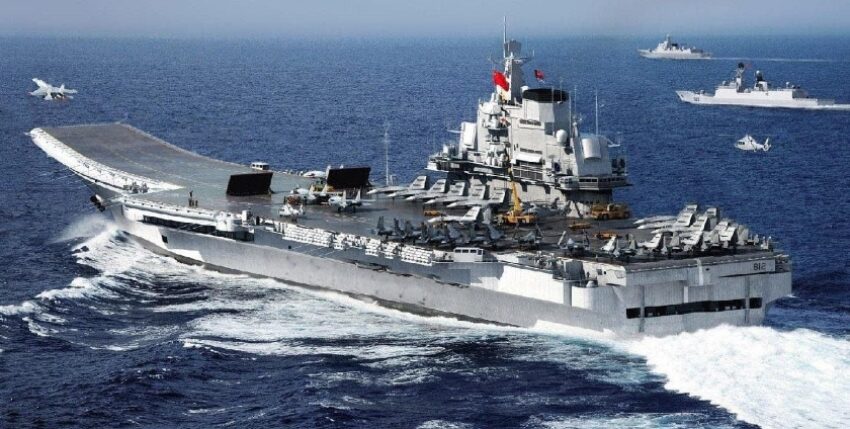
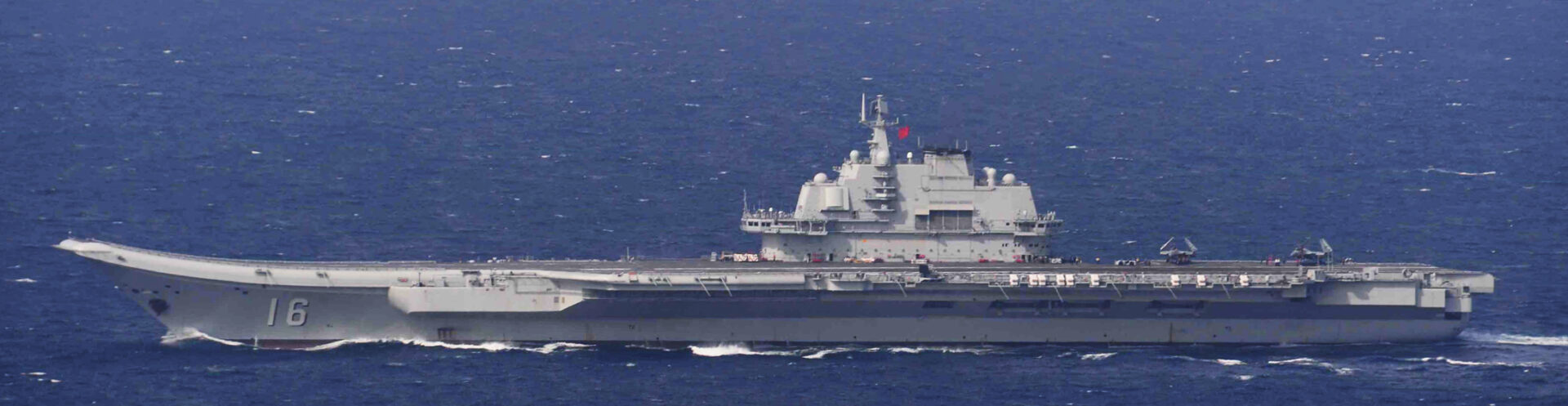
The most visible sign of China's new maritime ambitions is the construction of its own fleet of aircraft carriers. The first of these was the former Varyag, acquired from Ukraine in 1998 in an almost scrap-ready condition, which was put into service by PLAN in 2012 as the Liaoning (approx. 61,000 tonnes, up to 40 aircraft) after a lengthy overhaul. The experience gained with the Liaoning was taken into account when building a similar carrier, which was taken over by the fleet in 2019 as the Shandong (approx. 70,000 tonnes). With the much larger Fujian (approx. 90000 tonnes), the company finally broke new ground in shipbuilding technology in 2024 (including launch catapults instead of a "ski jump" ramp); it is the first purely Chinese carrier design and will probably have far more aircraft than its two predecessors. Although its conventional propulsion limits it as an instrument of global power projection, it nevertheless raises China's maritime capabilities to a new level. A fourth carrier - probably with nuclear propulsion - is currently under construction; at an estimated 110000 tonnes, it could become the largest aircraft carrier in the world. Even after the foreseeable retirement of the Liaoning in the 2030s, the carrier fleet is likely to continue to grow. In the long term, at least four carriers the size of the Fujian and beyond can be expected, with the Fujian potentially being the last conventionally powered carrier.
The growth of the carrier fleet is complemented by a rapid build-up of several classes of destroyers, with PLAN now having more than 50 ships in this segment. The largest destroyers of the Renhai class (type 055) can be described as "cruisers" due to their displacement of around 13,000 tonnes and are equipped with 112 VLS cells, which can fire long-range HHQ-9 air defence missiles (range up to 250 km) and CJ-10 cruise missiles (range 1500-2000 km) as well as guided missiles to combat ships and submarines. Eight Renhai class ships are already in active service, with eight more to follow.
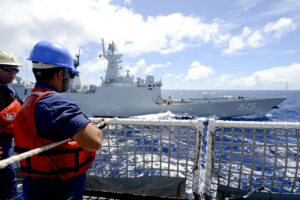
The PLAN has also been able to commission numerous new frigates and corvettes in recent years, not only expanding but also rejuvenating its fleet. One example of this is the 35 Jiangkai II-class frigates (type 054A, approx. 4000 tonnes), of which up to four units have been completed in individual years. Or the Jiangdao-class corvettes (type 056/056A, approx. 1500 tonnes), of which a total of 72 units were commissioned between 2013 and 2021 (22 of which are now serving in the China Coast Guard, or CCG for short).
A certain shift in emphasis can be recognised in submarine construction in recent years. While the number of diesel-electric submarines has stagnated at around 55 since 2000, there has been an increase in nuclear-powered fighter submarines from five to nine and in ballistic submarines from two to seven units; further growth is expected in both segments. However, PLAN appears to have serious problems with the development of quiet propulsion systems, which is one of the reasons why there is likely to have been a suspected Chinese hacker attack on the Russian defence company Rubin Design Bureau in 2021. To make its submarines quieter and faster, China, like the USA, has been working on a laser propulsion system for some time.
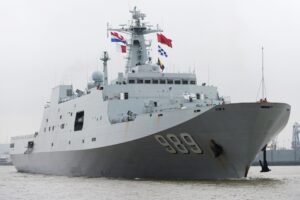
The amphibious component of the PLAN has experienced particularly dramatic growth in recent years, above all the already large pool of small to medium-sized landing ships (including 29 armoured landing ships of 3500 to 4000 tonnes alone) has been supplemented by eight dock landing ships of the Yuzhao class (type 071; 25000 tonnes), which correspond in size to the American San Antonio class. In addition, there are currently three Yushen-class helicopter carriers (type 075; 36,000 tonnes), which have a well deck and can carry 60 armoured vehicles and 28 helicopters as well as a battalion combat group of marines. The eight-ship class is soon to be reinforced by the even larger Yulan class (Type 076). All in all, the PLAN could in future have an amphibious capability spectrum on a par with that of the US Navy. Together with the PLAN Marine Corps (40,000 members in six brigades), this potential poses an enormous threat to Taiwan, as well as to Japan's southern islands.

The growth of the PLAN is accompanied by a massive expansion of the CCG, which is frequently deployed in connection with island disputes in the East and South China Seas and has long since assumed the role of a second navy. Territorial claims are usually backed up with "water gunning", laser and sonic attacks and ramming attempts, as the Philippine Coast Guard recently experienced again in the Spratly Islands. The CCG grew from 156 to 524 units between 2012 and 2020 alone and is supplemented by the paramilitary Maritime People's Militia.
All in all, the expansion of the Chinese naval forces currently consumes around 55% of the defence budget and demonstrates the enormous capacity of the Chinese shipbuilding industry. A study by the U.S. Navy's Office of Naval Intelligence estimates China's shipbuilding potential (tonnage that can be produced per unit of time) at 232(!) times that of the USA. Even if this ratio is likely to be significantly lower in the technically demanding naval shipbuilding sector, China has the economic basis to build a world-class navy.
Global maritime ambitions?
China's maritime armament can be interpreted as a building block of a globally orientated strategy with which the country aims to become a leading world power by the middle of the 21st century. Another central component of this strategy is the "Belt and Road Initiative" (BRI) announced by President Xi Jinping in 2013, which has since been promoting major infrastructure projects worldwide and strengthening China's economic influence. The BRI includes the idea of a "maritime Silk Road", which is why Chinese investments have been channelled into numerous port infrastructure projects via state-owned companies such as COSCO or China Merchants, particularly in Africa, Asia and Europe. Although the BRI primarily serves economic goals, it creates dependencies in the developing world in particular, which can give the PLAN access to bases. There is already a base in Djibouti on the Horn of Africa, and the Ream naval base in Cambodia, which has been expanded by China, could also be used by PLAN units in the future.
Far from its home waters, however, the PLAN has not yet maintained a significant presence, as would be expected for a blue water navy, instead frequently appearing as part of Sino-Russian naval manoeuvres. In recent years, exercises have taken place between the two countries in the Mediterranean, the Baltic Sea and the Black Sea, and since 2019 there have also been five joint naval manoeuvres involving Iranian units in the strategically important Gulf of Oman.
While overseas it usually remains purely a training exercise without an open demonstration of power, the PLAN shows a much more aggressive demeanour in its own littoral, especially towards Japan and Taiwan. For example, when a Sino-Russian naval formation circumnavigated the main Japanese islands in June 2022, Chinese units did not miss the opportunity to cross the Tsugaru Strait between the main Japanese islands of Honshū and Hokkaidō. Just two months later, the PLAN mobilised 13 ships at short notice for a maritime show of force directly off the Taiwanese 12-mile zone on the occasion of the visit to Taiwan by Nancy Pelosi (then Speaker of the US House of Representatives). Further sea/air manoeuvres within Taiwan's airspace surveillance zone followed in 2023 and 2024, with a battle group around the aircraft carrier Liaoning coming threateningly close to the southern tip of Taiwan in October 2024.
In September 2024, all Chinese aircraft carriers were at sea at the same time for the first time when Liaoning and Shandong, each with five escort ships, operated east of the Philippines and in the South China Sea respectively, while Fujian completed its fourth sea trials in the Yellow Sea; at the same time, a surface combat group of four ships operated in the Sea of Japan. It is no coincidence that the growth of the PLAN has alarmed China's neighbours in particular.
Beyond mere numerical comparisons
However, due to structural problems and various weaknesses, the PLAN is still a long way from the standard of a Blue Water Navy. Although the country has 30,000 kilometres of coastline, it only has limited access to the open oceans. Directly off the Chinese coast, a first island chain extends from Japan with the Ryūkyū Islands, Taiwan, the Philippines and the island of Borneo, while a second island chain from Japan via the Ogasawara Islands and Guam to Papua New Guinea lies just a little further east. Both island chains allow the monitoring of shipping traffic to and from China, which naturally complicates maritime operations overseas. China's repeated claims to Taiwan, the Japanese Senkaku Islands and some island groups in the South China Sea (Paracel and Spratly Islands; China has established bases here in some cases) are probably also aimed at freeing China from this geostrategic "embrace". In contrast, the USA can build on a free and secure coastal apron in the Atlantic and Pacific that does not stand in the way of global deployments of large naval units.
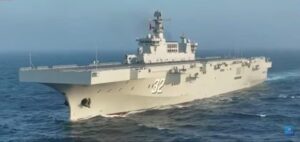
the core of PLAN's amphibious forces, photo: Chinese media
In addition, the PLAN still lacks overseas bases that could provide the necessary logistics for large naval units. At present, the PLAN can only rely on the small bases in Djibouti and Ream (Cambodia); other possible bases in Bata (Equatorial Guinea), Duqm (Oman), Gwadar (Pakistan), Hambantota (Sri Lanka), Khalifa (UAE), Vanuatu and the Solomon Islands have not yet progressed beyond the level of declarations of intent and preliminary soundings. An efficient fleet of supply ships that could compensate for the lack of bases overseas is only partially available.
In comparison, the USA has a dense network of mutually supporting bases in the Indo-Pacific region thanks to its allies and partners (including Australia, Japan, the Philippines, Singapore and South Korea) and its own or associated territories (including Guam, the Northern Mariana Islands, the Marshall Islands and Palau). The U.S. Navy can also rely on a land-based infrastructure in other parts of the world, for example in the Mediterranean or the Persian Gulf.
In any case, the composition of the PLAN only corresponds to the force mix of a blue water navy to a limited extent; in particular, it lacks nuclear-powered aircraft carriers and (quiet!) fighter submarines for power projection far from its own coasts. The fundamental modernisation of the corvette component and the still existing large pool of fast missile boats and diesel-electric submarines are more in line with the standard of a littoral navy operating under the protective shield of land-based missiles and air forces. With its DF-21 (1500 km range) and DF-26 (up to 4000 km range, hence often referred to as the "Guam Killer") ballistic missiles and its large number of 4th and 5th generation fighter aircraft, China would be more likely to adopt an A2/AD ("anti-access/area denial") strategy in the area of the first and second island chain, which would strengthen the country on the sea side but ultimately restrict it to waters close to home.
In addition, the massive influx of new ships since 2000 is likely to soon lead to exploding maintenance costs when more and more of these ships have to undergo their first longer repair and modernisation cycles. The funds required for further fleet growth are then likely to become scarce. It is also to be expected that the other branches of the armed forces will once again claim a higher share of defence spending in future, and this against the backdrop of a weakening economy.
After all, the PLAN simply lacks management personnel with operational experience. This is where the breathtaking growth of recent years, which has probably only partially led to the development of a new maritime self-image, takes its toll. On the other hand, the PLAN has systematically driven forward the professionalisation of its ship crews since 2000; in particular, the NCO corps has been enlarged and reformed. The extent to which this can compensate for a lack of operational experience remains to be seen.
Outlook
There is no question that the recent growth of the Chinese navy poses a serious threat to American supremacy on the world's oceans. However, given the range of capabilities achieved to date and the PLAN's geostrategic limitations, the threat to China's immediate neighbours is far more acute, and the PLAN could cause great harm to China's neighbours and the global economy as part of a regional A2/AD strategy.
How China intends to deal with the Taiwan issue in future will be of central importance for the PLAN's future course. Should an open military confrontation be sought - whether in the course of an invasion or a naval blockade - the USA and its allies would have serious problems standing up to a PLAN operating close to home. In any case, the West would do well to observe China's further maritime development.

 English
  German