





With the framework agreement signed on 19 December 2025 between TKMS and the Federal Office of Bundeswehr Equipment, Information Technology and In-Service Support (BAAINBw) for the delivery of DM2A5 heavyweight torpedoes, the German Navy is determining the future main armament of its new generation of submarines at an early stage. The decision concerns a central capability of the 212CD class and is also part of the German-Norwegian programme structure for the jointly developed submarine.
The early decision to procure the standard 212CD class weapon before the first boats are launched minimises subsequent integration and approval risks and ensures operational availability from launch - an aspect that was not always the case in previous submarine programmes. The new boats are also designed not only for coastal operations, but also for longer missions in complex underwater situations - including the North Atlantic and the High North. Range, signature behaviour, target tracking and adaptability to different mission profiles thus gain additional weight.
Software-centred torpedo
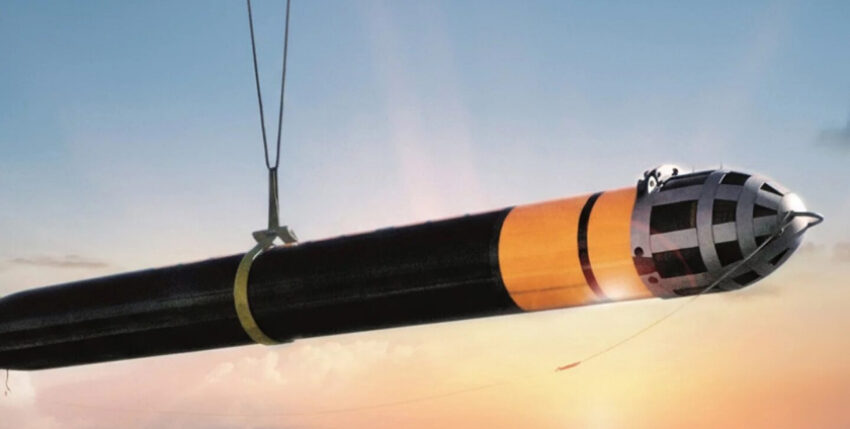
The DM2A5 is technically based on the DM2A4 introduced in the German Navy, which is internationally known as SeaHake mod 4 and is in service with around 20 users. This is a fully digital, fibre-optic-guided 533 mm torpedo with a conformal (hull-matched) sonar array, silver-zinc batteries and ranges of over 50 kilometres.
From the outset, the DM2A5 is designed for a software-centred system architecture with modular mission logic and signal processing so that algorithms, tactics and countermeasures can be reprogrammed. The battery-powered electric drive with low acoustic signature, the fibre optic data link to the boat and an advanced digital sonar are designed to improve the torpedo's performance parameters, particularly in multi-target scenarios and in acoustically challenging coastal waters.
The new heavyweight torpedoes are primarily intended for the twelve 212CD class submarines, a joint German-Norwegian development. Germany has increased its original order of two boats by four to six units; Norway has also increased its own order to six boats. Standardised armament for both navies will facilitate training, logistics and operational planning and at the same time increase interoperability within the German-Norwegian fleet alliance. The programme remains open to other partners in the future, for example as part of possible Canadian procurements.
Development, production and integration of the DM2A5 are the responsibility of Atlas Elektronik within the TKMS Group, which describes this torpedo order as the largest in the company's history to date. With the DM2A5 as software-based underwater weapon system the future torpedo is designed in such a way that technical-tactical adjustments can be made within the existing system architecture of the 212CD class both via the boat's command and weapon deployment system and torpedo-internally.
hum, ajs

 English
  German