

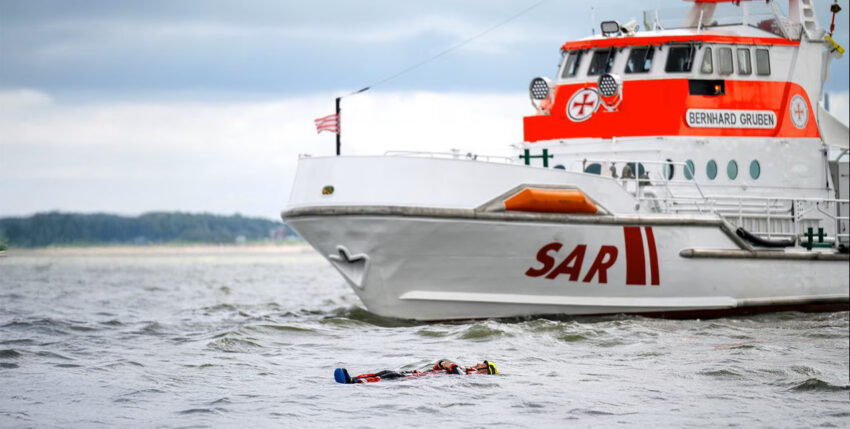







Newly developed camera systems are to be used as artificial eyes to significantly improve the automated search for shipwrecked persons. The Federal Maritime and Hydrographic Agency (BSH) is researching this new technology together with the German Maritime Search and Rescue Service (DGzRS).
The challenge
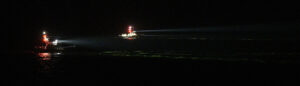
At a distance, in poor visibility and at night, the eyes of all sea rescuers quickly reach their limits. Infrared cameras and residual light amplifiers are good at detecting larger objects. But People in water are too small, especially if only their heads are visible. In digital images, these "objects" therefore often only take up a few pixels. The systems are not always able to reliably show whether it is an interference signal or a person.
Objective
The BSH and the DGzRS signed a corresponding agreement in Hamburg at the beginning of December 2024 to test the project with more powerful sensors and more precise data processing under realistic conditions at sea and with people swimming. In future, such systems could also be used on merchant ships to constantly monitor their surroundings and report obstacles such as tree trunks, containers or even life rafts.
In addition, the BSH and DGzRS intend to improve the range of life-saving equipment lights and the performance of electro-optical systems such as night vision devices so that people who have fallen overboard can be found better and more quickly even without the newly developed camera systems.
kdk, NDR

 English
  German