




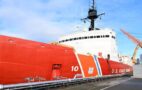



In recent decades, Western navies have had little experience in treating casualties in combat. Land-based operations by the US armed forces therefore form the basis for today's on-board medical concepts.
When people were preparing for the big battle in the Cold War, they expected the fighting to last a few days and looked with a certain fatalism at the expected probability of survival.
The circumstances have changed fundamentally over the last 30 years. Where a quick nuclear exchange of blows used to be the order of the day, we now expect conventional operations of longer duration, but also hybrid scenarios with a large number of casualties.
At the same time, the structure of the Bundeswehr has changed. The navy of the large conscript army has been replaced by a small one, highly specialised navy with intensively trained personnel. Rescued personnel must therefore be able to fight again, especially because specialised personnel cannot easily be replaced elsewhere after a training period of often several years. This is a change that makes the ambulance and medical combat service not only necessary out of a sense of care, but also strategically relevant. It is therefore necessary that the combat medical service is always seen as an essential part of naval combat and that the shipboard medical service remains an integral part of every shipboard command.
The last conventional sea battles of a NATO member took place in 1982 in the Falklands War, a conflict from which lessons could be learnt - with limitations - for material, personnel and medical services. In addition to the experiences of the world wars, attempts were made to derive calculations for casualty figures, injury patterns, triage and rescue chains. However, medical care, the effects of weapons and the nature of warfare have all undergone significant changes over the past 40 years, meaning that findings for the medical combat service must be continuously re-evaluated.
Accidents at sea, but also attacks (e.g. on the USS Cole) led to major incidents. However, due to the very different organisational structures of the medical services, no basic procedures could be derived from these incidents. For this reason, the concepts of TCCC (Tactical Combat Casualty Care) and Prolonged Fieldcare (care of patients over a longer period of time under restricted conditions) generated by land operations were adopted in a modified form for the Navy.
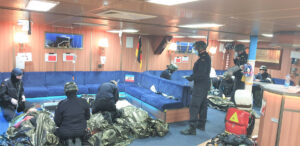
TCCC based this primarily on analyses of American casualties in Iraq and Afghanistan. Avoidable causes of death were identified: Massive blood loss, airway obstruction, tension pneumothorax and the negative impact on blood clotting due to lack of heat retention.
Unlike on land, however, a higher proportion of burn victims, smoke inhalation and non-penetrating injuries as well as chest injuries are expected at sea (as a rule, there is no need to wear a protective waistcoat in the hull). Wounded personnel will also have to be treated in greater numbers than on land and with significantly longer evacuation times due to the limited possibility of deployment. The naval medical service is responding to these circumstances with a training and combat concept tailored to this.
The "BRAVO onboard first responders" (EH-B Bord), who play a central role in the combat medical service, should be emphasised here. EH-B Bord are intensively trained crew members outside of the medical personnel who are on every military unit of the Navy and fulfil the tasks of a higher qualified first aider in a secondary function.
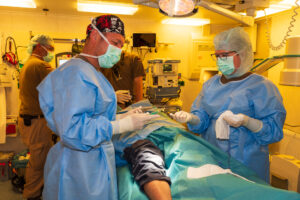
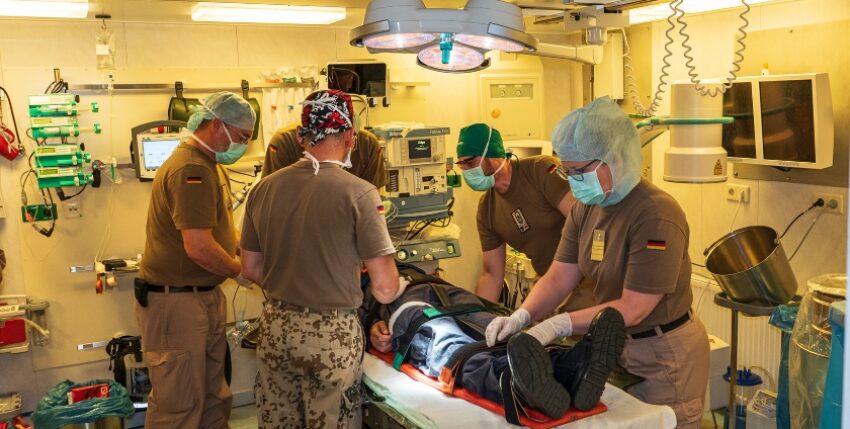
must be from other nations, photo: Bw
Derived from the TCCC concept, they use e.g. spiral and Guedel tubes to keep the airways open, in addition to ligating bleeding in the extremities using tourniquets. They are also trained to recognise a tension pneumothorax (air between the lungs and chest wall leads to respiratory distress and causes the large vessels at the heart to kink) and to carry out decompression punctures.
In addition to the intraosseous accesses used in the land forces (accesses for medication and infusions into the bone), the Navy trains its EH-B board in the creation of intravenous accesses. This is vital for burn victims, but also for casualties who cannot receive intraosseous access due to injuries to the sternum and chest.
In order to do justice to the specific injury patterns on board, ship's doctors and medical officers are trained in techniques such as coniotomy (tracheotomy) and escharotomy (relief incisions for extensive burns). These are also important elements in the care of burn victims.
Limited resources
In addition to the ship's medical team, a frigate with an on-board medical team consisting of a surgeon, anaesthetist, operating theatre nurse and anaesthetist nurse can have up to nine personnel, who are also supported by the EH-B on board during combat. Despite this personnel approach, the expected number of wounded poses a particular challenge. In the event of a hit by a modern sea-target missile, a mass casualty incident must be assumed in which the number of casualties exceeds the capacity of the helpers. This requires special organisational and structural measures. In a combat situation, the wounded are usually identified by rondengangers, given initial treatment as part of self-help and comrades' help and reported. The situation picture is created in the ship's technical control centre and the ship's hospital unit.
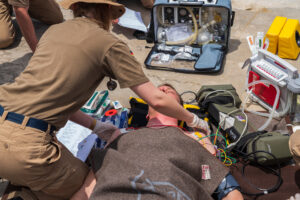
a different training than on land, Photo: Bw
If the combat situation allows, the casualties are transported to the casualty bays. This can only be guaranteed through close coordination between the ship's technical control centre and the ship's hospital unit. The control centre determines safe transport routes, while the ambulance service provides specialised units manned by EH-B personnel to care for the wounded. They provide more extensive first aid on site and are equipped with the rescue equipment for transport to the dressing stations. Once the wounded have been transported, the EH-B boards provide support at the battle stations and dressing areas depending on the situation.
While still on the ship, the wounded are recorded and triaged by the medical personnel, i.e. categorised according to the severity of their injuries and the urgency of their treatment. The concept of triage has been in place since the Napoleonic Wars and aims to utilise the available resources in such a way that as many patients as possible can be saved. A complete picture of the situation and smooth communication are essential for this.
If the wounded are deployable, they are transferred as quickly as possible to a higher level of treatment along the so-called medical rescue chain. These can be task force providers in the sea area with a sea rescue centre on board or land-based treatment facilities such as field hospitals and hospitals. The transfer of the wounded and civil-military cooperation are currently increasingly the focus of major maritime exercises due to their relevance in national and alliance defence.
Team of authors

 English
  German