



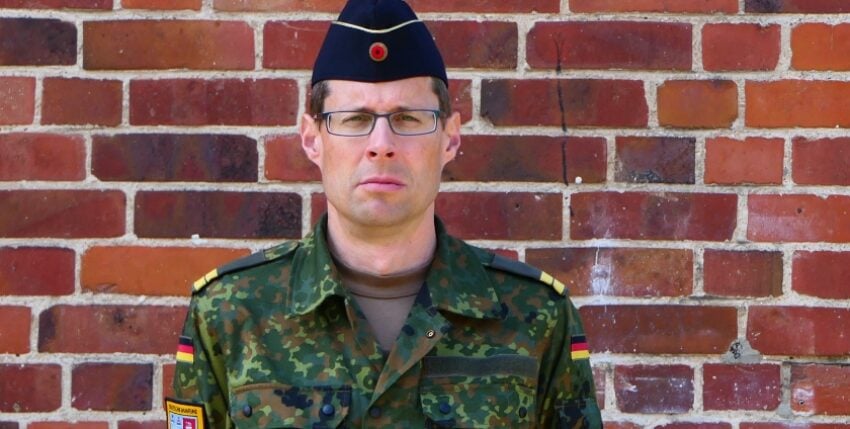






During the large-scale exercise Baltops, experts from the Naval Shipping Administration inform merchant ship captains about the background and exercise areas. In this interview, First Lieutenant Markus S. gives an insight into his work.
What are the tasks of the naval ship management during the Baltic Operations manoeuvre?
Our personnel in Germany fulfil the tasks of Naval Cooperation and Guidance for Shipping (NCAGS), as NATO calls it. We have contributed our expertise in advising civilian ships that pass through or in the immediate vicinity of the Baltops training area. A special team was formed in Kiel for this purpose, a Deployed NCAGS Element, or DNE for short. Around a dozen marines are part of this team. Their main task is to offer and give briefings to civilian shipping, i.e. the captains on board.
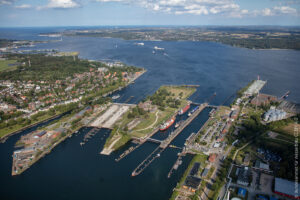
On the one hand, we address ferries and cruise ships that operate regularly in Kiel harbour. On the other hand, we also inform ships entering the Baltic Sea in the locks to the Kiel Canal. In addition, we can also receive information from ships that are travelling through the canal from the Baltic Sea and may have made observations.
We provide information on how long the Baltops manoeuvre lasts, how many ships are involved and which sea areas, especially near the major shipping routes, the NATO navies use. In return, we are open to any information we receive from merchant ships, starting with general hazards to shipping such as GPS signal interference.
Which NATO partners are you working with, and how does this cooperation work?
In addition to the German Navy, comrades from Denmark, Estonia, Latvia and the USA are also represented in the DNE Kiel. We speak English with each other and with the civilian ships without any problems. However, the basis for functioning communication between military partners and with civilian ships is NATO standards.
Especially with naval reservists from such different countries, we can draw on a wide range of expertise. They bring specialised knowledge and contacts from their civilian professions. And together we know practically the entire Baltic Sea very well. This network has become something of a family for many of us in recent years. This means that we can also provide ideal support for the exercise from our specialist side, regardless of where it is currently taking place geographically.
On the one hand, they have to follow a fictitious exercise scenario, but on the other, they always have to keep an eye on real-life events. And in real life in the Baltic Sea, the Russian shadow fleet and numerous cases of damage to pipelines, data and power cables have recently made headlines. Do these current threats also play a role during Baltop?
Of course, civil shipping is primarily interested in the extent to which the fictitious manoeuvre influences real events. That's why we have to take exercise artificialities into account when providing advice, but also differentiate between exercises and reality. For example, we do not explain the fictitious situations, partly because this could lead to misunderstandings.
It is important for us to provide only the information relevant to civilian shipping. Merchant ships would like to know exactly where and when naval manoeuvres are taking place in international waters, but not what the naval vessels are practising in detail. The interest in information is naturally particularly high this year.
The exercise also has an impact on reality. We assume that third countries will react to the presence of the many NATO ships by, for example, disrupting electronic navigation aids or presenting the NATO manoeuvre as a maritime security risk. And this could not only be misinformation, but also harassment: for example, harbours raising their security levels due to an alleged threat and the transhipment taking longer for everyone. NATO would be to blame for this. This leads to an increasingly complex mix between exercise and reality, in which we have to maintain an overview.
With a view to protecting critical infrastructure, we also advise civilian ships on how to recognise suspicious behaviour that could lead to the systems being compromised. We also provide information on who to contact if they wish to report such behaviour. The NATO Shipping Centre - our counterpart at alliance level - has also already called on civilian shipping to pay attention to such behaviour, especially in the Baltic Sea region, in the publicly distributed "Messages for Mariners".
The aspect of suspicious behaviour is also so important because very different ships have damaged critical infrastructure in the Baltic Sea. We therefore have to analyse a large number of individual ships, so-called vessels of interestobserve. The frequently used term "shadow fleet" suggests a uniform group, and as experts we take a critical view of this.
What exactly does this technical term vessel of interest mean instead of generalisation?
Under vessel of interest is understood to mean vessels in a sea area that stand out from the mass of all ships and boats travelling there due to unusual behaviour. This can be, for example, unclear information about the port of destination of a freighter, the unintentional or intentional loss of the automatic ship identification signal or unusual course and speed changes in the vicinity of critical underwater facilities. A tanker approaching another vessel below the usual safety distance can also indicate a ship-to-ship transfer - as in the Baltic Sea off Kaliningrad or in the East China Sea.
Such behaviour must then be further examined to see whether it is possible to directly deduce illegal actions from these observations. There may also have been a technical defect or an acute evasive manoeuvre may have been necessary. The NATO navies therefore have a fundamental interest in further reconnaissance of individual ships, no more, but also no less. This is where the neutral designation comes from.
What is the feedback from civilian sailors on your briefings?
They are grateful for the information. This is reflected in the trust they have built up and in the fact that we have received many reports of local jamming and spoofing from merchant ships. If a ship's navigation equipment suddenly indicates that it is travelling over land and only in circles, this is suspicious - and a real danger. Captains have also reported misinformation about the manoeuvre.
The Russian navy also carried out large-scale exercises in the Baltic Sea during Baltop. Is there such an exchange with civilian shipping as there is with you on the other side?
Not to my knowledge. But as is customary internationally, the Russian Navy also uses publications such as "News for Sailors" to openly announce its major exercises. We all want to avoid accidents and ensure that our manoeuvres run smoothly.
Retired frigate captain Marcus Mohr and technical government inspector Nina Mühe are members of the naval shipping command.
Marcus Mohr and Nina Mühe

 English
  German