




In the secluded village of Linstow experts from associations every year, Authorities, the armed forces, industry and Procurement together. This time was the influx from the economy particularly large.
The motto "The Maritime Battle: Drivers for Research, Armaments and Use" brought together representatives from politics, business, science and the armed forces for this year's 27th Naval Workshop on 23 and 24 September at the Van der Valk Resort in Linstow. As always, the classic triangle came together: the navy, the public sector and industry.
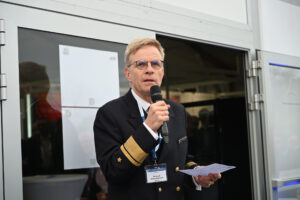
The prospect of a security policy future with more investment, innovation and opportunities led to a record attendance. The patron, Rear Admiral Christoph Müller-Meinhard, welcomed over 800 participants to the traditional barbecue evening. As soon as the traditional introductory beer was served in the outdoor area, it was clear from the crowds that this was no class reunion, and Müller-Meinhard emphasised the seriousness of the situation, the time pressure and the responsibility in his speech.
The welcome address on the second day was given by retired Major General Wolfgang Döring, while State Secretary Jochen Schulte from the Ministry of Economics of the host state of Mecklenburg-Vorpommern gave the welcoming address. The State Secretary pointed out that the federal state was not a peripheral location, but was one of the few states to host all branches of the armed forces. The organiser, retired Colonel Bernd Kögel, was to hold the reins for the last time and was given a fitting farewell at the end with a "Thank you, Bernd".
Vice Admiral Frank Lenski, Deputy Inspector General of the Navy and Commander of the Fleet and Support Forces, kicked off the event. He looked back on the history of the workshop and mentioned the comparatively small start in Eckernförde with 200 people. He warned that the workshop was not an occasion for a gold rush; after all, this was not the Yukon. We are here to do something. He spoke about availability, presence and the commitment of the Russian shadow fleet. It is an era like never before: a lot of money, but little time.
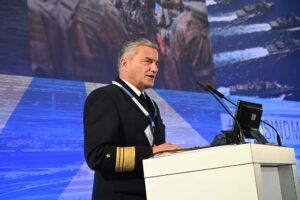
As it was the outgoing commander's last appearance, he was given a standing ovation. Head of Department Eckart Meyer-Höper, Deputy Head of Planning at the Ministry of Defence, used football as an allegory and called on the audience to impose their own game on their opponents. His reference to small companies and start-ups, which have not yet recognised their excellence in the defence sector and should be allowed to enter, may not have pleased everyone present - he spoke openly of the "discomfort of the top dogs".
Vice Admiral Carsten Stawitzki, Head of Armaments at the Ministry of Defence, used the keynote speech to make his usual strong points. He spoke about the strategic orientation and armaments planning of the Bundeswehr, in particular the maritime forces, in the context of Turning Point 2.0 to ensure credible deterrence and alliance capability. He emphasised the importance of modern equipment and logistical support. With regard to the adaptation of legal framework conditions, he added an emotional note: "We can only help Ukraine because it is not in the EU." This was followed by a scolding of several institutions, saying that he had no understanding for delays.

Harald Fassmer, President of the German Shipbuilding and Ocean Industries Association, gave the keynote speech on behalf of the maritime industry. He repeated his association's well-known formula that maritime security is also the security of the entire country. He proposed a two-pronged strategy for solving the problems with the frigate 126.
The other keynote speeches were given by Ministerialdirigent Alexander Schott, Head of the Research and Innovation Hub at the Ministry of Defence, Captain Markus Gansow, Head of Department at the Bundeswehr Planning Office, and Frank Menning, Director of the Bundeswehr Technical Service 71.
The announced President of the Federal Office of Bundeswehr Equipment, Information Technology and In-Service Support, Annette Lehnigk-Emden, was not present in Linstow. The seven keynote speeches at the beginning of the event, as rich in content as they were, were judged by the plenary as "too much of a good thing".
Further presentations were given by Flotilla Admiral Dirk Gärtner from the Naval Command on the planning and conception of the navy, Senior Government Director Rainer Sacher on the war-ready naval arsenal and Heiko Höfler from the law firm PwC Legal on maritime law in the context of autonomous systems.
The technical focus of the DWT is traditionally on the more than 30 poster presentations over two days. Personal dialogue and networking took place at the stands of the more than 60 companies present. The exhibition was sold out. Finally, Estonian Ambassador Marika Linttam spoke about her country's view of the Baltic Sea.
Holger Schlüter

 English
  German