


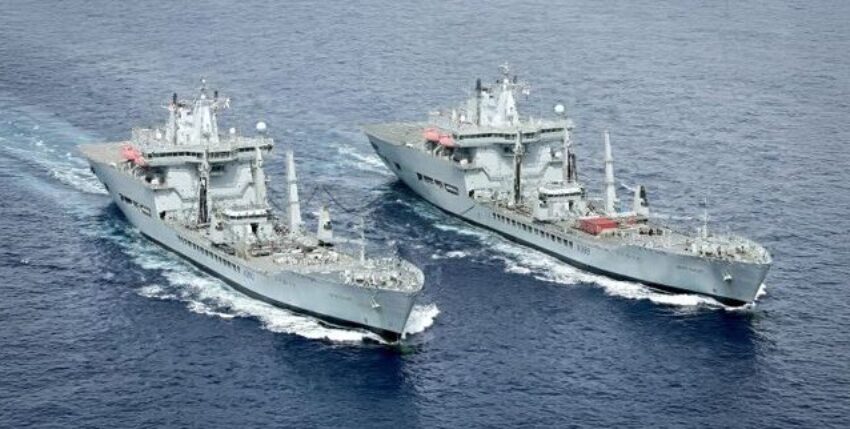






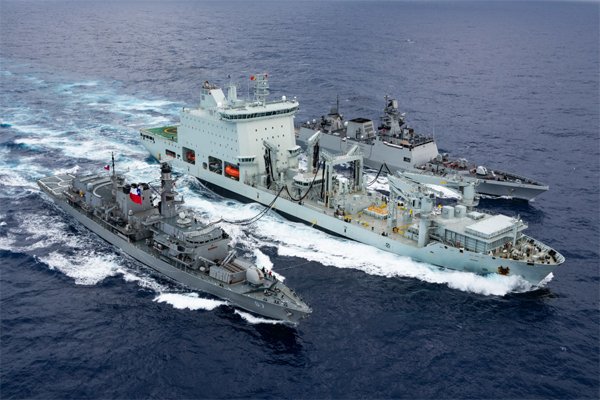
As part of the ongoing downsizing and reorganisation of the Royal Navy and the Royal Fleet Auxiliary (RFA), the United Kingdom has completed the sale of the fleet tankers „Wave Knight“ and „Wave Ruler“ to the private Inocea Group.
The two large supply ships have only been on reduced standby duty in recent years. In the meantime, both a sale to another navy and scrapping had been considered. The units, which were commissioned in 2003, are each 196 metres long, displace around 31,500 tonnes and have a range of more than 10,000 nautical miles.
As Inocea announced in mid-February, the company has undertaken to restore and operate both ships to a fully operational condition in accordance with the specifications of their class and the respective flag state. According to a co-owner of the group of companies, Inocea is pursuing a clear goal: both ships are to continue to support allied fleets in the coming decades, increase their operational range and thus contribute to maritime operational readiness.
Inocea positions itself as a service provider for demanding maritime mission profiles and products for maritime applications. The spectrum ranges from building modern polar icebreakers and supporting NATO operations with its own combat support ship to cyber security solutions for merchant shipping. The Group also has a presence in Canada (Davie Shipbuilding), Finland (Helsinki Shipyard) and the USA (Gulf Copper) through shareholdings and shipyard activities. An important reference case is the commercially operated combat support ship „Asterix“, which has been supporting NATO partners and allied navies since 2018. This model shows that support units can also be successfully deployed under private management - at least in peacetime.
The sale also comes in the context of growing pressure to save money and the planned modernisation of the British naval forces. There are also reports of persistent staff shortages within the RFA. The British Ministry of Defence therefore announced at the end of 2024 that both ships would be decommissioned early as part of a „cost-effective decision“. According to the Royal Navy, the decommissioning of these units and other planned measures should result in savings totalling 500 million pounds (around 578.6 million euros) within five years.
Nevertheless, the model of civilian-operated naval suppliers raises considerable practical and security policy issues. Purely civilian manning arrangements can be economical and flexible in peacetime. In an operational environment with a threat situation, however, fundamental uncertainties come to light. In the event of armed conflict, questions inevitably arise as to the nationality and legal status of the crews, risk tolerance and liability, as well as the resilience of contractual arrangements under combat conditions. It also remains unclear how such ships can be integrated into military command and control structures in the event of war.
All in all, the sale of „Wave Knight“ and „Wave Ruler“ is therefore more than just another cost-cutting move by the Royal Navy. It is an example of a structural change in maritime support: away from state-operated reserve capacities and towards commercially managed, flexibly deployable solutions. However, it will only become clear whether this model is sustainable in the long term when economic efficiency meets operational reality.
kdk, navylookout

 English
  German