





[et_pb_section fb_built="1" _builder_version="3.22" global_colors_info="{}"][et_pb_row _builder_version="3.25" background_size="initial" background_position="top_left" background_repeat="repeat" global_colors_info="{}"][et_pb_column type="4_4" _builder_version="3.25" custom_padding="|||" global_colors_info="{}" custom_padding__hover="|||"][et_pb_text _builder_version="4.14.5" background_size="initial" background_position="top_left" background_repeat="repeat" custom_margin="-50px||||false|false" hover_enabled="0" global_colors_info="{}" sticky_enabled="0"]
A small ray of hope for the 7th Fleet with its Task Force 75: Naval Sea Systems Command (NAVSEA) and Supervisor of Salvage and Diving (SUPSALV) were able to On 2 March, the US Navy recovered the wreckage of its F-35C Lightning II (Joint Strike Fighter), which crashed into the sea on 24 January during an unsuccessful landing on the aircraft carrier USS "Carl Vinson", from a depth of 3,800 metres.
Special diving assistants
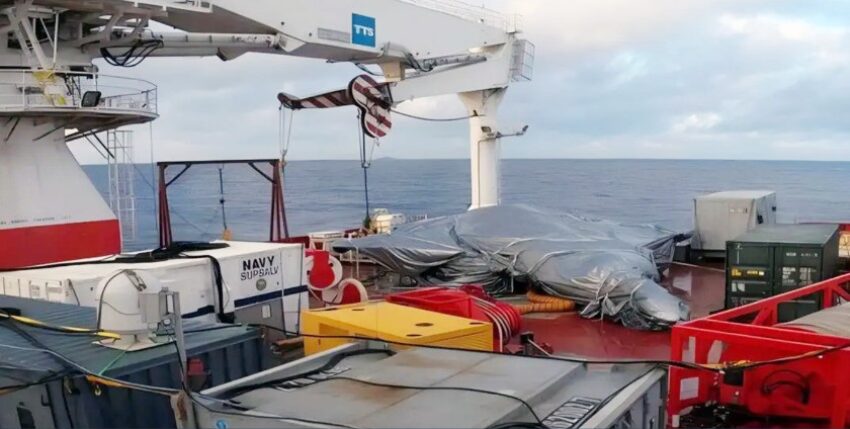
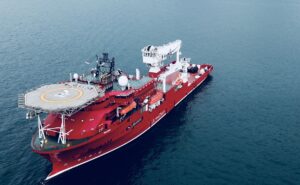
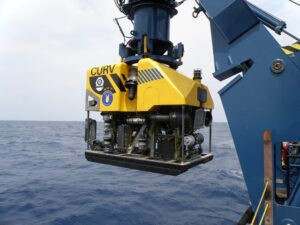
Also present was the Diving support vessel DSCV "Picasso" from the Singapore-based company Ultra Deep Solutions, which was able to lift the wreckage of the stealth fighter on board. This was made possible by the remote-controlled underwater robot CURV-21, which was used to place the wire strops around the fuselage at depth, allowing the F-35C to be brought back to daylight. Wrapped in foil, it now lay on the upper deck of the "Picasso" on its way to further investigations.
Race for the salvage
However, as the incident had occurred in the South China Sea, the Americans feared that China might use its resources to search for the wreckage and gain insight into the technology of this fighter aircraft. To prevent this, the US Navy quickly mobilised its salvage capabilities.
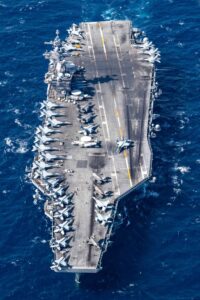
The pilot was able to eject from the jet in the accident, but another six soldiers on the flight deck were injured. The "Carl Vinson" has been back in its home port of San Diego/USA since mid-February.
Incidentally, SUPSALV had already lifted a wreck of a Sikorsky MH-60S Seahawk naval helicopter from the lead ship USS "Blue Ridge", which had been lying at a depth of 5,800 metres off Japan for almost 14 months, using the CURV-21 a year ago. This depth had never been reached before. So we now know quite well how to do it!
[/et_pb_text][/et_pb_column][/et_pb_row][/et_pb_section]

 English
  German