





Parliamentary pressure increases - Budget Committee creates room for manoeuvre: Bundestag prepares a possible F126 alternative solution with 7.8 billion. MEKO A-200 as a bridge to the delayed Lower Saxony class?
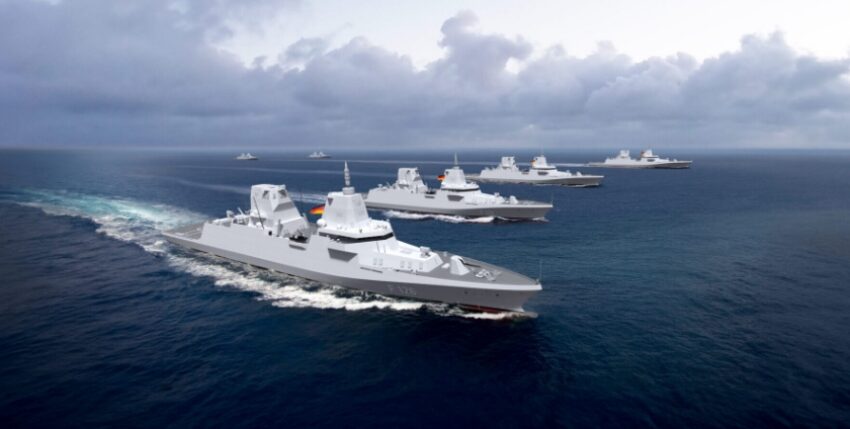
The Budget Committee of the German Bundestag has made a far-reaching decision in its review meeting on the 2026 federal budget: If necessary, the Federal Ministry of Defence will be able to use around 7.8 billion euros in the coming budget years to tackle the procurement of an alternative platform outside of the funding line for the F126 frigate, according to a recent Bundestag statement. The coalition parliamentary groups had submitted amendments to this effect, with which new titles were included in the individual budget and in the special fund.
Ministry and parliament still in harmony?
While the BMVg under Minister Boris Pistorius still seems to be sticking to a continuation of the F126 programme under German leadership - now with NVL in charge instead of Damen - the Bundestag is increasingly signalling impatience.
For the frigate project - including the possible procurement of an alternative platform - an initial €724.7 million is to flow from the special fund in 2026, with €878.2 million earmarked as a commitment authorisation for 2027. From 2028, funding will come from the core budget: 6.2 billion euros up to and including 2033.
Parliament is thus opening up alternative solutions so that the navy does not have to wait another few years for the necessary platforms to arrive. However, before the funds can be utilised, the Budget Committee must lift a block placed on the special fund. At the same time, the appropriations for the F126 procurement remain blocked - a signal that Parliament's confidence in the original project may have suffered.
Due diligence negotiations are currently underway in Vlissingen between Damen, the BMVg and NVL regarding the transfer of project responsibility. This review could take up to six months. The BMVg has a considerable interest in the continued operation of the F126: around 1.8 billion euros have already been invested and the first sections are at the participating German shipyards. Cancelling the project could pose a considerable political risk for the ministry.
MEKO A200: The alternative
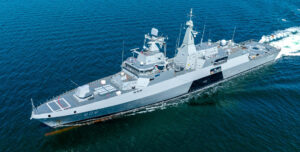
The MEKO A-200 from ThyssenKrupp Marine Systems (TKMS) is being considered as an alternative platform - a proven design with impressive delivery performance, as demonstrated by the MEKO A-200EN "Al Aziz" class project for Egypt: At the end of 2018, Cairo signed a contract with TKMS for four MEKO A-200 frigates for around 2 billion euros - around 500 million euros each. The first ship of this simplified export variant was handed over after just 38 months.
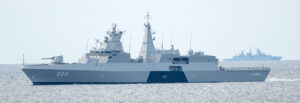
If the order is placed promptly and the basic design is adhered to in a disciplined manner, the first ship for the German Navy could be available as early as 2030 - provided the procurement is not delayed by subsequent capability optimisations. In any case, much sooner than the F126, which is being continued under German leadership as a complex multi-purpose frigate with eight units and is now costed at a good 10 billion euros.
The situation at TKMS
The Kiel shipyard German Naval Yards Kiel (GNYK) - TKMS' immediate neighbour - has run into rough waters after the F126 delays meant that no payments were made for construction work that had been agreed but not called off. Talks on the takeover of GNYK by TKMS are said to be at an advanced stage. Both companies use the same shipyard site in Kiel. While TKMS specialises in submarine construction, GNYK has large dry dock and crane capacities for surface vessels. A takeover of GNYK would provide TKMS with around 400 qualified employees and the complete infrastructure - capacities that TKMS seriously needs with the expected order to build the F127 and the submarine projects that are still pending.
Three scenarios - and a difficult political decision
What opportunities does the German frigate project now face?
1. parallel procurement
F126 will be continued under NVL management and will arrive later (2032+); at the same time, the construction of a few MEKO frigates will be ordered from TKMS as a fast bridge solution (delivery from 2030). This saves face vis-à-vis The Hague, utilises investments made and offers the greatest increase in capacity for the navy in the long term - but also means: two training lines, two logistics concepts, double engineering commitment at the shipyards. That will be really expensive.
2. continuation of the original frigate project
F126 will be continued under NVL management and will be delayed disproportionately; there will be no parallel procurement. This focuses all forces on one project and avoids organisational duplication - but relies on NVL actually being able to deliver, because continuing a Dutch design through a German shipyard requires a rewriting of all plans and designs in a different company philosophy. This is less of a financial risk than a technical and above all a time risk, which is weighed heavily in parliament.
3. demolition of F126 and procurement of MEKO A-200 variant
The order to build several, but somewhat less capable MEKO frigates, but with an earlier delivery date, means rapid growth well within the financial framework, perhaps even with room for something "unmanned". The German Navy's key submarine-hunting capability, which is intended to keep the Atlantic sea lanes free for American reinforcements in the event of an alliance crisis, will lose out somewhat - especially at a time of growing submarine threat from the Russian Federation. However, it also means the total loss of the 1.8 billion euros already spent, damage to the reputation of a reliable partner, a strain on German-Dutch relations, plus legal disputes, claims for damages and arbitration proceedings lasting for years. An extremely difficult decision that requires considerable political courage. A decision between the positive factors of a technology-finance timeline with a negative assessment of a reduction in capability - and a huge shambles.
Time is of the essence
The budget decision is a clear signal: the German Navy needs ships - and it needs them soon, whether through an F126 reset, MEKO alternative or a combination of both approaches. The upcoming negotiations in Vlissingen will show whether a reset under German leadership is possible or whether the Damen contract will be cancelled.

 English
  German
One Response
Eighth Marine Forum,
The new attempt for a rescue attempt with NVL (Rheinmetall) with the not design phase mature F126 plans of Damen Naval is in my opinion already risky, OK CEO Armin Papperger is not the first the best but he does not have a magic wand.
Time is extremely short (nevertheless, you start with a new delay), the effort is difficult to estimate and should not be underestimated (not favourable starting conditions).
If things don't work out in time, you have to answer for many losses of forces and material in an emergency, and there are also negative consequences. The enemy does not sleep, on the contrary, he lurks in the dark and waits for the right moment.
Just think of the story of the F125 frigate: in the end, after many delays and improvements, the original F125 was successfully turned into a good and valued platform, but this time is absolutely not available for the Damen Naval-NVL F126.
The absolute priority is the urgent and highly necessary expansion and increase in combat effectiveness of the German Navy, including the security situation of the armed forces!!!
So my suggestion: Option 2
Step 01 :
- A quick but temporary procurement of (4 to 5) MEKO A200De frigates. In my opinion the hangar is already a bit cramped for the NH90 Sea Tiger and its ASW equipment, but maybe something can be done. When the right ships arrive, the MEKO 200De can replace the K130 Batch 1 step by step (wouldn't be so bad yet).
- The armament should be reconsidered (drones!).
- Realistically, this could start to run from 2030 (one per year)
- Maybe you could also consider the MEKO A210 (a further development of the A200 with a better hangar and armament), if they can be delivered fast enough!
Step 02 : U212CD submarines for the GIUK zone
- Second production line for the U212CD (Wismar) goes into operation
- The U212CD is a very good submarine hunter, ideal for monitoring and deterring the GIUK zone.
- Realistically, this could start to run from 2031 (one per year)
- At the same time, the production of a Muse support platform type 405 in OPEX mode should be started. Using OPEX, the Type 405 can be made ready for series production. The type 405 is important to support the U212CD.
- When the Type 405 is ready for series production, 5 pieces can be added without risk.
- When the new ASM ships are running, the U212CD will be released step by step.
Step 03 : Frigate F125 Batch 2 as ASW platform (F125B2ASM)
- The Frigate 125 had problems and significant delays in the beginning, but after several adjustments is a good platform and is currently acting as a base for the F127 (so a good reference)
- At the moment the 4 current F125s are being upgraded with AD and ASW capabilities to temporarily support the F123, unfortunately the retrofitting of the sonars is expensive.
- Should a new Batch 2 be ordered, the AD, ASW capabilities and sonars could be integrated immediately with minimal effort as all blueprints are available. The star can be extended at the rear (+/- 6 metres) for the Atlas ASW Mission Modules. With the adapted blueprints the production can start quickly and the result is a kind of slim F127-ASM with a width of 18.8 m and a length of +/- 155 m, so a proven concept, less risks with the IBN, faster available, lighter and cheaper than a real F127ASW.
- The star could be designed in the same way as the MEKO 300 (suggestion only).
- The armament should be reconsidered (drones!).
- In addition, the shipyards NVL and TKMS already have experience with the production of the F125 (Riese advantage).
- Many personnel (armed forces and maintenance) are already familiar with the F125, so a changeover to the F125B2ASW should be possible quickly (Riese advantage).
- Realistically, this could start to run from 2031 (one per year)
- It may also be possible to choose the F127ASW, but that will be expensive and take much longer. A combination of F125B2ASM and F127ASM is also an option, i.e. 6 F125B2ASM and 3 F127ASM?