








On 15 January 2026, the European Defence Agency (EDA) discussed the high-level requirements for the European Combat Vessel (ECV) with the seven participating navies and industry representatives in Brussels. The largely harmonised capability profile is intended to create a European family of surface combatants that will shape Europe's fleets in the 2040s.
From the systems-to-hull approach to the frigate family
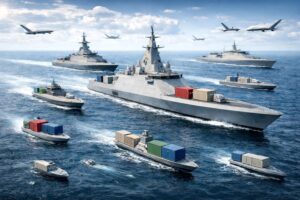
From a maritime perspective, ECV is above all an attempt to map the floating platforms from the future 'workhorse frigate' to the fleet flagship in a common design. The EDA documents define three size classes - small (<3,000 tonnes), medium (4,500-6,000 tonnes) and large (7,000-8,000 tonnes) - which, as a 'family of modular ships', form a continuous line from escort vessel to multi-role combat ship to command platform. What they all have in common is a range of 10,000 nautical miles at 15 knots, 30 days' autonomy at sea and worldwide operational capability up to sea state 6+.
Multi-domain battlespace: air, surface, underwater, cyber
The operational framework is broad. In peacetime, ECV units are expected to maintain a presence, secure SLOCs, protect EEZ interests, conduct maritime security operations and provide support after natural disasters (HADR) - including traditional tasks such as fisheries surveillance, environmental protection and combating illegal activities. In crises, their roles may expand to include Maritime Interdiction Operations, strategic pre-positioning, A2/AD in all domains and evacuation operations. In armed conflict, the full range is required: Sea Control and Sea Denial, Integrated Air and Missile Defence (IAMD/AAW), Anti-Surface and Anti-Submarine Warfare, Strike Warfare and Naval Gunfire Support.
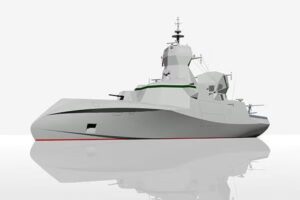
The requirements of the multi-domain approach include 4D air search radars, high-volume air reconnaissance, a full range of AAW effectors and - in the larger versions - BMD options. In the surface area, hypersonic sea target missiles with ranges of well over 75 nautical miles are required, supplemented by a 76mm main calibre, railgun option and ammunition for precise firefighting. For underwater warfare, ECVs should have a combination of hull and towed sonars, variable depth sonar, sonobuoys and light torpedoes; very light and supercavitating high-speed torpedoes are also explicitly mentioned.
UxV mothership and flagship capability
The platforms are designed as UxV "motherships". All variants must be able to operate UAV, USV and UUV/AUV. The medium and large versions with hangar capacities for medium multi-purpose helicopters and tactical drones, the smaller versions with a reduced but compatible approach. The documentation handed out at the conference emphasises the "teaming" concept: UxVs should not only serve as an extension of the sensor and weapon range, but also operate in swarms, support data fusion and relieve the own signature in the EM and acoustic range.
The ECV is defined as a C2 multipurpose platform. The Combat Management System should be AI-supported, provide multi-sensor data fusion and provide distributed combat networks with edge/fog computing right up to the tactical edge. The ships must be able to operate in disrupted connection environments (C2D2E, DDIL) - i.e. maintain a maritime situation picture with target assignment and formation control even if GNSS and SATCOM connections are disrupted or have failed. NATO-compliant data links (e.g. Link-16/22, JREAP, VMF) and the capability for cooperative engagement, and in the future also for joint composite tracking, are required.
Between compact frigate and battle cruiser
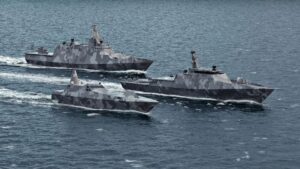
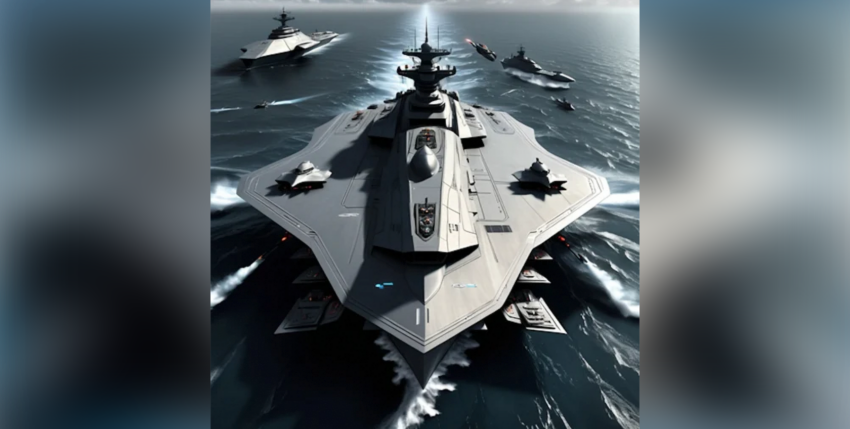
In French specialist discourse, the future of surface ships is described along the lines of "frégates compactes" versus "croiseurs de combat". From a French fleet perspective, ECV translates this format debate into a graduated but coherent capability picture: the 'small' and 'medium' versions are in the range of today's multi-purpose frigates - with additional multi-domain depth - while the large variant with 7,000-8,000 tonnes, extensive AAW/BMD, flagship C2, DEW option and pronounced UxV mothership role is operationally closer to a European "battle cruiser".
Industry, ILS and technology transfer
For the fleet planning of the navies involved, this means that ECVs are less a single class than a family of capabilities that can replace or supplement national lines in the future. Italy, Spain and the Netherlands can think of future frigate and command platforms within a common framework. Smaller navies gain access to a high-value standard that would otherwise be almost impossible to finance. At the same time, the documentation provided includes a highly integrated logistics component (ILS) - from distributed maintenance and upgrade capabilities to technology transfer and national certification centres. The aim is to fulfil operational reality, operational availability and national sovereignty over the entire life cycle of the ships.
Conclusion
Key questions remain unanswered for the naval community. Will ECVs become the backbone of a future European "blue-water surface force", or just another overly ambitious paper project? The decisive factor will be whether the very ambitious technological goals ('direct energy weapon', hypersonic, distributed C2, UxV swarm) can be backed up with realistic time and cost paths.
Will it be possible to persuade key nations such as Germany, France and Italy to get on board? Or will they stick to national lines? From a German perspective, the dimensions are remarkable. Unlike the future F127 frigate, ECV is content with a displacement of far less than 10,000 tonnes - for now.
From today's perspective, ECV is the first concept that no longer thinks of Europe's maritime capabilities as additive, but as a networked, multi-modular fleet architecture - from small escort vessels to highly equipped command and combat platforms.

 English
  German