







Military strike against Iran: trigger for a new oil crisis?
A massive military strike by the US and Israeli armed forces. Obviously they are going all in. The strikes are not only directed against the nuclear programme, but also against the revolutionary leaders. After Donald Trump's confirmation, the state media reported that Iran's supreme leader Ali Khamenei had been killed. So far, the population seems to be more in agreement, if the sparse videos from Iran are anything to go by. There are also initial indications that the strikes are having a significant impact. The Iranian government reacted quickly and violently on Saturday, as it had threatened to do, and aimed its missiles at Bahrain, the United Arab Emirates, Qatar, Saudi Arabia and, as expected, Israel. However, no major damage has been reported so far and the defence appears to be working - just like in 2025. The American armed forces had partially evacuated their bases in direct range of the Iranian missiles as a precaution. This is the only way to explain why no substantial damage was reported at the base in Bahrain that was hit. At least there have been no fatalities there. There has so far been no reaction from the „proxies", such as Hamas or Hezbollah. It is uncertain how long Iran will be able to continue using its missiles, of which there are estimated to be thousands. These missiles are usually fired from launch pads in the form of converted lorries. However, as every launch is recorded by satellite, these „launchers“ become priority targets for fighter bombers, which in turn should rapidly reduce the number of launchers. According to experts, there are now only a few left. And then large reserves are no longer of any use.
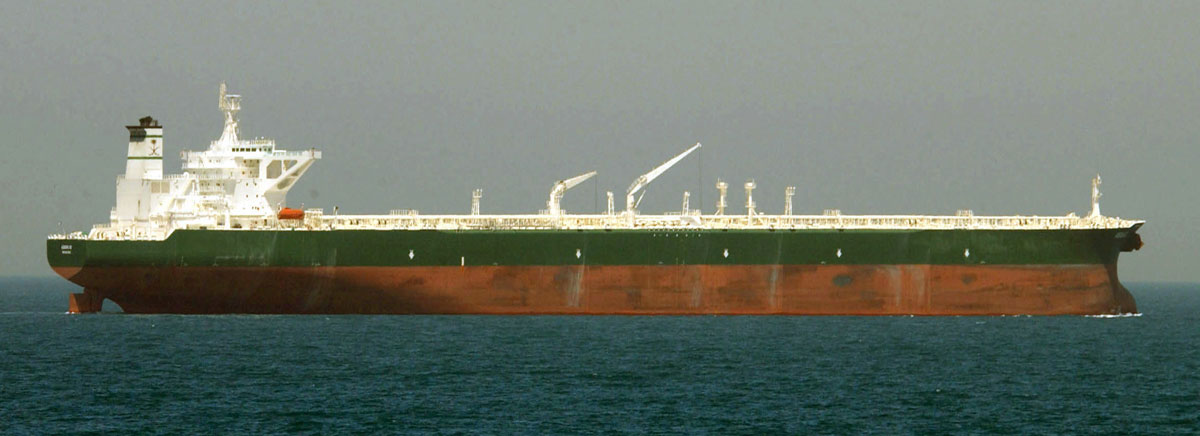
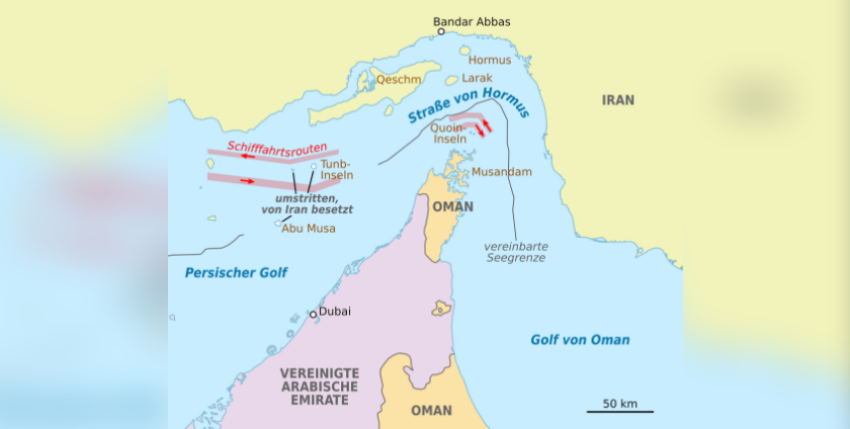
If this is the case, then the acute danger to shipping in the Strait of Hormuz from Iran should also decrease noticeably. Initially, the latent threat to shipping traffic in the Strait of Hormuz did not appear to be affected. The situation changed with the threat issued against all shipping traffic on the morning of 28 February. marine traffic The picture became increasingly bleak: shipping traffic either passed entirely in the southern part of the strait or took up a waiting position. By the evening of 28 February, only a few ships could still be seen in the waterway and the northern Iranian section was barely frequented. The ships are currently gathering in waiting positions off Dubai and in the Gulf of Oman. The Strait of Hormuz is of key economic importance, as it is used to transport at peak times up to 40% of the global Oil consumption be transported. There are practically no alternative routes. At its narrowest point, the strait is only 20-30 nautical miles wide and connects the oil ports of numerous Gulf states with markets in Asia, Europe and the USA. Even minor disruptions extend transport times and significantly increase costs. The region has been under pressure for years due to the Iran's nuclear programme: There have been repeated threats of a closure, for example in 2006/07, 2011 and 2014, and most recently in 2025. It is questionable whether it even makes sense for Iran to attack ships or close the road, as the mullahs would primarily harm their own allies and traditional friends - such as China or India.
There are fears of an escalation and fears of a volatile oil market are doing the rounds. After a cursory review of the market data, it is more likely that lower oil prices (approx. USD 58-60/barrel) for 2026. The reason for this is an expected Oversupply, after Brent fell sharply in February (according to Goldman Sachs and JPMorgan). Iran's importance for the global oil market is considerably lower than it used to be. The largest producers are the USA are 18-19 million barrels of oil per day, followed by Saudi Arabia and Russia each with 10-11 million barrels per day. The five largest producing countries cover over half of global demand. In this respect, we do not believe that the closure of the Strait of Hormuz will trigger an „oil crisis“, nevertheless an escalation factor. The oil producers in the Gulf and the customers who depend on them - see above - have an immense interest in a quick end to the blockade. In view of Iran's dwindling resources, the blockade will not last.
Text: hsc / ajs

 English
  German