





Diplomatic divergence: a truce with two truths
Although the ceasefire announced at the last minute on 7 April 2026 prevented the feared „Power Plant Day“ - the total destruction of Iran's electricity and bridge infrastructure - it reveals a deep divide in the perceptions of the warring parties. While President Trump justifies the U-turn by claiming that Iran has agreed to a „complete, immediate and safe opening“ of the Strait of Hormuz, Tehran is celebrating the agreement as a „historic victory“ against unlawful aggression. Iranian Foreign Minister Abbas Araghchi made it unmistakably clear that passage would only be possible „in coordination with the Iranian armed forces“ and subject to „technical restrictions“. This contradictory reading has led analysts such as Richard Meade of Lloyd's List Intelligence The strait has already been labelled „Schrödinger's Strait“: it is geographically open, but remains de facto geopolitically closed to Western players. Significantly, only three ships over 10,000 DWT passed through the strait between the announcement of the ceasefire and 8 April - all with direct connections to Iran. The traffic volume is therefore still around 90 % below the pre-war level.
Transatlantic ruptures: 'Left in the lurch'
In parallel to the regional conflict, diplomatic trench warfare within NATO has intensified. Following a meeting with NATO Secretary General Mark Rutte on 8 April, President Trump massively escalated his criticism of the European allies. Via Truth Social he accused the Europeans of having „left the USA alone“ in the fight against Iran: „NATO WASN'T THERE WHEN WE NEEDED THEM, AND THEY WON'T BE THERE IF WE NEED THEM AGAIN“. The US government is currently examining plans to withdraw US troops from countries that have not actively supported the Iran campaign or denied overflight rights - countries such as Austria and Spain are mentioned by name - in order to redeploy them to more co-operative member states. Meanwhile, there is growing concern in Europe that Trump's threat to withdraw from NATO will permanently erode the Western security architecture, while leading politicians such as Emmanuel Macron are warning that unpredictable signals from Washington are destroying the core of the alliance's trust.
Financial Stalingrad: The attrition of the dollar system
Despite the respite provided by the ceasefire, the financial risk to the US financial system remains existential. The Pentagon estimates the costs for the first five weeks of the war at around USD 42 billion, with daily expenses of up to USD 1 billion. The Penn Wharton Budget School estimates the net war costs for two months at USD 65 billion. Developments on the bond market are particularly dangerous: China has reduced its holdings of US government bonds to a record low of USD 683 billion. Rising oil prices are fuelling inflationary expectations, which drove the yield on 10-year US government bonds up to 4.37 per cent. At the same time, Iran is attacking the dollar's supremacy by consistently demanding tolls in yuan or cryptocurrencies. If significant proportions of global oil trade are permanently converted to yuan invoicing, the petrodollar arrangement of 1974 - the cornerstone of global dollar hegemony - threatens to collapse for good.
The resource trap: helium, bromine and the technological standstill
Global security of supply depends on critical resources whose production remains interrupted despite the ceasefire. The Iranian attack on Ras Laffan on 2 March permanently damaged the world's second most important helium complex; two of 14 liquefaction trains were hit so badly that it is estimated to take three to five years to repair. As helium is an indispensable by-product of LNG liquefaction, around a third of the global supply remains offline, which poses massive problems for the semiconductor industry (especially TSMC and Samsung). In addition, bromine is coming to the fore as a strategic component: Iran is the world's second largest producer of this element after Israel, which is indispensable for the pharmaceutical industry, flame retardants in electronics and oil refining. The blockade of Hormuz and potential export bans are massively exacerbating the global shortage of these chemical raw materials.
Operational situation: Larak-Island bypass and the Oman corridor
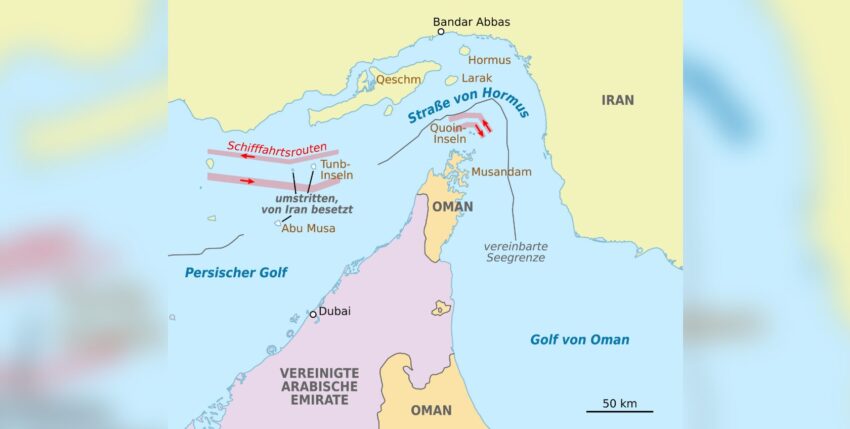
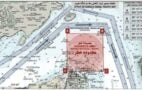
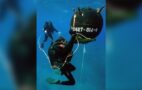
At the operational level, there are currently around 700 ships in the Persian Gulf, including over 400 oil tankers. Iran has effectively turned the Strait of Hormuz into a selective toll regime. Ships are forced to use the northern Larak Island Corridor along the Iranian coast, where the IRGC Navy carries out visual verification and charges an average of USD 2 million per supertanker (VLCC). In parallel, the southern Oman Corridor, part of the original Traffic Separation Scheme (TSS) is effectively impassable for Western ships due to Iranian mine warnings and threats. Iranian negotiation proposals envisage sharing future tolls with Oman, which would cement Tehran's de facto control over the entire strait. While partner states such as India or Vietnam are exempt from tolls through diplomatic agreements, ships with a direct Iran nexus accounted for 80 % of traffic last week. Experts see this as a clear breach of the UNCLOS Convention on the Law of the Sea, but Tehran is recodifying international law through military decisions of fact.
Conclusion and outlook
The ceasefire in Islamabad is not a solution, but merely a temporary buffer. The USA faces the existential question of whether it can pay the financial price of a long war of attrition while the technological supply chain (helium) threatens to haemorrhage. For Europe, the situation is worsening: the combination of Trump's accusations and the ongoing energy crisis is forcing the continent into a strategic autonomy for which it is not prepared militarily or industrially. The next 48 hours will show whether Iran will actually open the Larak Corridor to non-Iranian ships - or whether the US will return to a total escalation against the Iranian energy industry once the deadline expires.
Text: Editor Uwe Mergener
Map Strait of Hormuz - Copyright NorthNorthWest, Licence: Creative Commons by-sa-3.0 en

 English
  German