








Ukraine sets new standards in naval warfare without its own navy
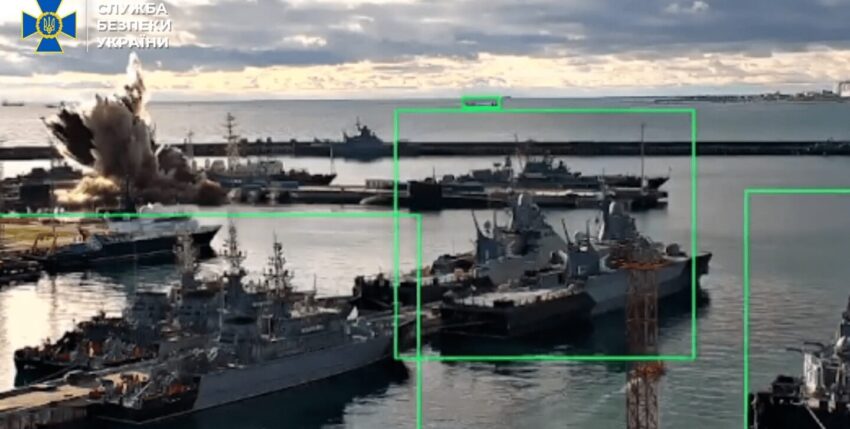
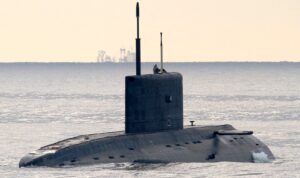
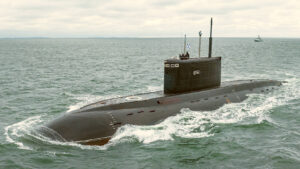
On 15 December 2025, an underwater explosion occurred in the heavily protected naval base of the Russian Black Sea port of Novorossiysk in the immediate vicinity of a Project 636.3 (Varshavyanka, NATO: Improved Kilo) diesel submarine moored there. The Ukrainian security service SBU subsequently declared that it had attacked and "critically damaged" a submarine for the first time using an underwater drone.
Damage effect
The Russian side confirmed an incident, but denied damage to ships or crews. However, commercial satellite images show clear damage to pier and harbour structures after the incident. According to analyses by open sources, the detonation point was around 10 to 20 metres behind the stern of a kilo boat moored on the inner pier. The stern section of a submarine is considered to be particularly vulnerable, as the propeller, steering gear and shaft with their hull penetrations are concentrated there. In this respect, the choice of the point of impact appears to be deliberate in order to achieve maximum damage with limited explosive effect. These range from a temporary inability to manoeuvre (minimal damage) to risky repairs to the shaft system in a dock in the Black Sea region (if available) to a total loss due to damage/breakage to the pressure hull.
Suspected weapon system

Ukraine describes the deployed means as an unmanned underwater vehicle of the "Sub Sea Baby" type, of which neither technical details (dimensions, propulsion, sensors, warhead) have been published, nor are any images available. The previously known "Sea Baby" platform has been used as a Ukrainian surface seed drone since 2023, including in attacks on the Crimean Bridge and against Russian naval targets in the port of Sevastopol. There is no evidence of modifications for underwater missions. However, programmes such as "Toloka" indicate that Ukraine is also independently developing torpedo-like underwater platforms. Needless to speculate - the technical truths come to light with some delay anyway - but then too late for this news.
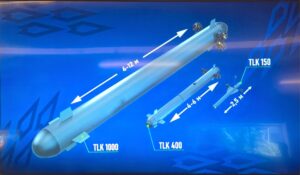
Photo: hum
Tactics
The approach through the busy harbour required precise navigation and targeted control to the submarine berths. Two kilo boats were lying to the right and left along the inner pier - these were passed - the one lying transversely at the rear was attacked with a favourable target geometry at an angle of 90 degrees - possibly even with an increased weapon effect due to the concrete structure of the pier. Satellite images from the following day show the boat presumed to have been hit still at its original berth, but slightly lower down. In the meantime, another boat has moved to an outer berth on the same pier.
Black Sea Fleet
Of the original six modernised Kilo boats (project 636.3), only two or three units are currently still available to the Black Sea Fleet. Following the loss of the "Rostov-na-Donu" (B-237, hit in the dock in Sevastopol) and the transfer of "Krasnodar" (B-265) and "Novorossiysk" (B-261) to the Mediterranean before the start of the war, only "Kolpino" (B-271) remained in the Black Sea Fleet, "Veliky Novgorod" (B-268) and "Stary Oskol" (B-262), as well as a seventh kilo boat, the 15 years older "Alrosa" (B-871, project 877V, pump jet). As there is only unclear information about the condition of the "Stary Oskol" and "Alrosa" cannot yet launch Kalibr land-based missiles, the size of the submarine part of this fleet can be described as "limited".
Consequence
The incident marks a further stage in Ukraine's asymmetric naval warfare. After the withdrawal from Sevastopol, Novorossiysk was considered a comparatively safe harbour for the Russian Black Sea fleet. As no reliable protection can be guaranteed here either, despite increased security measures, further efforts must be made for harbour and object protection, other locations must be chosen and reduced capabilities of the submarine component must be expected.
Conclusion
A nation without its own high seas or marginal seas navy forces an established naval power with surface and underwater units into a defensive deployment. The fact that Ukraine, of all countries, is shaping the naval war in the Black Sea points to a new aspect of maritime power projection: Maritime impact is increasingly being generated by the ability to strike at the enemy in the depths of the geography - regardless of size. The protection of harbours and rear bases is thus becoming a central challenge for modern naval forces - far beyond the Black Sea.
Don't put all your eggs in one basket!
Video of the Ukrainian domestic intelligence service SBU (Sluschba bespeky Ukrajiny):
Assignment of the ships in the video
Floating pier in the foreground: 3 minesweepers - presumably 2 Alexandrit class (62 metres, 900 tonnes, project 12700) and 1 Gorya class (68 metres, 1,150 tonnes, project 12660), in front 2 FK corvettes Bykov class (94 metres, 1,700 tonnes, project 22160).
Fixed pier: inside 3 Kilo-class submarines; on the outside 1 Krivak frigate (123 metres, 3,300 tonnes, project 1135/1135M). Other vehicles are difficult to categorise.
Outer pier, inside: 1 Bykov corvette.
Authors: hum / ajs



 English
  German