






What lies ahead for maritime Europe - and what the navies should make of it
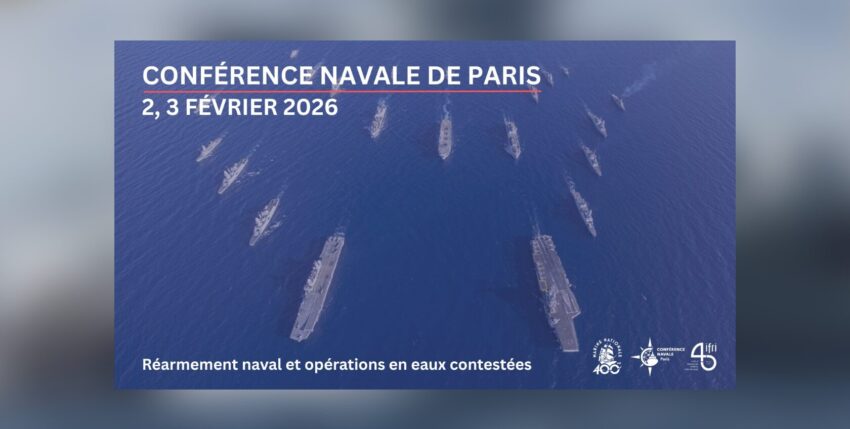
The message of the Paris Naval Conference 2026 (2/3 February): The time for hiding behind symbolic contributions and long project durations is coming to an end. Whether Europe's maritime deterrent will be effective will largely depend on whether - in our case - Germany, its navy and the German maritime industry really are geared up for war and industrial speed in the coming years.
Summarising the contributions to the conference organised by the IFRI (Institut Français des Relations Internationales), the future credibility of European deterrence will not only be decided in front of Brest, Portsmouth and Norfolk, but also in Wilhelmshaven, Eckernförde and in the German defence industry. The expectations of Germany's navy and industry are correspondingly high if Europe is to achieve its war capability on the northern flank, in the Baltic Sea and its approaches by around 2030.
The goals formulated in the "Marine 2025 course", the 2035+ target vision and the "Commanders Intent 2026" of the Chief of Naval Operations are being reinforced in terms of time and sustainability.
Germany as the key to the northern flank
The conference described the return of high-intensity naval warfare in the North Atlantic, North Sea and Baltic Sea - with Russia as the main threat and hybrid activities against underwater infrastructure, harbours and offshore facilities. For Germany, this would mean
- The navy remains a core player on NATO's northern flank, with responsibility from the Baltic Sea via the North Sea to the northern Atlantic.
- The focus on deterrence on the northern flank, high operational readiness by 2029 and technological reorganisation by 2035 formulated in the "Marine 2025 course" is confirmed by Paris, placed under greater time pressure and set within a European framework of expectations.
Paris 2026 emphasises that it is less a question of whether Germany "contributes". Rather, it is about whether it is perceived as a reliable mainstay of presence and control of maritime space in the Baltic Sea region and on the access route to Scandinavia.
Military expectations of the German Navy
The requirements outlined in Paris - air-sea superiority, protection of critical infrastructure, endurance - are in line with the German capability profile: modern sensor technology, sub-hunting capability, long-range missiles and unmanned systems in the core mission. A profile that is being honed in the "Commanders Intent 2026" of the Chief of Naval Operations.
- The inspector explicitly calls for the establishment of a German Navy drone fleet and the consistent integration of unmanned systems under, on and above water, including loitering munitions.
- He links this to clear guidelines on operational readiness - two thirds of the units should be available, "a ship in the dockyard is no deterrent" - and emphasises that harmlessness is "not a strategy for avoiding conflict".
Deterrence = war capability
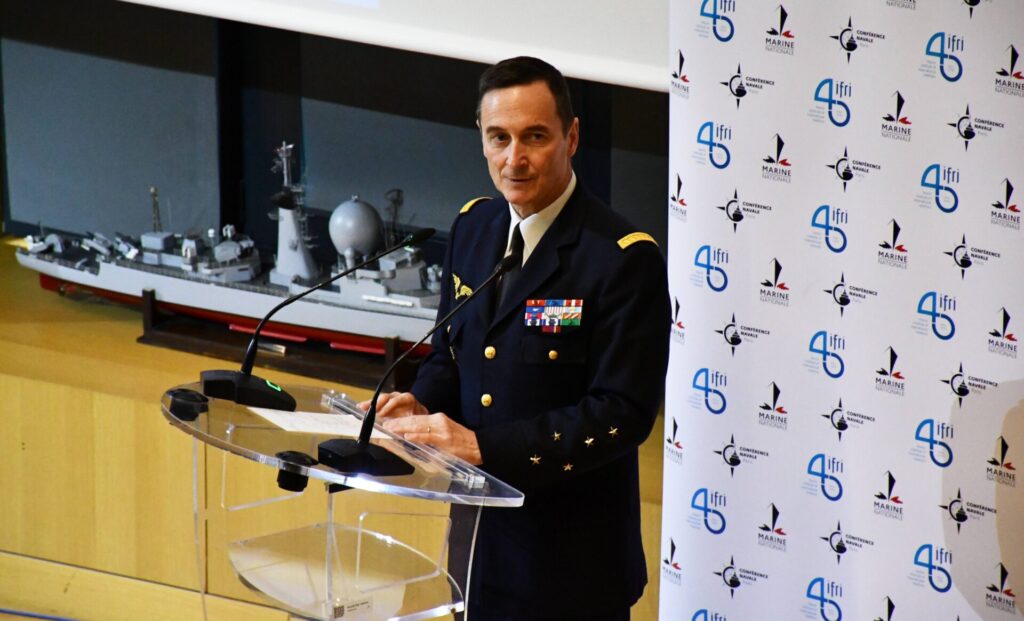
Admiral Kaack is thus on the same line as the French inspector general General Fabien Mandon, whose statements can be summarised as follows: Deterrence means being ready for war - materially, technologically and mentally. He opened the conference dryly with "Today, we are preparing for war".
Mandon describes the navy as the first bulwark of national sovereignty and the guardian of a globalised economy. Not only because of the 80-90 per cent of vital goods that are transported by sea. With examples such as the circumnavigation of Africa due to the threats in the Red Sea and Operation Cleaners against Russian oil exports, he links naval operations with economic warfare. The same applies to undersea cables as the backbone of the digital economy. He reminds us that only the sea enables the mass transport of forces and material into a conflict. He calls for more lethality (more missiles on board, with longer ranges) and more ships - "what counts is mass". At the same time, he warns of the "transparency" of the battlefield through quantum technology, space and acoustics and refers to drone warfare (Ukraine, Huthi) as well as the need for AI-supported evaluation with simultaneous cyber resilience.
Summarising the lines of the conference, there are several areas of expectation for the German Navy:
- StaminaThe Baltic and North Seas are not only military areas, but also industrial lifelines - for energy, trade and data. Vigilance and deterrence operations such as in "Baltic Guard" must be able to be carried out with greater intensity in the long term - despite the smallest navy in the history of the Bundeswehr.
- Multi-domain capability: The demand for "victory at sea" in complex battlefields coincides with the German view of the 2026 Paris Naval Conference: What lies ahead for the German Navy and Europe's deterrent: modern sensor technology, submarine hunting capability, long-range missiles and unmanned systems, as laid out in the 2035+ target picture and "Naval Course 2025", will become decisive parameters.
- Unmanned systemsThe conference emphasises unmanned platforms and data-driven warfare - exactly the line that Vice Admiral Kaack outlines as the "German Navy's drone fleet" above and below water.
- Critical infrastructureThe protection of data and supply chains, submarine cables and offshore infrastructure is becoming a core task that directly affects German economic and industrial policy.
The German line is certainly confirmed in Paris - the questions are the speed and consistency of implementation.
Industrial policy expectations of Germany
As a consequence, this means that deterrence has become an industrial issue: "industrial tempo" and resilient supply chains have been categorised as equally important as fleet size. Shipyard and armaments capacities must be able to replace losses and produce systems quickly in order for deterrence to remain credible.
For Germany, this means that
- Shipyards and system houses as a strategic resourceGerman locations - from naval shipbuilding and sensor technology to guided missiles - are seen as a necessary pillar of the maritime rearmament in the European context.
- Series instead of individual piecesThe industrial mass and retrofitting capability demanded in Paris is a poor match for the German tradition of complex, individual platform projects. The pressure for greater involvement in European series and standardisation projects is growing.
- Synchronisation with "Marine 2025 course"The goals formulated in the course - modernisation, greater operational readiness, priority for unmanned systems - must be underpinned by industrial policy: through long-term framework and call-off contracts, accelerated awards and the use of European funding instruments (EDF, etc.) for key maritime projects.
It is precisely because of its economic strength that Germany is considered to be setting the pace here: if Berlin hesitates when it comes to maritime procurement, it slows down the entire European scaling of maritime scaffolding.
Implications for the navy and politics
Three core statements can be derived from Paris for the German maritime discourse:
- From symbol to war capabilityThe German Navy must upgrade its role from "present contributor" to one of the main pillars of northern flank defence - with clearly measurable goals for operational readiness, sustainability and presence in the North and Baltic Seas.
- Industry as part of operational planningShipyards, suppliers and system houses must be considered in scenarios at an early stage - not as downstream supporters, but as an integral prerequisite for longer operations and rapid regeneration.
- Take the 2030 time horizon seriouslyThe time horizon set by Paris coincides with German interim targets (operational by 2029, technological transformation by 2035+). Budget and procurement decisions will be measured by whether they make these targets achievable or postpone them further.
The German Navy has mapped out its course with its basic documents Kurs Marine 2025, Zielbild 2035+ and Commanders Intent 2026. It is now up to Berlin to back this up politically and industrially. The signal from the Paris Naval Conference 2026 is unmistakable: whether Europe's maritime deterrent is effective will largely depend on whether the Federal Republic of Germany actually trims its navy and maritime industry for war capability and industrial speed in the coming years.
The days of hiding behind symbolic contributions and long project durations are coming to an end.
+++++++++++++

 English
  German