

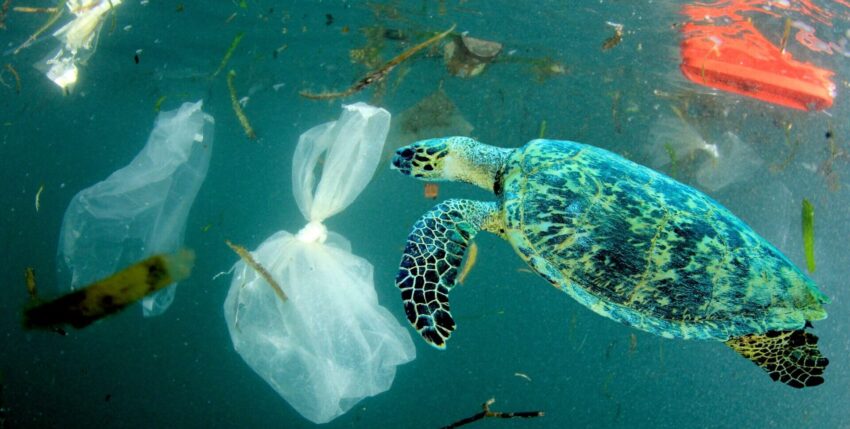



At the beginning of February, "The Conversation", an Australian online network of non-profit media companies with news, research reports and expert analyses, reported on an impressive study on the migration of plastic waste in the Indian Ocean.
Initial situation
In 2019, the Seychelles Island Foundation and Oxford University carried out a clean-up on the uninhabited Aldabra Atoll north-west of Madagascar. A total of 25 tonnes of plastic waste was collected and removed from a 35-kilometre stretch of the island. A further 500 tonnes of other waste was left behind, as it would have cost 5 million dollars to transport. Based on this alarming situation, the question of where all this rubbish could have come from on the UNESCO World Heritage-listed breeding ground of the green sea turtle, among others, was investigated.
Study
In a Study the movement of plastic particles discharged into the Indian and Western Pacific from 1993 to 2019 was calculated, making it possible to determine the point of discharge depending on the point of origin.
To this end, the regional waste generation rates and fishing activities were converted into billions of particles and their movement simulated using wind, waves and ocean currents. In addition, the speeds of scientific drifters (instruments for recording ocean currents) and GPS-tracked fishing nets were evaluated, as they exhibit the same behaviour as plastic. Bottle caps and objects with low buoyancy sink quickly and determine the failure rate. In addition, plastic loses buoyancy when it breaks or is covered by aquatic organisms.
For plastic from the eastern Indian Ocean to reach the Aldabra Atoll, the model estimates that it must float for at least six months. "Long-distance drifters" are therefore more likely to be the longer-floating objects. And there is a strong seasonal dependency in the amount of rubbish that arrives - depending on the changing weather conditions in the area every six months.
When determining the probability of these pieces actually washing up on the coast of the atoll, it was also possible to determine that only 3% of the waste within 10 kilometres of a coastline is landed.
Results
The model led to the conclusion that although Indonesia could be named as the main source of waste on Aldabra, other countries such as India, Sri Lanka and the Philippines are also included. You can be impressed by the visualisation of a four-year model calculation here:
More facts
China was identified as the manufacturer of half of the plastic bottles initially collected. However, this is outside the entry areas that are directly connected to the atoll. This means that most of the rubbish must have come from Chinese fishing vessels and ships travelling along the shipping routes passing by. Subsequent waste investigations on Aldabra in 2020 showed that the vast majority (83%) of the newly washed up plastics on the atoll could be attributed to fishing, primarily purse seine fishing (2000 metre net, up to 200 metres deep, deployed in a circle and pulled together at the bottom, encircling schooling fish such as tuna), which is carried out around Madagascar.
Improvements
The Seychelles are not the source of plastic waste, but they bear the costs of cleaning up and disposing of it and are therefore looking for solutions to avoid waste from the polluters. Even though the United Nations has reached an agreement on plastic waste (UN Treaty on Plastic Pollution, UNEA 5.2, March 2022), the crucial negotiations have only just begun and will take years before binding treaties are finalised.
What to do?
Until then, all that remains is much stricter national and international enforcement of regulations that have been in place since 1983 (Ban on the Disposal of Plastic into the Sea - International Convention for the Prevention of Pollution from Ships (Marpol)) against fishing and shipping. And for the Seychelles, the certainty that the only way to reduce the threat to flora and fauna from plastic debris and microplastic is to quickly clean up its countless beaches after the monsoon-induced rubbish season in spring.
Source: The Conversation, International Maritime Organisation, World Wildlife Fund, Maritime Stewardship Council, Geovation

 English
  German