










Russia relocates nuclear icebreaker to the Gulf of Finland - ice winter as a stress test for maritime room for manoeuvre
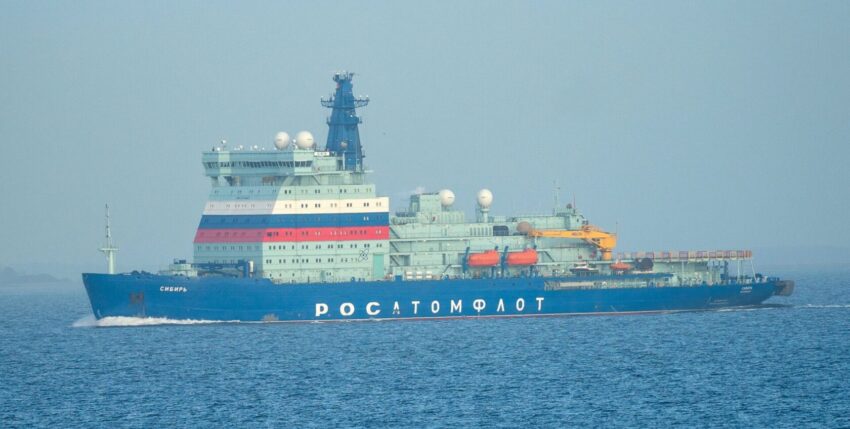
The severe icing of the Gulf of Finland in the winter of 2025/26 is forcing Russia to deploy an unusual force: the nuclear-powered icebreaker „Sibir" (project 22220) and the conventional icebreaker „Murmansk" have been moved from Arctic operating areas to the Baltic Sea. The aim is to keep the approaches to the ports of St. Petersburg, Primorsk, Ust-Luga and Vysotsk open - a sea area that is of key importance for Russian energy and bulk cargo transport during winter operations. The move demonstrates Russia's ability to redistribute high-value maritime capabilities between the Arctic and the Baltic Sea - but at the same time reveals a structural conflict of objectives: what stabilises the Gulf of Finland export corridor simultaneously weakens the icebreaker presence in the Arctic, where economic and military demands on the Northeast Passage remain as high as ever.
Official confirmations and Russian force approaches
According to the state nuclear authority Rosatom, the company is sending the nuclear icebreaker „Sibir" to the Gulf of Finland „at the request of the Ministry of Transport" to provide ice escort services. At the same time, the Russian Ministry of Transport (Mintrans) organised the pre-deployment of the linear icebreaker „Murmansk", which according to the authorities should arrive in the area of operation in mid-February. Mintrans publicly emphasises that the icebreaker's position is „normal", but at the same time admits that the actual ice conditions have exceeded expectations and that the ice thickness could reach 30 to 40 centimetres at the beginning of March.
Another official source is the information letter No. 183/2026 from the „Administration of the Baltic Sea Ports" (under Rosmorretchflot/Mintrans) dated 10 February. It states that four linear icebreakers are currently working in the Gulf of Finland; the arrival of two additional linear icebreakers is expected by the end of February - without mentioning them by name, but consistent with the involvement of „Murmansk" and a nuclear icebreaker.
Current situation (as at 19 February 2026, 08:00 CET)
AIS data from VesselFinder confirms that both icebreakers have arrived in the operational area on schedule. The nuclear icebreaker „Sibir" (IMO 9774422) is located directly off Primorsk, east of Bolshoy-Beryozovy Island in the eastern Gulf of Finland; it is travelling at a speed of 9.4 knots. The target designation „TO ORDERS" is often used by Russian units to disguise their intentions. Due to the high speed, the „Sibir“ may be on the last few kilometres of its journey without ice service. The last documented port is Pevek (Chukchi Sea), which she left on 4 January - the march from the Arctic to the Baltic thus took around six weeks.
The diesel-electric icebreaker „Murmansk" (IMO 9658666) is in the western Gulf of Finland, between Helsinki and Tallinn, on an easterly course at a speed of 2.7 knots - a characteristically low speed for icebreaking and escort operations. The destination is St. Petersburg with an arrival time of 19 February, 18:00.
With the arrival of both ships, the reinforcement to six linear icebreakers in the Gulf of Finland announced by Mintrans has been completed - a disposition that has not been expanded in the width and heaviness of the deployed platforms (nuclear heavy icebreaker plus conventional linear icebreaker) since the winter of 2010/11, when the nuclear icebreaker „Vaigach" was also called from Arctic waters into the Baltic Sea.
‚Linear icebreaker‘ (Russian: линейный ледокол) is the Russian technical term for deep-sea icebreakers that are designed for open sea areas and heavy ice - in contrast to harbour/buggy icebreakers, which are only used inside harbours, roadsteads and on river estuaries.
Ice situation in the Gulf of Finland: ice almost everywhere
The latest official ice reports paint a challenging picture for the Gulf of Finland from a maritime perspective. On 18 February, the Baltic Sea Ice Service BSIS reported solid ice of 35-45 cm in the entire area from St. Petersburg to the length of the Krasnaya Gorka lighthouse - a section of around 40 nautical miles that covers the entire inner harbour approach to the Russian metropolis. Zones of very dense ice follow seawards as far as the Estonian coast. This means that there are practically no ice-free areas of water, and fairways in channels have to be kept navigable using icebreakers.
Harbour and traffic restrictions: outgoing and incoming ships
Against this backdrop, the regimes for ice shipping and convoying in the Gulf of Finland are tightening - not only for outbound export traffic, but also for inbound ships. Reports based on Bloomberg put the waiting times at assembly points for icebreaker convoys at five to seven days. Tankers as well as bulk and general cargo ships are affected. Mintrans has expressly advised shipping companies and charterers to take these circumstances into account when planning their schedules - in effect, a signal to the market that the risk for unreinforced or only slightly ice-strengthened tonnage has increased significantly.
In addition to Russia, Finnish and Estonian harbours in the Gulf are also regulated by assistance and ice class restrictions. The BSH ice report specifies minimum requirements (including 2,000 dwt and ice classes IC/IB) for several Finnish harbours in the Gulf of Finland in order for icebreaker assistance to be granted. The Finnish transport authority Väylä points out that such restrictions generally come into force five days after publication, which also directly affects incoming tonnage from EU ports.
Baltic Sea access: open, but with restrictions
The approaches to the Baltic Sea via the Skagerrak, Kattegat, Belt and Sound remain navigable in principle despite winter conditions. The BSH's ice report (Federal Maritime and Hydrographic Agency) reports predominantly new ice or thin ice in bays and sheltered areas for the Belt and Sound. This means that the main shipping lanes between the North Sea and Baltic Sea are not blocked by thick fast ice.
At the same time, shipping authorities are warning that floating navigation signs, lights and marks may be unlit or out of position due to winter conditions. This results in a cumulative risk picture for outbound and inbound large tonnage: clear sea routes in the approaches, but limited navigational aids and increased uncertainties in coastal routes and harbour approaches. Added to this are low water levels in the Baltic Sea, which at times have pushed the water level up to 67 centimetres below the long-term average.
Capabilities: What the relocation reveals about Russian options
The fact that Russia is moving a nuclear-powered deep-sea icebreaker from the Arctic to the Baltic with „Sibir" is initially a pragmatic response to the ice situation - but also shows that these platforms can also be made available outside their primary deployment area if necessary. Project 22220 icebreakers have two RITM-200 reactors and achieve a propulsion power of around 60 MW; this enables them to carry out long-duration operations without fuel logistics and operate in much thicker ice than conventional diesel-electric icebreakers. In the narrow, shallow and high-frequency Gulf of Finland, these reserves are particularly relevant because they can stabilise convoys even when the ice continues to grow thicker and keep channels clear, which is essential for tankers and bulk carriers.
At the same time, capacity limits are becoming virulent. Mintrans estimates a limited number of „linear" and harbour icebreakers for the season in the Baltic region and confirms the need for additional support, which makes waiting times and congestion in the convoy system plausible. Any loss of a large icebreaker would further reduce the room for manoeuvre. In addition, any high-value asset relocated to the Baltic Sea would be missing in the Arctic, where icebreakers are firmly planned for year-round utilisation of the Northeast Passage.
Valuation
Maritime economic. The events in the Gulf of Finland are more than just a marginal phenomenon. They illustrate how strongly extreme winter conditions influence the operational availability of maritime platforms and the robustness of supply and export corridors - on the Russian side, but also on the Western side. While Russia is pulling nuclear icebreakers into the Baltic Sea, other Baltic Sea states are tying up their own icebreaking and auxiliary capacities in an increasingly risky navigational environment.
In the Gulf of Finland, port handling in ice effectively becomes a function of icebreaker availability, convoy timing and ice class regime: just a few additional centimetres of ice thickness trigger escort obligations or entry bans and extend waiting times at convoy assembly points by (several) days. Mintrans explicitly recommends that shipping companies take these circumstances into account when deciding whether to send ships into the Gulf of Finland at all. An operational situation decision has a direct impact on charter scheduling, supply chains and export revenues.
Maritime economic-military. Conversely, the economic importance of the corridor is driving the operational deployment of forces: the relocation of „Sibir" and „Murmansk" primarily serves to maintain the flow of traffic - but in fact it also demonstrates that Russia is willing and able to move Arctic high-value capabilities to the Baltic Sea at short notice if the situation requires it.
In the ice winter, operational safety becomes a direct prerequisite for economic throughput - and economic time pressure in turn forces operational priorities. The 2025/26 winter stress test shows how closely maritime operational and economic logic are intertwined: The relocation of „Sibir“ and „Murmansk“ primarily serves to maintain traffic in the Gulf of Finland - but in fact it also demonstrates that Russia is willing and able to move Arctic high-value capabilities to the Baltic Sea at short notice if the situation requires it.
In their home region, the economic pressure is no less: the Northeast Passage is Moscow's strategic economic project for the coming decades - with growing LNG, oil and ore transports, a government-propagated target of 80-100 million tonnes of annual throughput by 2030 and an increasingly year-round route that does not work without nuclear icebreakers in winter operations. Every nuclear icebreaker that conducts convoys in the Baltic Sea is not available for these transports.
Military. There is also the military dimension: nuclear icebreakers are not just logistics assets in the North Sea, but an integral part of the Russian operational framework in the Arctic - for supply, positioning and potentially also for military convoy security in a NATO threat scenario. NATO has described the icebreaker gap in its own armed forces as a critical capability gap for years; conversely, the fact that Russia now has to reactively pull its Arctic heavy icebreakers into the Baltic Sea shows that Moscow does not have unlimited capacity either and has to weigh up competing priorities.
The relocation of „Sibir" and „Murmansk" to the Gulf of Finland is also a conflict of objectives that has come to light in Russia's maritime strategy. Both ships are now missing in the operational areas for which they were primarily designed and planned: the Arctic Northeast Passage (NSR). In this respect, the ice winter of 2025/26 reveals a structural tension: Russia can shift Arctic high-value capabilities to the Baltic Sea - at the expense of the Arctic. This raises the strategic question of how long Russia can afford to keep them there.
Text: Mergener

 English
  German