










Trump's industry scolding and Hegseth's procurement line
At the beginning of January 2026, US President Donald Trump made his criticism of the defence company Raytheon (RTX) public in a social media post. Presumably less focussed on the individual case and more as a deliberately chosen example of a broader problem he had identified: delivery capability and priorities. The accusation: wrong industrial priorities (shareholder value), too little focus on production capacities, resulting in insufficient delivery performance. This tone is flanked by the line taken by Defence Minister Pete Hegseth, who explicitly classifies procurement as part of military operational capability: Production speed, flexibility and delivery are to become more important than perfected specifications and lengthy process validation. For Europe, this is not just a national-American debate. Because as soon as the USA aligns its armaments logic more strongly to national prioritisation and short-term effects, the risk for allies shifts - away from the written contract situation and towards the real supply chain.
Europe's fleets on the USA's drip
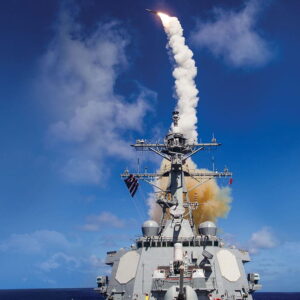
The structural consequences of this development are particularly clear in the maritime sector. For years, European navies have been dependent on American equipment and US-influenced standards in key capability segments - from maritime reconnaissance, launchers and missile systems to sensors, data links and electronic components. These dependencies are not the result of individual decisions, but the expression of a procurement pattern within NATO that has grown over the years. Maritime long-range reconnaissance in several countries is based on the P-8 Poseidon; surface combatants use the Mk-41 launcher as a universal backbone for effectors, while 'strike' options are increasingly linked to the Tomahawk cruise missile. In maritime air defence, too, many fleets remain dependent on US interceptor missiles - and thus tied to US production, modernisation cycles and prioritisation in the event of a crisis. In addition, Link 16 remains the tactical data link standard in many units, which makes NATO-wide interoperability possible, but is linked to a US-dominated armaments network in terms of terminals, crypto-modernisation and release management. And even where systems operate nationally, their precision and synchronisation often depends on PNT services such as GPS: position, navigation, timing and therefore consistent situational awareness are not a convenience function in high-intensity scenarios, but a prerequisite for effectiveness.

There is also another, often underestimated dependency in the area of digital operating and management infrastructure. "Digital independence" is not just a buzzword, as an event in a neighbouring country shows: in 2025, a case was referred to in parliament in France in which Microsoft is said to have temporarily suspended access to cloud mail services of the International Criminal Court in the context of US sanctions - a signal that even services operated in Europe have become de facto influenceable by extraterritorial regimes. In Europe, "break-glass" continuity models are now being discussed in order to maintain operations in the event of a crisis, even if US orders or sanctions restrict cloud services. For maritime armed forces that rely on networked battle management, data links and precise time/position services, digital independence is thus becoming a supplement to traditional defence sovereignty.
F127: Architectural dependency
For programmes such as the future German air defence frigate F127, this has long been more than just a question of technical detail. Several key equipment decisions have already been made: A standardised command and weapon deployment system has been underpinned by the budget, the selection of powerful US sensor technology has been confirmed, and the integration of American systems is also planned for launch systems and missiles. This means that dependency is not just "bought in", it becomes part of the architecture: mission-relevant software versions, interface approvals, weapons integration and the procurement path for effectors are all part of a chain that Europe can only control to a limited extent itself. This is operationally attractive because the ecosystem of battle management, launchers and effectors fits together - but it is strategically tricky as soon as availability can no longer be taken for granted.
Capacity bottlenecks as a driver
The capacity debates in the USA show that this is not just about theory: artillery ammunition is being ramped up, but falls short of the target figure marked as necessary; in the case of Patriot interceptor missiles, the expansion of production is planned over several years; and even with programmes such as the F-35, the recent past has shown how strongly software releases and acceptance processes can influence real availability. For European users, this leads to a sober consequence: it is not only the performance of a system that is decisive, but also its predictable availability over many years - in production, modernisation and munitions logic.
Consequences for Europe's fleets
Trump's Raytheon statement is not an anecdote of frustration. He wants the incentive structure of US defence procurement to change - towards speed and meeting its own needs. Europeans and other customers who have relied on US supply chains would be left behind.

Those who ignore this reality risk high-value platforms whose limiting factor is not the fuselage, radar or tactical concept, but the system chain behind it: Ammunition tracking, spare parts availability, configuration management, certification of new software versions and the authorisation/integration of effectors. The answer to this does not have to be political decoupling, but rather more consistent risk management in procurement. This includes resilient stockpiling concepts, contractually secured subsequent delivery and repair paths, European maintenance and repair capacities as well as ammunition and upgrade planning that prices in realistic production rates. Where alternatives are available - for effectors, sensors or PNT - diversification can cushion dependencies. It seems necessary to treat "resilience" not as a subordinate logistics issue, but as a component of operational capability. It is not the result of soapbox speeches, but of ammunition replenishment, spare parts, certified software versions and the ability to supply and integrate effectors even under pressure. Trump's system reform is forcing European self-sufficiency. This is strategic irreversibility. And something that security policymakers need to internalise and make recognisable.
hum, ajs

 English
  German