

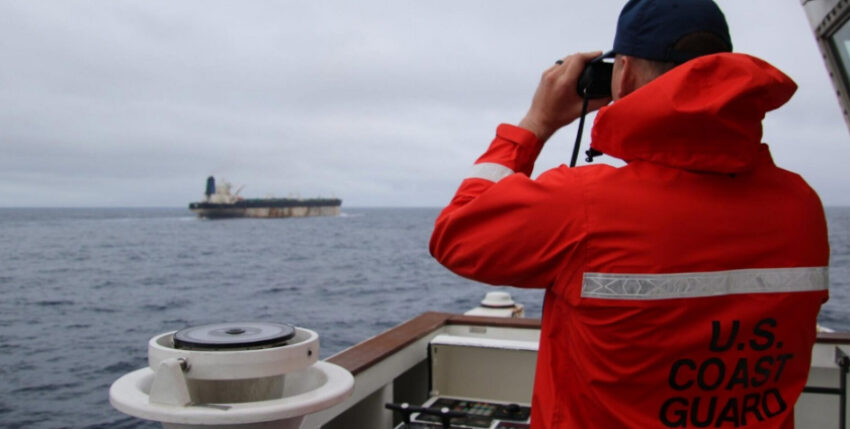





The boarding of the Very Large Crude Carrier tanker "Marinera" (VLCC, ex "Bella 1") in the North Atlantic on 7 January 2026 does not mark a routine case of maritime sanctions enforcement, but a borderline case of international regulatory policy. For the first time, a ship registered under the Russian flag was seized by US forces on the high seas - accompanied by intensive NATO reconnaissance and under the silent observation of Russian naval units. The incident raises fundamental rather than operational questions: The scope of national sanctions regimes, the rights of flag states - and the risks of escalation for the alliance.
Why the "Bella 1" became the "Marinera"
The tanker was not targeted by the US authorities by chance. The "Bella 1" had been part of the growing shadow fleet that facilitates sanctioned crude oil exports from Venezuela, Iran and Russia since 2024. According to findings by Western authorities, the approximately 309,000-dwt ship repeatedly transported crude oil from Venezuelan ports, using non-transparent charter and ownership structures and at times operating without reliable insurance. The ship also appeared in US investigations in connection with supply chains that transported crude oil to Asia via third countries and relied on both Russian and Iranian trading structures.
Against this backdrop, the "Bella 1" was listed by the US sanctions authority Office of Foreign Assets Control (OFAC). When US Coast Guard units attempted to inspect the ship off the Venezuelan coast on 20 and 21 December 2025, it evaded the measure: the AIS signal was temporarily switched off, the course was changed several times and the ship ultimately evaded into international waters. For US authorities, this was a classic pattern of active sanctions evasion.
The decisive step followed a few days later. During the Atlantic crossing, the ship not only changed its name to "Marinera", but was also officially entered into the Russian shipping register on 31 December 2025, with its home port being Sochi. The flag state thus changed from Guyana to Russia - immediately after the US intervention attempts and obviously with the aim of gaining political protection.
From sanction object to political test case
From Washington's point of view, this process crossed a threshold: US lawyers deemed the change of flag during an ongoing pursuit to be inadmissible and declared the ship stateless. Moscow objected, demanded that the pursuit be stopped and spoke of a provocation. The "Marinera" was thus transformed from an object of sanctions into a political test case.
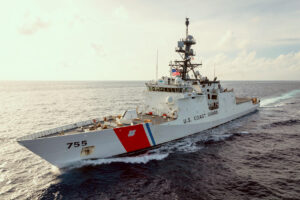
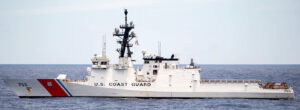
On this basis, Washington launched an interdiction operation in the North Atlantic. The US Coast Guard Cutter "Munro" (Legend class, 127 metres, 4,200 tonnes) formed the operational tip, supported by a broad reconnaissance package. US P-8 Poseidon maritime patrol aircraft, U-2 Dragon Lady high-altitude reconnaissance aircraft and aerial refuelling aircraft operated from the UK. The Royal Air Force participated with RC-135W Rivet Joint SIGINT aircraft and Eurofighter Typhoon jets from RAF Lossiemouth, and Irish maritime reconnaissance aircraft also tracked the tanker's route. Officials commented only briefly on the co-operation.
Russia reacted sharply politically and deployed forces, but did not allow them to intervene directly in the events. OSINT analyses indicate that at least one Russian submarine and several surface units of the Northern Fleet were present in the extended operational area. The raid by specialised forces of the 160th Special Operations Aviation Regiment ("Night Stalkers") from the US Coast Guard Cutter "Munro" itself proceeded without incident.
International law grey area with potential for escalation
Regardless of the operational success, the legal core remains controversial. Boarding on the high seas against the declared will of the flag state is in a grey area, even if sanctions are enforced. The US approach of declaring the change of flag null and void and deriving statelessness from this is by no means uncontroversial under international law.
Access to a Russian-registered ship can be interpreted by Moscow as an attack on its own interests at any time. Even if Russia did not react in the "Marinera" case, the precedent remains. Should a pattern establish itself in which shadow flotilla ships specifically claim Russian protection and Western forces nevertheless intervene, the question shifts from law enforcement to alliance policy. In the most extreme case, NATO would be faced with the question of whether such a confrontation could be considered relevant to the security of the Alliance - including the discussion about Article 5.
Europe's answer beyond boarding
The case is a warning for Europe. On the one hand, the systematic circumvention of sanctions must not be tolerated. On the other hand, the militarisation of enforcement at sea can lead to an escalation spiral.
The more effective lever is clearly on land. A tanker can operate at sea, but remains dependent on classification, insurance, financing, port state control, bunkering and spare parts. If these interfaces are used consistently, the flag of defence loses its value. It protects against access at sea - not against the economic reality in the harbour.
More than an isolated case
The boarding of the "Marinera" was not an isolated event, but part of a development. Data providers such as Windward have been recording an increase in the reflagging of exposed shadow flotilla ships to Russia for months. This turns opportunistic flag shopping into a strategic defence assertion. This is a serious challenge for the maritime order - not because of a single tanker, but because of the question of how far sanctions can be enforced at sea without opening up new security policy fronts.
hum, ajs



 English
  German