



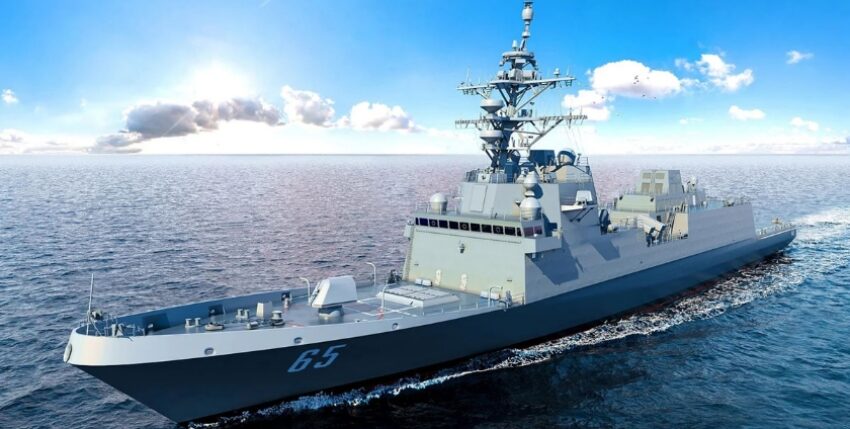






The US Navy has stopped its Constellation-class frigate programme (FFG-62) and terminated the construction of further units in addition to the two ships already under construction. Officially, considerable delays, cost increases and an unresolved degree of maturity of the design are cited as reasons. At the same time, the naval leadership emphasises that the decision is part of a fundamental strategic change of course in fleet construction.
Management and programme errors in the development process
As a multi-purpose platform, the Constellation class was intended to close the gap between the Littoral Combat Ships (LCS) and the large destroyers and take on central tasks such as escort, submarine hunting, air defence and presence operations. The frigate was developed on the basis of the proven FREMM design by Fincantieri, but with extensive adaptations to US systems, sensor technology and battle management.
It was precisely these modifications that proved to be the main problem: construction of the type ship began before the design was completely frozen. Changes during construction led to additional complexity, a weight increase of over ten per cent, construction stops and follow-up costs. The originally planned entry into service date of 2026 was postponed to 2029 at the earliest; the costs for the first unit rose to around USD 1.5 billion. At the start of construction, the cost of the first unit, "USS Constellation", was estimated at USD 1.281 billion, construction number 2 was to cost USD 1.053 billion and construction numbers 3 and 4 USD 1.09 billion each.
Programme cancellation as a strategic decision
Navy Secretary John Phelan described the move as necessary to Regaining the ability to act. In future, ship types that can be built more quickly and are available earlier will be prioritised. A high-ranking representative of the Ministry of Defence emphasised that the discontinuation would create "flexibility to direct shipyard capacities towards future projects instead of committing to a single large ship for years".
The US Navy announced that alternative surface combatants of the Category "Small Surface Combatants" - manned and unmanned navies. The aim is to strengthen the fleet in terms of numbers more quickly and to establish the ability to react in separate maritime situations.
The decision follows a presentation by Defence Minister Hegseth on 7 November 2025 to representatives of the defence industry and Pentagon acquisition managers. With a comprehensive reform of the procurement processes, "Transforming the Warfighting Acquisition System to Accelerate Fielding of Capabilities", the focus is to be consistently on "speed to delivery" in future: Speed, less bureaucracy, greater flexibility and market/competitive logic instead of lengthy, cumbersome planning and approval processes.

More mass, less complexity
With the end of the Constellation class, the pressure on the US Navy's fleet planning concept is growing. The frigates were intended to be an essential component of the quantitative dynamics of the Chinese PLAN in the western Pacific. Between 2022 and 2025, the PLAN ran annually in the high single-digit to low double-digit range new larger surface ships - modern destroyers, frigates, amphibious carriers and individual large combat ships. This series production creates regionally concentrated presence and deployment options in the run-up to a possible Taiwan conflict.
The US Navy, on the other hand, must fulfil global commitments and spread its forces across the Atlantic, Mediterranean, Arctic and Pacific. A fleet that relies too heavily on a few highly complex units will lose Operational elasticity. The course we have now embarked on therefore focuses more on Mass, availability and sensor networkingsupplemented by unmanned systems.
Impact on Europe
The decision has a strategic dimension for Europe. If the US Navy's ability to maintain a presence and deterrence in several sea areas simultaneously decreases, the likelihood that Washington will concentrate its forces in the Indo-Pacific in the event of a crisis increases. Europe must expect that Transatlantic maritime safety guarantees can no longer be guaranteed as a matter of course - especially in the North Atlantic, the Arctic and the Mediterranean - in the front yard of European navies.
German reference
The cancellation of the programme also has an impact on German investments: Rolls-Royce mtu four diesel-electric generator sets of the type 20V 4000 M53B deliver. The contract was awarded in 2021 and confirmed in 2023, but the planned scope has been cancelled. Fincantieri Marinette Marine remains an industrial partner for future programmes, but is expected to receive orders in the area of amphibious platforms and unmanned surface units.

 English
  German