

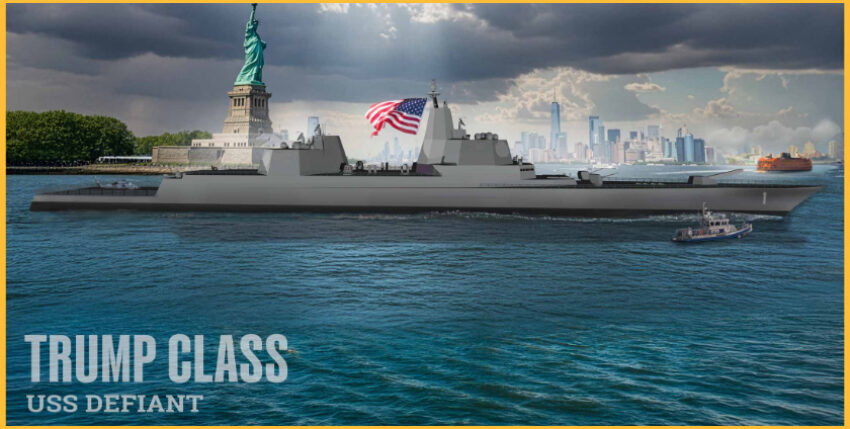







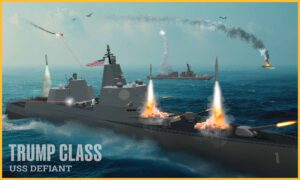
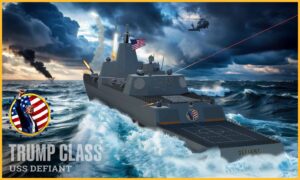
On 21 December 2025, the US government announced the introduction of a new class of large surface combatants in a press release on navy.mil: the "Trump Class". One day later, in a speech at Mar-a-Lago, President Donald Trump presented the battleship "USS Defiant" (BBG-1) as the type ship of a series of 10-25 units and the centrepiece of a "Golden Fleet" - a rather political narrative that emphasises visible strength without yet presenting a coherent fleet concept. The aim: to restore visible maritime superiority over China and Russia.
Battleship concept
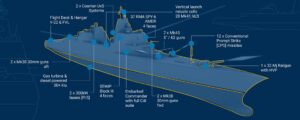
According to US figures, the Trump class is said to have a displacement of around 30,000 to 40,000 tonnes with a length of 260 metres and a crew of up to 850 - significantly larger than the Arleigh Burke class and close to the size of the Iowa class battleships (270 metres, 46,000 tonnes). However, the dimensions serve less to provide a stable artillery platform for the three turrets, each with three 16-inch calibre (40.6 cm) tubes, as was the case during the Second World War, and more to accommodate extensive sensor technology, command and weapon deployment systems and a very high number of vertical launch cells. Up to 130 VLS are mentioned, supplemented by separate launch modules for hypersonic weapons. These ships will also have conventional 5-inch guns, short-range air defence and new protection systems against unmanned air and underwater threats. The integration of high-energy laser weapons and electromagnetic guns (railguns) is also being examined - technologies whose operational readiness is not yet assured. The Trump class would thus be capable of carrying out both conventional long-range attacks (strike) and long-range security and defence tasks for a carrier or task force. Extended command and control capabilities (C2/C4ISR capabilities) are intended to authorise it as a command platform for mixed manned and unmanned forces. The ship would therefore be regarded as a hub within a networked fleet formation.
The repeatedly mentioned sea-based deployment of nuclear-capable cruise missiles (SLCM-N) from these platforms should be assessed with caution - it would be a departure from the previous US practice of concentrating nuclear deterrence at sea primarily on submarines and keeping surface combatants free of them.
Further data can be found on the matching glossy website: https://www.goldenfleet.navy.mil/
Main armament: 12 x cells Surface Launch Cruise Missile-Nuclear as Conventional Prompt Strike (CPS); 128 x cells Vertical Launch System;
Secondary armament: 1 x railgun (32 megajoules) with High Velocity Projectiles (HVP); 2 x 5-inch cannon with HPV ammunition; 2 x laser weapons (300 or 600 kilowatts);
Self-defence: 2 x RAM launchers; 4 x 30mm cannons; 4 x ODIN laser weapons; 2 x Counter-UxS systems.
Timetable and costs
The timetable remains vague. While political statements assume that the first ships will be put into service from the mid-2030s, the project is actually still in an initial concept phase. A first keel laying before the end of the 2020s seems unrealistic given the tense situation in US shipbuilding.
The costs are also open. Estimates from the security policy environment range from five to over ten billion US dollars per unit - depending on the technological requirements and the actual fitting of new systems. In any case, the Trump class will inevitably come into direct competition with ongoing major programmes, including the replacement for the recently halted Constellation class (FFG(X)) - now being continued as FF(X) quasi as an OPV, the Next Generation Destroyer Programme (DDG(X), replacement Ticonderoga class), the construction of the Columbia class (submarines) and the Gerald R. Ford class aircraft carriers.
Classification
Looking at the successes of the US Navy's last construction programmes (overpriced Zumwalt cruisers/destroyers, halted construction of the Constellation frigates, inefficient Littoral Combat Ship, construction delays for submarines and carriers), the US shipbuilding capacities and the Pentagon's planning skills do not reflect well. The presidential announcement of the "USS Trotzig" as the "largest, deadliest and best-looking warship of all time" in a "golden fleet" is one of the unfulfilled maximum promises of the current US administration - in this respect, cautious scepticism is generally required when assessing the feasibility of a Trump class. Trump already found the navy ships "ugly" during his first term of office - now he has thrown a ship design to suit his personal taste into the ring.
Beyond the maritime dimension, the announcement of the Trump class could point to a new strategic component: Although the planned deployment of nuclear-capable weapons on surface ships expands the US options for maritime power projection, it also increases target prioritisation for these platforms in high-intensity conflicts and exacerbates the escalation dynamics in unclear scenarios. Visibility could explicitly be part of a deterrence logic here - with all the associated risks.
The project is ambivalent for European NATO partners. On the one hand, such a platform strengthens the US capability for air defence and defence at unit level and thus also the protection of exposed NATO flanks - unless the focus on the Pacific hemisphere is realigned by the strategy paper anyway. On the other hand, such a resource-intensive programme ties up industrial and financial capacities, with potential effects on cooperation projects and supply chains, such as the German F127 frigate project.
Within the USA, the project has met with a mixed response. Critical voices from security policy think tanks warn of a cost explosion, technological overzealousness and a strategic dead end. Supporters, on the other hand, see the new class as a necessary response to Chinese anti-access/area-denial concepts and the increasing threat to traditional carrier battle groups from long-range precision weapons.
Conclusion
In the end, the Trump class represents less a return of the battleship than a strategic experiment. It bundles military capabilities on a single, 'highly visible' platform - in an environment that is increasingly characterised by the vulnerability of large platforms and the networking of unmanned small combat assets in a swarm. Whether this concept has a credible deterrent effect or merely increases the risk of escalation will not be decided by colourful images and strong announcements. This will be decided exclusively by the interplay of budgetary decisions, industrial realisation and operational sea trials. Above all, however, the upcoming FY2027 defence budget will be the touchstone - what is not substantially included will not be.
As we celebrate Christmas 2025 these days, this is Trump's gift to the maritime world. We are expected to be grateful . . .
hum, ajs

 English
  German
One Response
Planning ships of this size (30,000 - 40,000 tonnes) and in this number (10 - 25 units) is neither militarily sensible nor financially feasible. It is simply megalomaniacal. The name alone (Trump class) is proof of this. Not even one of these ships will ever really be built. That is certain for me.
Originally, 32 ships of the Zumvalt class (14,500 tonnes, i.e. only half the size) were to be built. After three units, the project was cancelled due to unaffordability. (4.4 billion $ per ship). The Arleigh Burke class of less than 10,000 tonnes has been regularly developed further, it is successful and proven. If the Trump administration now simply wants to tackle something new and go beyond the Arleigh Burke, if it is prepared to go the whole hog, then another five or so units of the Zumvalt class could possibly be built in a modified form. This would also keep the construction costs within limits.
However, if ships of the so-called Trump class really were to be built, then for every ten ships decommissioned due to age, at most one new ship would be built to replace it (rough estimate), if at all. Such a drop in numbers would be fatal for the US Navy. And should one of these ships really be lost. The consequences would be unforeseeable.