







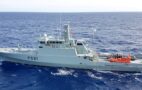


The Baltic Sea is a marginal sea in which both NATO forces and Russia's Baltic Fleet operate. Flotilla Admiral Henning Faltin is responsible for security in the Baltic Sea as commander of the Navy's Operational Flotilla 1. In "Nachgefragt", Faltin explains how the Baltic Sea is being protected during the war in Ukraine.
The Russian invasion of Ukraine has "basically changed everything" for the navy, says Flotilla Admiral Henning Faltin in the last "Nachgefragt" episode before the Christmas break. This starts with the personal attitude of the navy personnel: Before the outbreak of the war, they were practically in training mode, now they see themselves "in operational command, even if we are not at war with Russia."
In addition, all focal points of naval activities in the North and Baltic Seas have been shifted to the eastern Baltic Sea - i.e. towards Russia. "We put so many units to sea within a few days of the Russian attack that we had over 2,000 additional soldiers at sea. We simply showed that this was not acceptable," said the commander of Operational Flotilla 1 to "Nachgefragt" presenter Captain Tim Engemann.
Permanent naval presence in the Baltic Sea
Marginal seas such as the Baltic Sea are shallow, narrow and often close to coasts, says Faltin. This harbours risks: both sea mines and enemy land and air forces could threaten civilian and military shipping traffic. "When they operate in marginal seas, they need a high degree of assertiveness, i.e. self-protection." This is another reason why the German Navy always works with partners and allies, emphasises the flotilla admiral. "We need the others, the others need us - and we all need the Americans to make that clear." Together, they ensure that there are always enough ships and submarines patrolling the Baltic Sea: "Firstly, of course, there are the permanent NATO task forces. There are ship formations and there are naval mine warfare units that are always deployed there. And, of course, we also have the maritime reconnaissance aircraft for maritime surveillance."
Better protection of critical infrastructures
Nevertheless, the blowing up of the undersea Nordstream gas pipelines in September could not be prevented. What's more, the attack on the critical infrastructure initially went unnoticed. It is still not clear who blew up the pipelines. Such an attack was simply not expected, admits Faltin: "Until recently, it was beyond imagination that these explosions would happen on Nordstream 1 and 2."
The navy is endeavouring to improve the protection of gas pipelines and data cables on the seabed. For example, a start has been made on inspecting all critical infrastructure in German territorial waters. "We are looking to see if there are any anomalies. And I expect that this will become a new task for us." However, it is also generally very difficult to prevent such attacks, according to the flotilla admiral. "You have to have a very good picture of the situation. And even then, it will probably be difficult or even impossible to establish 100 per cent security."
Russian forces on the Baltic Sea remain strong
Even after the setbacks in Ukraine and the Black Sea, the flotilla admiral points out that there has been no significant weakening of the Russian armed forces in the region. "Russia has naval forces near Kaliningrad and St Petersburg that we take very seriously." The Baltic fleet is capable of reconnoitring the entire eastern Baltic Sea and attacking it with long-range missiles. The Russian air forces in the region and missile positions on land must also be taken into account.
So far, however, the Russian forces in the Baltic Sea region have behaved relatively calmly, says Faltin. "Behaviour there is largely at the normal level that we saw before the war." He can rule out the possibility of a submarine suddenly appearing off the German coast: "We have too good a picture of the situation, and we also have too good sensors. We would know that beforehand and we wouldn't let it happen."

 English
  German