
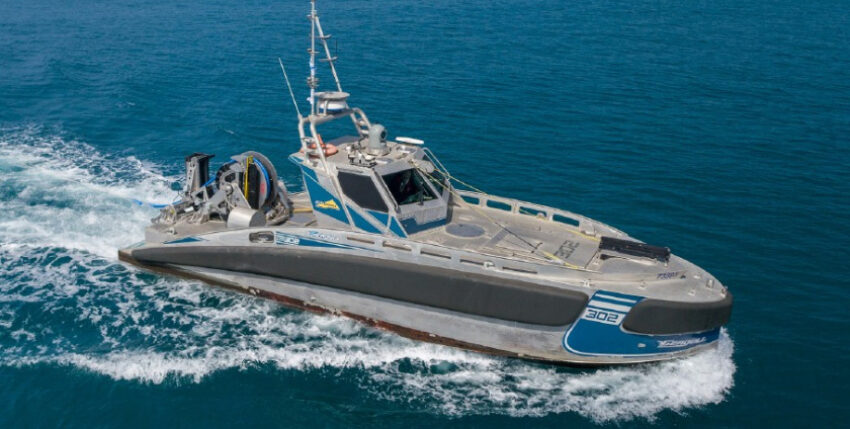





The unmanned surface drone (USV) Seagull is to receive significantly enhanced capabilities in the future. This was announced by Elbit Systems during a press trip with German journalists in Israel. 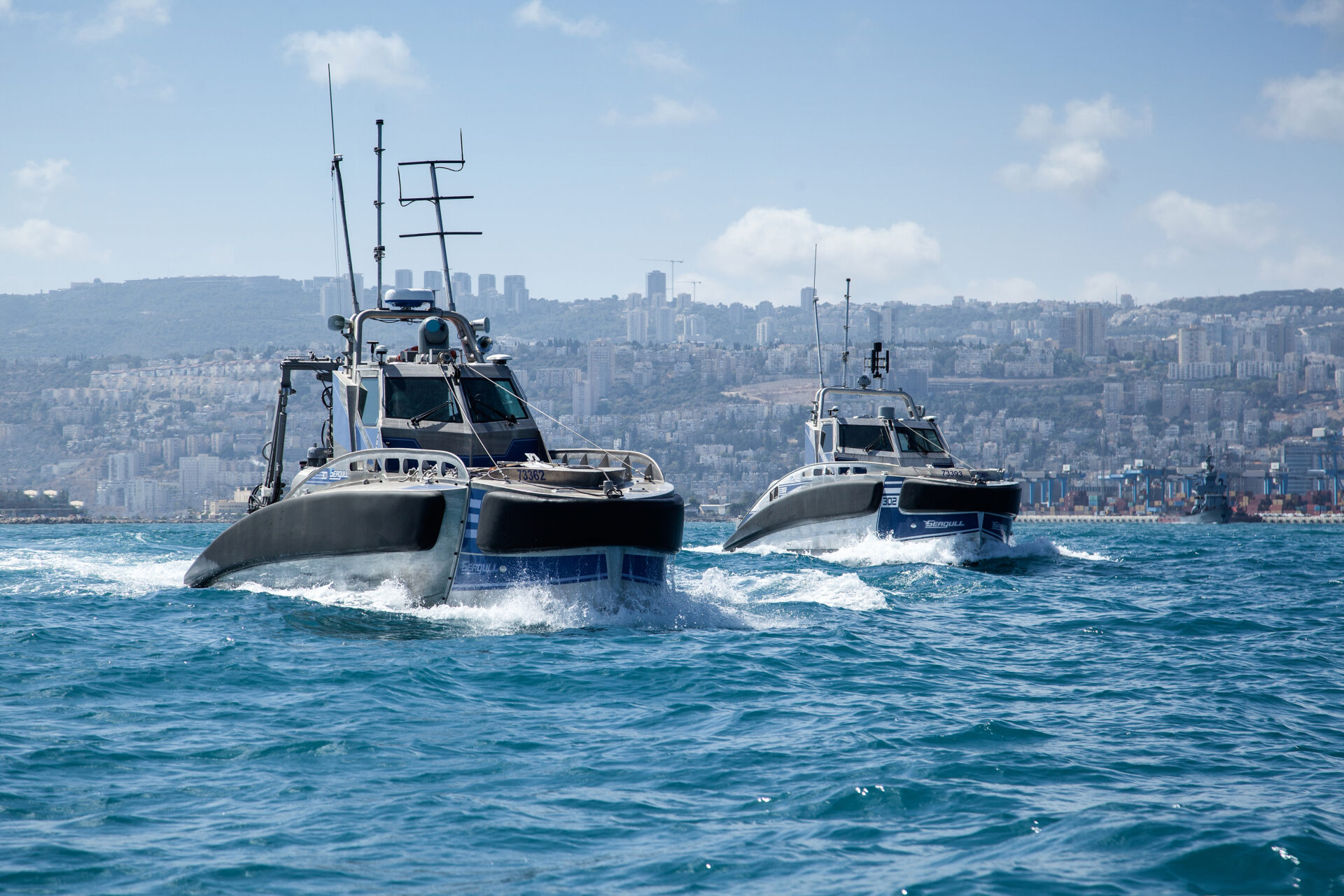
Photo: Elbit
The Seagull is a twelve-metre-long, highly mobile and air-transportable system that can be deployed either independently or from a mother ship. It reaches the deployment site fully autonomously and behaves like a conventional watercraft. Equipped with two diesel engines, the USV can carry out surveillance and reconnaissance tasks for more than four days. In addition, various weapons can be deployed, including a remote-controlled weapon station, a torpedo launching system, anti-diving equipment and non-lethal weapons.
The Seagull can be equipped with different sonar systems - such as hull, towed or submersible sonar - to detect foreign objects under water. These objects can then be cleared by a second system using a detonator. A data link with a range of up to 20 nautical miles is available for communication; at greater distances, transmission takes place via Satcom. Two USVs can be controlled by a single mission control system. In 2022, the full and unmanned use of the system was successfully demonstrated during an exercise in the North Sea under difficult conditions.
Further development
The new version, the Seagull MK3, will be 20 metres long and have a displacement of up to 35 tonnes. Up to 25 tonnes are planned for fuel and payload; there will be space on deck for a standardised 20-foot Iso container. The operational endurance will increase to around seven to ten days, and the system can be used in sea states up to force five (seastate 5 - wave height 2.5 to 4 metres, corresponding to wind forces from Beaufort 5 to 6 "fresh breeze" to "strong wind").
Unmanned systems
The guiding principle "Every unit a drone carrier" reflects the future direction of the German Navy. A key objective is to systematically and consistently expand unmanned capabilities. Projects such as the Future Combat Surface Systems (FCSS), Large Remote Multi-purpose Vessels (LRMV), Large Uncrewed Underwater Vehicles (LUUV) and VTOL-UAVs (Vertical Take-Off and Landing Unmanned Aerial Vehicles) are at the centre of this development. The use of such unmanned systems is intended to significantly increase the navy's effectiveness - a realisation that was drawn in particular from the lessons of the Ukraine war. In the coming years, it can be assumed that the navy will not grow primarily through the procurement of new manned combat vessels. Instead, the focus will be on integrating flexible and, in some cases, autonomous unmanned systems into the fleet. To this end, the navy has already carried out several OPEXs - both with surface and underwater drones. Such trials are also planned for this year.

 English
  German