






Inspector of the Navy
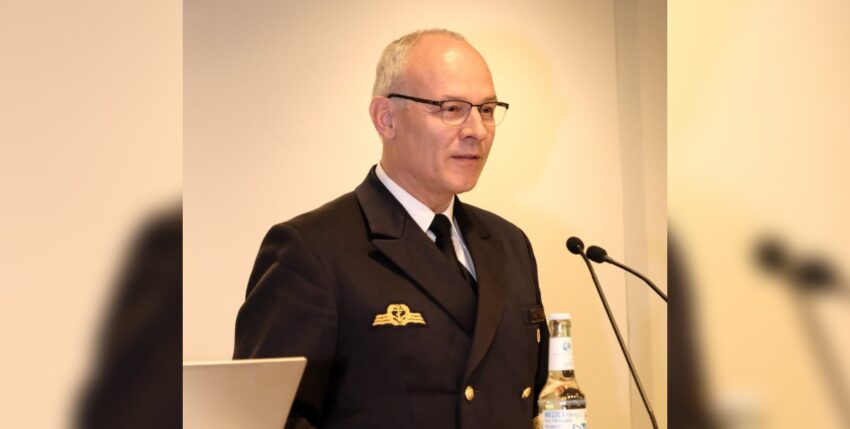
Vice Admiral Jan Christian Kaack
Maritime Convention 22
The German Navy's requirement for a national security strategy
Berlin, 08 November 2022
Dear State Secretary Gerken,
Dear Mr Wenzel, State Secretary,
Dear Admiral Schneider - dear Carsten, dear Mr Schulte!
Thank you very much for having me here this evening at the embassy of the most beautiful federal state in the world.
But it really is about time, because the last time was five years ago.
I am therefore delighted to be able to enjoy your great hospitality once again after my involuntary absence.
Ladies and gentlemen
I very much welcome the fact that we are giving space to the topic of "National Security Strategy" in this forum. For me, this is a real passion topic. Why?
Because I have been intensively involved in this topic for 16 years and because I have experienced the power that a good strategy can unleash in a nation.
During my studies at the US Naval War College in Newport, Rhode Island, I had the opportunity to work intensively on strategy development:
Analyse national strategies, develop your own, derive a force strategy and force structures from this. Clear and comprehensible.
I was then able to experience that strategy development doesn't just work in theory when we created our maritime umbrella document GEMEINSAM.MEER.VERANTWORTUNG. 2016, which we were not allowed to publish alongside the WEISSBUCH at the time... A missed opportunity for me.
Ladies and gentlemen,
But why have a national security strategy at all? It worked well for a long time without....
I still remember very well the visit of the then head of the Federal Chancellery, Thomas de Maizière, to the Bundeswehr Command and Staff College in 2008. That was shortly after I had returned from the USA.
At the time, de Maiziere's answer to a question from a course participant as to whether he would also consider the lack of a German national security strategy to be a deficit was quite surprising.
From the government's point of view, he believes, it would not be so uncharming not to have a national security strategy. It would not be so easy to be pinned down to one position - both in terms of domestic and foreign policy. This creates more independence, flexibility and you are also less predictable.
Ladies and gentlemen,
As you can imagine, this statement caused a certain amount of murmuring in the Moltkesaal and was the subject of much discussion afterwards.
Still under the impression of reunification and the wars in Iraq and Afghanistan, Germany was still searching for its role in the world.
Ladies and gentlemen, that can no longer apply today in 2022.
We are experiencing a war in Europe and global attacks on the values we stand for - Germany must take a stand. Whether we want to or not.
I see for myself every day in the cooperation with our partners - especially in the Baltic Sea - that we are expected to position ourselves and lead. And if you want to lead, you need a compass and a nautical chart - in other words, a comprehensible strategy.
And that is why, in my view, it is not only right but also urgent to develop a national strategy.
I very much welcomed the announcement in the coalition agreement and have been following developments with interest ever since.
Our Minister rightly speaks of a strategy from a single mould, across departmental boundaries, and has used the term "integrated security".
This also corresponds to my idea and addresses the need to consider all "instruments of national power" on an equal footing.
A security strategy can therefore only unfold if diplomacy, information space or strategic communication, the military and the economy (and science) are concerted. In other words, the famous "comprehensive approach".
And we have considerable potential for improvement here. We often still think far too small in our "stovepipes" - the military is even usually left out of the equation. The turnaround has not yet arrived in people's minds.
We are currently experiencing this in the sea dimension!
Ladies and gentlemen!
Let me briefly summarise my expectations of the new National Security Strategy. I would like to preface this with the inscription on the medieval city gate of the old Hanseatic city of Lübeck, which I still consider to be meaningful for the challenges of our time:
CONCORDIA DOMI - FORIS PAX / Harmony in the house - peace outside the gate
Unity in the home For me, this means bringing all the painful issues that have been discussed intensively in this forum over many years to an amicable, harmonious and effective solution:
Are the processes and responsibilities that we have given ourselves still up to date? Are they geared towards the goal of state and social resilience?
We have all learnt that internal and external security are becoming increasingly blurred and that the concept of security needs to be defined more broadly.
Of course, this also and especially affects - as the Foreign Minister put it - the "competences between the Bundeswehr and national security authorities, between the federal government and the federal states".
Who does what in peace, crisis and conflict? How do we work together in the individual phases? How do we organise the transition?
What do, for example, fisheries protection, customs or the Waterways and Shipping Administration do in the transition from crisis to conflict?
How do we avoid redundancies and duplication of security measures with the aim of creating more effective monitoring, protection and defence mechanisms?
Are we prepared - if necessary - to prioritise security rooms at home?
Are we prepared to organise responsibilities transnationally (e.g. European coastguard)?
Allow me to cite the latest developments in the underwater sector as an example. For years, the German Navy has been warning of the vulnerability of critical maritime infrastructure - unfortunately largely unheeded.
A few weeks ago, however, even the last person realised how vulnerable this infrastructure is and what a massive impact its destruction - in the midst of peace - can have on the cohesion of societies.
We can turn off the gas at the bottom of the sea, cut off countries from external electricity supplies and exclude them from information.
We know that Russia not only systematically monitors our critical underwater infrastructure, but also has the means to target it.
So how do we organise our measures in such a way that, at least in our national areas of responsibility, we effectively locate task, competence and responsibility?
For me, a new era also means thinking "out of the box".
We must therefore continue to work consistently on the sensitive interfaces between external and internal security, which are enshrined in the constitution.
There's no question that this is a big board.
Peace at the gate for me means making it clear what we stand for - and where.
Desmond Tutu: "If you are neutral in situations of injustice, you have chosen the side of the oppressor."
Ultimately, it's about taking a stand for the security of our freedom - worldwide. And that's why we can't be indifferent to what happens in the South China Sea or the Arctic, or how the situation develops in the Indian Ocean or the Gulf of Guinea.
Ladies and gentlemen, our view as a navy must not be limited to the Baltic and North Sea or the northern flank. We must position ourselves as "regionally rooted, but globally committed" in order to fulfil this requirement.
That is why, in addition to national and alliance defence, we are also focusing on the security of global trade routes with potential bottlenecks and participation in international crisis management. Given the diversity of tasks and limited resources, I very much welcome it when the Federal Government positions itself clearly so that we can plan and prioritise forces and capabilities.
We must be honest and constantly remind ourselves of our responsibility for Germany, our value partners and the alliance.
Consistent action ultimately also increases reliability for our alliance and value partners. Be it in the context of a Regional Maritime Headquarters, a possible German underwater data fusion centre, Indo-Pacific deployment or Alliance defence in the North Atlantic.
And finally - and this brings us back to the beginning - the national security strategy must be a sufficient umbrella document to enable the derivations for the dimensions according to goals, ways and means.
It is therefore right to formulate high expectations for this strategy. The course must now be set and as concretely as possible, without producing a "motherhood and applepie" paper under the motto: "good for all and harm to none".
Thank you.

 English
  German