










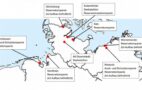

The navy is on course: 2025, no more ten years for many new builds, but with a pragmatic focus on what can be done quickly and innovative solutions to rapidly increase the efficiency and effectiveness of what is already available. Because only those warships, submarines, aircraft and trained personnel that can be produced quickly or are available before the start of a war will also be available during it - and visibly contribute to deterring an attack.
However, both the war in Ukraine, which has been going on for over three years, and the logic of nuclear deterrence indicate that war in Europe will not be over quickly in the 21st century either. Just as Since Ukraine's supporters have been holding back out of concern about Russia's nuclear escalation, it is unlikely that the EU and NATO would pursue a rapid military victory over Russia with any vigour, even if the defence against a conventional attack were to be successful in the short term. An essential part of the credible threat against the aggressor is therefore based on the ability to hold out longer than the aggressor.
This perseverance, however, boils down to a competition between the warlike performance of society and the economy - and that depends on the sea. Over 90% of global trade takes place by sea. If war and a war economy were to break out, the continental peninsula of Europe would not only be dependent on military supplies, but also on imports of energy, raw materials and other goods - not just to defend itself, but to survive. And maritime trade is not just about statistics, but about ships - ships that can depart and arrive, be loaded and unloaded and reach their destinations safely. It is therefore not enough to consider the protection of these sea routes only at their point of arrival. What Europe needs to be successful on day 30, day 200 or day 1,000 of a war must also be secured at distant locations.
Maritime security and naval power are essential in order to cope well with the pre-war or not-yet-war phase of global power-political tensions and hybrid threats - and not to lose power or invite further escalation before it even begins. EU member states are already losing economic potential because offshore wind projects are being abandoned due to uncertainty about hybrid threats, a lack of defence capability and price increases in supply chains. International trade is also becoming more and more power-based - so it will play a significant role whose aircraft carrier groups can operate undisturbed off which coast when it comes to strategic raw material supplies.
In times of geopolitical logic, sea power is once again paying for itself: the fleet used to protect trade, but today it enables much more far-reaching economic utilisation of the sea. Without effective protection, opportunities for the sustainable use of the ocean, energy sovereignty and economic success lie dormant.
Just as shipping and geopolitics are inextricably linked, the navy is also a central instrument of the overall strategy - always with a global horizon. Without permanently secured access to the world via the sea, Europe is not in a position to compete in power politics - and is definitely not fit for war beyond the first few weeks of a major conflict.
For decades, Germany - at times even as the third largest shipping nation in the world - relied on its allies to protect its global maritime interests. But this is increasingly being called into question. Europe can only become a geopolitical player if it becomes a maritime power - and it can only do both if Germany goes full steam ahead.
Dr Moritz Brake is a Senior Fellow at the Center for Advanced Security, Strategic and Integration Studies at the University of Bonn and founder of the companies Nexmaris and Atalantica.
Moritz Brake

 English
  German
2 responses
The article emphasises the necessity of an efficient navy for the economic and geopolitical stability of Germany and Europe. The dependence on maritime trade for survival and defence capability in a potential conflict is rightly emphasised.
In this context, the German Navy's current and planned armaments projects are of crucial importance, but also raise questions. The F127 class frigate is currently in the planning phase and is expected to play a central role as a future air defence carrier. However, it should be noted that the full combat capability of these platforms will probably only be achieved with the introduction of the "Large Remote Missile Vessels" (LRMV). As far as I know, these largely unmanned units will act as "external weapon carriers" for the frigates and significantly increase their air defence and other capabilities.
According to current plans in the PDF "Kurs Marine 2025", the procurement of three LRMVs is planned, which are to operate together with the new F127 frigates. However, recent reports indicate that the number of F127 class frigates could be increased from the original six to eight. A corresponding adjustment to the number of LRMVs does not appear to have been taken into account in these considerations to date. This could lead to a capability gap, as the original ratio of 1 to 2 is no longer maintained.
In addition to the conceptual issues with the F127, there are also considerable difficulties with another important project, the F126 class frigate. According to reports, IT problems at the Dutch general contractor shipyard are causing massive delays. There is talk of a possible delay of up to 48 months (hopefully less), which could postpone the commissioning of the first ship to 2032 or later.
In summary, it can be said that although the navy is on the right course by recognising the importance of maritime security, the implementation of the necessary modernisation steps is associated with considerable hurdles. The delays with the F126 and the inconsistencies in the planning of the F127 and the associated LRMV show that the path to a "war-ready" fleet, as called for in the article, is still long and very sea mine-heavy.
The article emphasises the necessity of an efficient navy for the economic and geopolitical stability of Germany and Europe. The dependence on maritime trade for survival and defence capability in a potential conflict is rightly emphasised.
In this context, the German Navy's current and planned armaments projects are of crucial importance, but also raise questions. The F127 class frigate is currently in the planning phase and is expected to play a central role as a future air defence carrier. However, it should be noted that the full combat capability of these platforms will probably only be achieved with the introduction of the "Large Remote Missile Vessels" (LRMV). As far as I know, these largely unmanned units will act as "external weapon carriers" for the frigates and significantly increase their air defence and other capabilities.
According to current plans in the PDF "Kurs Marine 2025", the procurement of three LRMVs is planned, which are to operate together with the new F127 frigates. However, recent reports indicate that the number of F127 class frigates could be increased from the original six to eight. A corresponding adjustment to the number of LRMVs does not appear to have been taken into account in these considerations to date. This could lead to a capability gap, as the original ratio of 1 to 2 is no longer maintained.
In addition to the conceptual issues with the F127, there are also considerable difficulties with another important project, the F126 class frigate. According to reports, IT problems at the Dutch general contractor shipyard are causing massive delays. There is talk of a possible delay of up to 48 months (hopefully less), which could postpone the commissioning of the first ship to 2032 or later.
In summary, it can be said that although the navy is on the right course by recognising the importance of maritime security, the implementation of the necessary modernisation steps is associated with considerable hurdles. The delays with the F126 and the inconsistencies in the planning of the F127 and the associated LRMV show that the path to a "war-ready" fleet, as called for in the article, is still long and very sea mine-heavy.