








The public interest in the deployment of the German Navy is considerable. It doesn't just seem to be about the Iran war or high energy prices; the questions to our editorial team and vibrating telephones after the publication of the explanatory piece testify to an honest, objective interest in the deployment options that was not always known.
The inspector's appearance before the press
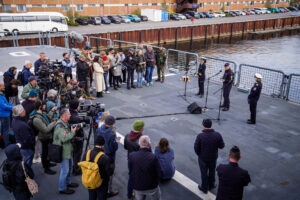
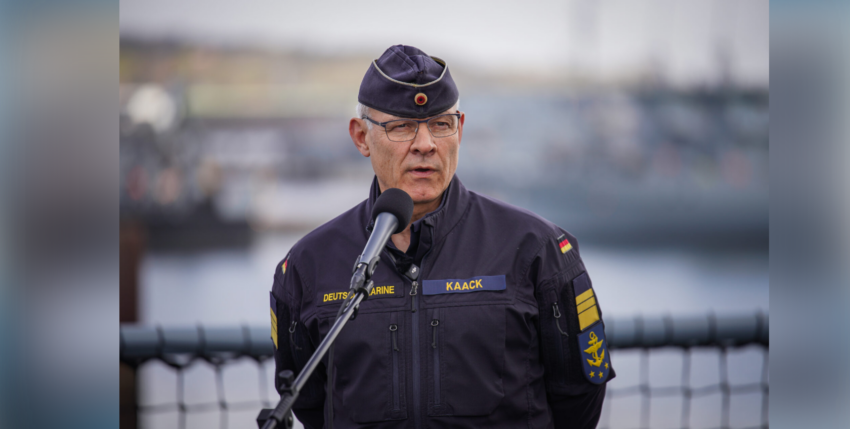
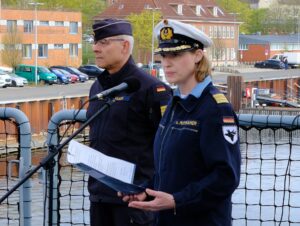
Vice Admiral Jan C. Kaack, Inspector of the German Navy, had apparently also realised this and decided to go public. On Thursday 23 April, he invited members of the press to Kiel to explain the situation of the German Navy and its mine countermeasures capabilities against the backdrop of current expectations of Germany. The reason for the trip to Kiel is that the 3rd Mine Countermeasures Squadron is based there, which has the required capabilities for a possible deployment in the Persian Gulf. The commander of the 3rd Minesweeper Squadron, Frigate Captain Inka von Puttkamer, gave a comprehensive presentation of the unit's operational capabilities to the 40 or so journalists.
In his speech on board the tender „Donau“, Jan Kaack once again emphasised the current threats to Germany and Europe, not only in the Baltic Sea, but in the entire North Flank region. The inspector never tires of citing acts of sabotage, hybrid threats and the shadow fleet as evidence that we are being „tested“ - as he calls it.
And this is putting a huge strain on the navy's order book. The „smallest fleet of all time“ is working at the limit with its men and women. This means that a deployment of the German Navy in the Persian Gulf forces them to prioritise. When asked what was not being done for this, he referred to the deployment in the Aegean, which would then be given less priority. In addition, it could be assumed that a unit would have to be temporarily withdrawn from a NATO organisation. As a further option for a German contribution, he was asked about the possible deployment of the new P-8A Poseidon maritime patrol aircraft, three of which have already completed their first flights for the navy. He did not rule this out, but also hinted at „other possibilities“ for reconnaissance.
Pre-stationing to save time
He said openly that „of course“ preparations are already underway, because „the military always has a plan“ in order to be able to react immediately when a mandate is issued. This concerns logistics, material and, above all, personnel; these three points are „always an issue“. He also made it clear that Germany could not undertake such an endeavour alone, but only in cooperation with allies. Furthermore, a decision - as well as a mandate - has not yet been made. However, this still means that the intention is to deploy in advance in order to be „in front of the Suez“ when the order comes. A time-saving "forward deployment" utilises the flexibility of naval forces as its strength. If the deployment order does not materialise, they would turn back. Politicians now seem to have understood this principle - which was not always the case.
Confident presentation of skills
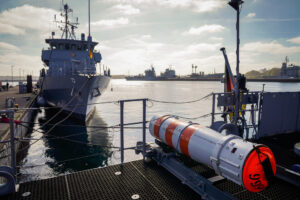
The commander of the unit, who described her unit as the „eye of the navy under water“, also referred to the high operational load. When asked about the unit's operational capability, she explained the principle of „three units“. She rejected criticism of the capability due to the age of the boats, which are now over thirty years old, because despite their age, the hulls of the ten remaining „Frankenthal class“ boats, which are made of non-magnetic steel, are impeccable. However, she conceded that the systems permanently scaffolded on board were getting on in years and that replacements were needed. However, a refit of the sonar systems will have to wait until the beginning of 2027. The units „that should have been built 15 years ago“ are now missing. Particularly noteworthy is the fact that a ceasefire for the exercise of mine defence needed. Under constant threat from drones and missiles, reasonable mine sweeping would be out of the question, because „just as a destroyer cannot clear mines, a minesweeper cannot fend off such threats“.
All participants accepted the invitation to join the minehunting boat „Sulzbach-Rosenberg“. There, they were welcomed by experts who candidly explained the capabilities of the mine defence technology. The equipment on display has been modernised and new equipment is being added, including containers and modular equipment.
What was presented
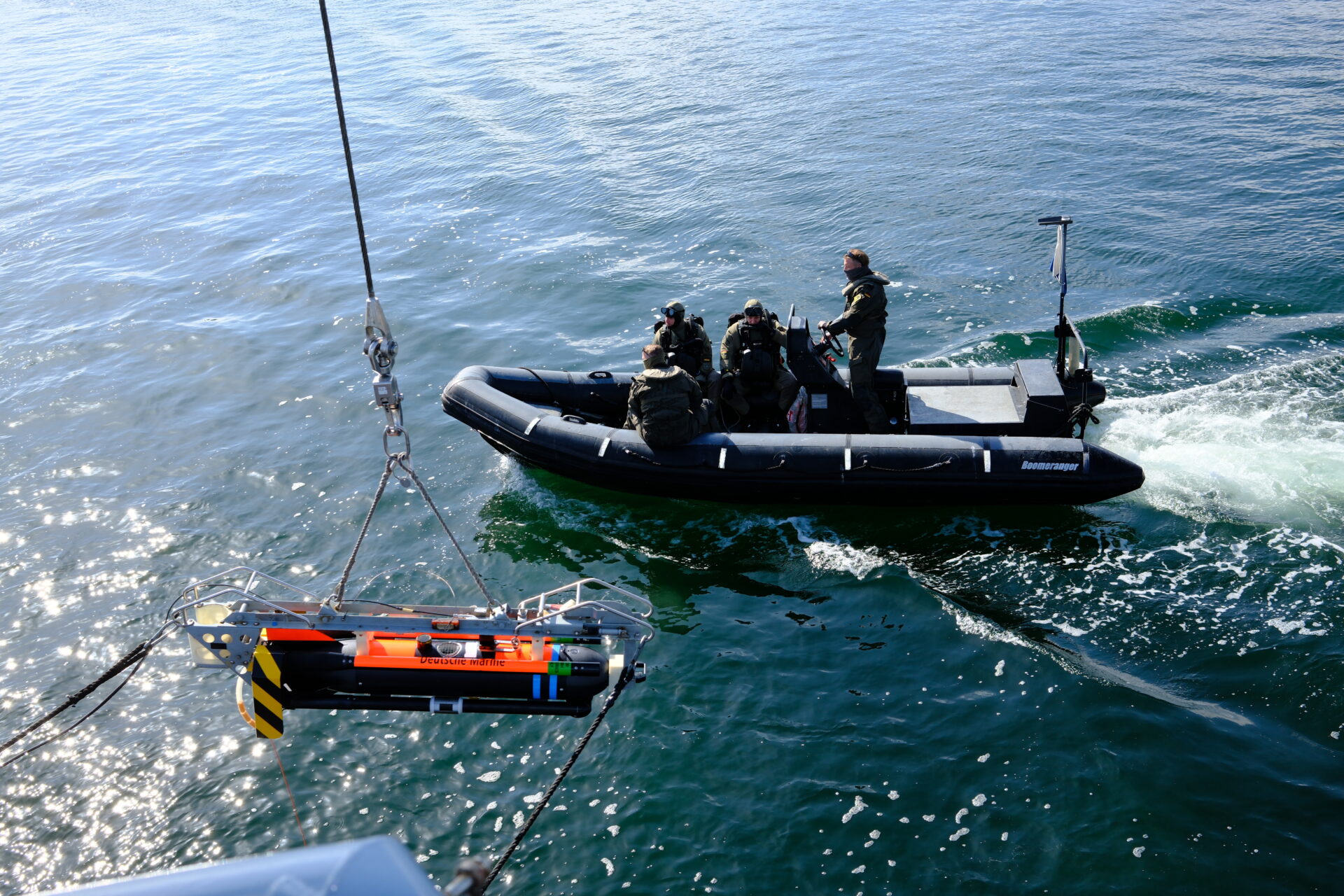
Some of what we have is older, but it is perfectly suitable. From the 1970s onwards, the German Navy used remote-controlled systems for destroying sea mines. These („PAP 104“, later „Pinguin“) were organically connected to the minesweeper. Those days are over, today the „Sea fox“, which can be used flexibly in two versions. In the „Combat version“, it destroys the detected mine with a shaped charge as a disposable weapon.
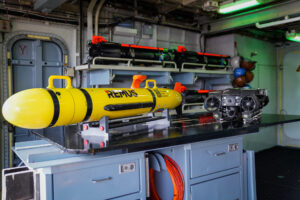
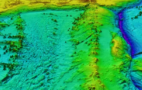
The unmanned underwater vehicles „REMUS 100“ UUV's, which Huntington Ingalls Industries supplied to the German Navy, have an endurance of up to 12 hours for seabed surveys. The German Navy acquired „REMUS“ after extensive testing by the Federal Office of Defence Technology and Procurement. For years, these UUVs have been used for area searches, debris field mapping and topographical seabed mapping in water depths of up to 100 metres. They have a side-scan sonar and can be used efficiently in areas with poor visibility (see https://marineforum.online/einsatzgruppe-unbemannte-systeme-entschieden-in-die-zukunft/).
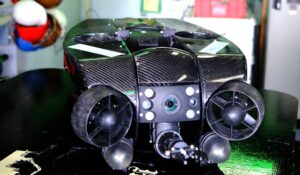
For operations in harbours and around boats, ROVs from the company Deep Trekker are used. These are hand-operated, smaller, commercially available devices with sonar, video and thermal imaging cameras.
The Hollow remote control rod type seal is a 20-metre, 100-tonne remote-controlled minesweeper that generates magnetic and acoustic signals that are very similar to the profile of a ship and thus trigger the sea mines. Introduced as the „Troika“ system, it has been used successfully since the early 1980s. 18 units were built, 12 of which are still in operation. It has the advantage of detonating the mines by simulation without endangering the boat and crew. However, it is only 9 knots slow, has to be "piggybacked" into the clearance area by chartered special ships and is controlled from a minesweeper - it cannot be used without this hollow-barrelled control centre.
Furthermore, the Mine diver with a rescue inflatable boat. A company commander explained their work as underwater explosive ordnance disposal divers to the journalists. Although the mine divers need a platform at sea, this does not necessarily have to be a minesweeper.
It has not yet been decided which weapons will be used or what resources will be provided by Germany in cooperation with allies. These questions will be answered by political decisions. However, the planning, which is intended to show politicians all possible options, is in full swing.
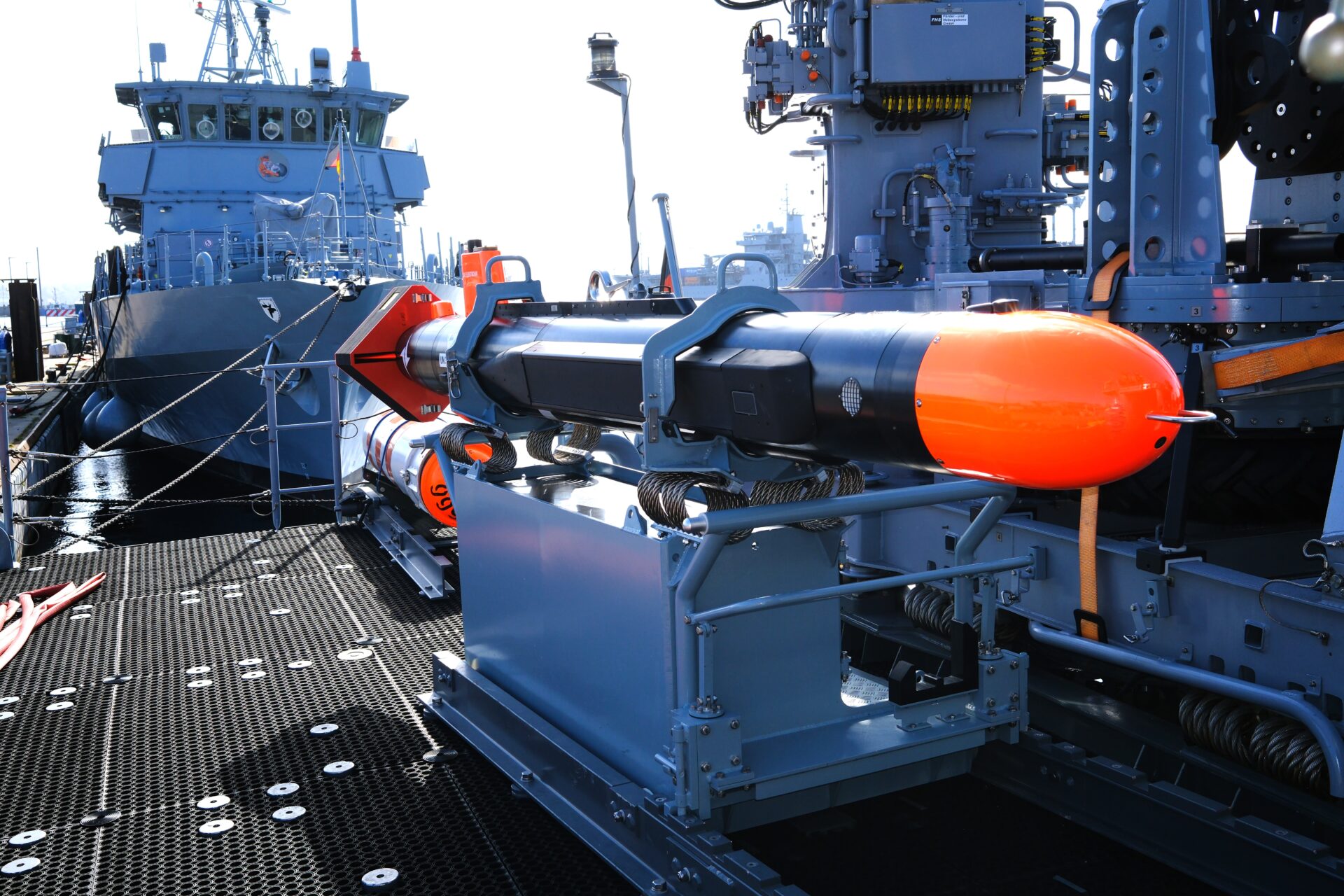
Part of the future of the German Navy's mine defence could already be seen on board: The „SeaCat“ from the company Atlas Elektronik. The drones use high-resolution sonar to create a comprehensive underwater image at depths of up to 300 metres and achieve three times the area search performance of a minehunting boat without the use of drones. This is made possible by data processing during the mission. The devices are in the process of being introduced, but have not yet been finalised.
What can the units in the region expect?
The crews have to be prepared for a devouring enemy - the heat. This was the experience of the operation in the Persian Gulf in 1990/91, when the „Minenabwehrverband Südflanke“ was one of the very first foreign missions of the Bundeswehr. Operational experience is also documented, although it is over 30 years old, but it is still a good guide: mine hunting was not as successful as the „Seehunde“ - and mine divers were indispensable. Why is that so? Frigate Captain von Puttkamer made it clear that the sea area was different from the Baltic Sea - for which our units were designed.
Like the Baltic Sea, the Gulf is a marginal sea with very limited access. But the more southerly climate zone with significantly higher temperatures causes strong evaporation of the surface water, which leads to an increased mineral content of the remaining water. As a result, the heavy, salty water sinks and seeks its way out of the Persian Gulf near the bottom into normally salty water in the Gulf of Oman. As a result, „fresh“ water flows back into the Gulf near the surface. In the Strait of Hormuz, in addition to the tidal currents, this results in differently flowing, clearly stratified water masses - in at the top and out at the bottom. However, water stratification with differing salinity or temperature also means that underwater sensors become inaccurate in signal processing and distort the image. Successfully clearing mines in such a sea area depends on the skilful use of all means and on the training, experience and prudence of divers and operators.
Plan - prepare - do. We will report back.
Text: Schlüter/Stephenson

 English
  German
One Response
And here, too, the editorial team has once again produced an excellent „explanatory piece“. Objective and based on facts and experience. Where else do you find that in the media landscape today?