









Cautious summary of the maritime aspects of the USA/Israel-Iran war a fortnight after the start of operations „Epic Fury“(USA)/„Rising Lion“(ISR)
(as at 13 March 2026).
This analysis is based on a combined evaluation of government reports (CENTCOM, Ministry of Defence (London), Ministère des Armées (Paris) as well as data from international think tanks (Bruegel, CSIS, IISS, ISPK, RUSI, SIPRI) and media reports (Bloomberg, France 24, NYT, Xinhua, Al Jazeera) as well as international shipping institutes (UKMTO, JMIC) and primary data from publicly available media worldwide. The position data of maritime units was updated by comparing official fleet movements, AIS data snippets and OSINT analyses. The overview makes no claim to completeness - the position distribution and composition of the forces remains flexible and can change within a short period of time.
Current situation
A fortnight after the start of hostilities, the „fog of war“ of conjecture, untruths and unconfirmed reports is clearing a little - a clearer picture is emerging of the overall activities and the state of the warring parties.
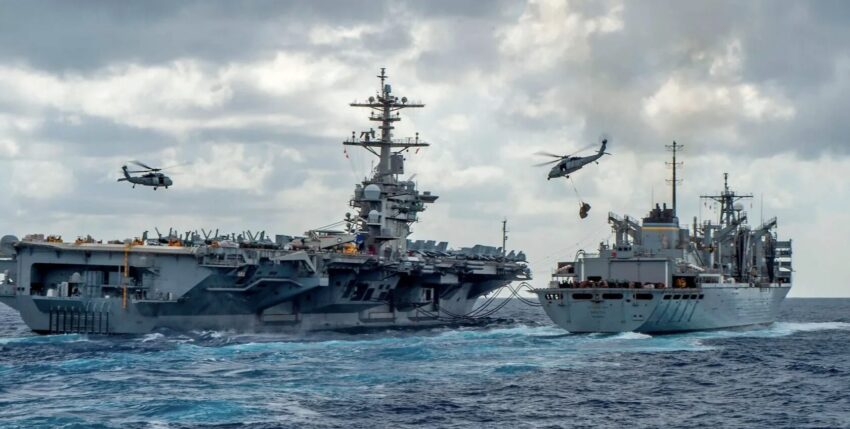
On American side, two carrier groups have (Carrier Strike Group - CSG) in the Arabian Sea and initially also in the eastern Mediterranean; a third carrier group is heading for the eastern Mediterranean, taking the place previously occupied by the Ford group, which has moved south to the Red Sea. The US Navy's forces are thus positioned in a strategic triangle.
France deploys a strong carrier group (Groupe Aeronaval - GAN) into the Red Sea, while Italy a carrier group (Expeditionary Task Force - ETF) to protect the NATO/EU southern flank in the Mediterranean and the Turkey with the drone carrier returning from the Baltic Sea and other national units, is protecting its own interests in the north-eastern Mediterranean. Other nations participate ship by ship - only Great Britain can only send a (single) destroyer towards its own base on Cyprus and put one of its two carriers on standby after a considerable delay. Europe's north keeps its forces on standby at the site - in anticipation of asymmetrical opportunity actions.
Iran's maritime capabilities have been reduced to a residual stock of missile-armed speedboats by firing on the coastal infrastructure (radar, launching pads, submarine bunkers) and sinking all larger and now also smaller units and platforms of the regular navy (Artesh) and the Revolutionary Guards (IRGC), as well as by eliminating the leadership ranks. These remaining small naval assets in unknown numbers as well as bunkered batteries on land do not rule out uncoordinated „pinprick options“ and still pose a real residual threat to shipping traffic in the entire area. Two Iranian ships (IRIS "Lavan", small Hengam-class drone carrier, and IRIS "Bushehr", Bandar Abbas-class supply ship) were interned in Indian/Srilankan harbours during the redeployment of Indian Fleet Review. There is no need to list the Iranian losses.
To the west of the Persian Gulf theatre of war, a picture of relative military stabilisation and simultaneous expansion into all adjacent maritime areas is emerging. While the direct kinetic strikes against Iran's naval infrastructure and coastal positions are decreasing („Squeezing Iran from the Sea“), the focus of the operations is shifting to the military security and political containment of the maritime areas from the eastern Mediterranean to the Strait of Hormuz with the aim of making this strait navigable again for the transport of energy and raw materials, which is extremely important for the global economy.
Maritime situation USA/ISR (as at 12 March 2026)
Gulf of Oman/North Arabian Sea: Lincoln Carrier Group (CSG 3), sea control, air strikes against Iran; consisting of USS "Abraham Lincoln" (CVN 72) and the four Arleigh Burke destroyers USS "Frank E Petersen Jr." (DDG 121), USS "Spruance" (DDG 111), USS "McFaul" (DDG 74), USS "Pinckney" (DDG 91); plus deep-sea protection Arabian Sea/Indian Ocean: USS "Charlotte" (SSN 766) (Los Angeles class) and USS "Minnesota" (SSN 783) (Virginia class).
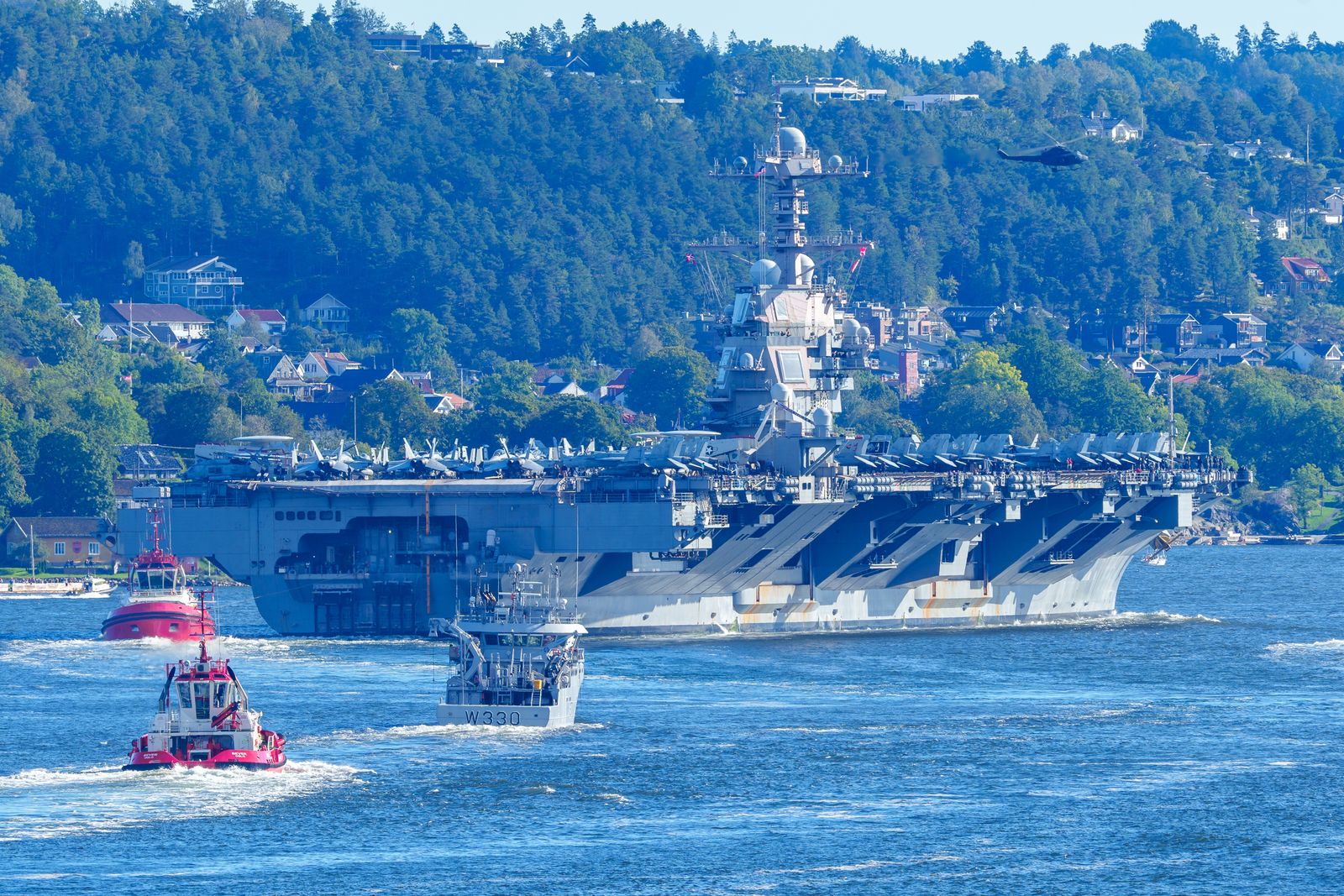
Red Sea: Ford carrier group (CSG 12), after passage of Suez Canal (05/03/2016) Sea and airspace control eastern Mediterranean up to Bab-al-Mandeb including support for Israel, securing exit from Suez Canal and containment of Houthi militias; consisting of USS "Gerald R. Ford" (CVN 78) and the three Arleigh Burke destroyers USS "Bainbridge" (DDG 96), USS "Mahan" (DDG 72) and USS "Churchill" (DDG 81).
Inbound Eastern Mediterranean: Bush Carrier Group (CSG 10), passage of Gibraltar, then (from 15 March) sea and airspace control in the eastern Mediterranean to secure Cyprus, the entrance to the Suez Canal and support for Israel; consisting of USS "George H W Bush" (CVN 77) and the four Arleigh Burke destroyers USS "Gonzalez" (DDG 66), USS "Mason" (DDG 87), USS "Ross" (DDG 71), USS "Donald Cook" (DDG 75), as well as the Spanish frigate „Blas de Lezo“ (F 103) (F100, Alvaro de Bazan class).
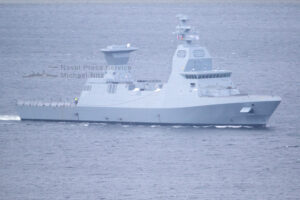
As part of the Operation RISING LION is located INS "Stomach" (Sa'ar 6 class) to secure the gas fields in the Israeli coastal apron.
Associations/units not involved in the war
Transit Red Sea: FRA: de Gaulle carrier group (GAN), passage Suez Canal securing Red Sea/Bab-al-Mandeb and preparation tanker escort in the Strait of Hormuz; consisting of "Charles de Gaulle" (R 91) and AD frigate „Chevalier Paul“ (D 656) (FDA Horizon class), ASW frigate „Alsace“ (D 621) (FREMM Aquitaine class), supply ship „Jacques Chervalier“ (A 725), attack submarine „Suffren“ (S 635) (SNA Barracuda class), the Italian AD frigate „Andrea Doria“ (D 553) (FDA Orrizonte class), the Dutch AD frigate „HNLMS Evertsen“ (F 805) (LCF De Zeven Provinciën).
Central Mediterranean: ITA: Cavour carrier group (ETF), consisting of „Cavour“ (CVH 550, on standby in Taranto) and other units, including „Trieste“ (L 9890) (LHD, flagship of an Amphibious Task Group (ATG)) and the frigate „Federico Martinengo“ (F 596) (FREMM Bergamini-class). Possibly also the Spanish frigate „Cristóbal Colón“ (F 105) (F100 class) with the task of air defence/protection of Cyprus and the French LHD „Mistral“ in the EVAC ops/hospital role.
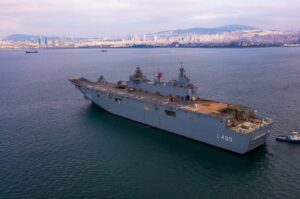
Eastern Mediterranean: TUR: Anadolu Drone Carriers Association, consisting of TCG "Anadolu" (L 400) and other national units for missile/drone defence of Turkey, which is at risk from Azerbaijan to Cyprus due to Iran's „horizontal escalation“.
Portsmouth/UK: GBR: Aircraft carrier „Prince of Wales (R 09) on 5-day standby (so far without departure order) and destroyer „Dragon“ (D 35) (Daring class, Type 45) departing 16.03.26 for Cyprus.
Ongoing NATO/EU/UN operations in the area
NATO Operation SEA GUARDIAN„Gaziantep“ (F 490) (Gabya class), Turkey, eastern Mediterranean.
EUNAVFOR ASPIDES: Destroyer „Caio Duilio“ (D 554) (Orizzonte class), Italy, south Red Sea.
EUNAVFOR SOMALIA/ATALANTAFrigate „Canarias“ (F 86) (Santa María class), Spain, Indian Ocean/Gulf of Aden.
UNIFILFrigate „Nordrhein-Westfalen“ (F 223) (F125 class), Germany, station Beirut.
Securing the Strait of Hormuz
As unclear as the findings on bunkered storage locations are, the inventory overviews of Iranian sea mines are just as uncertain: military sources assume that there were initially over 2,000 to 6,000 sea mines of various technological levels - Iranian forces should therefore still have a very relevant arsenal. Many of these types could be transported across the Persian Gulf in small, difficult-to-detect boats, each loaded with less than a handful of mines. Since it is impossible to estimate from here how many boats and ammunition stocks are actually still operational, the potential threat cannot be dismissed out of hand. It would be possible to limit this uncertainty by gaining control of the numerous islands off the coast of Iran and a rapid-response, land-based surveillance of a large part of the Iranian coastline. But we are not there yet!
For this reason, the US Navy has so far taken the view that regular escorts are „currently not possible“ under the current threat situation from mines, missiles, drones and speedboats. However, information from the Pentagon and the US Navy indicates that a Hormuz Surface Action Group (SAG) prepared for „Operation Epic Escort“ (working title?) as an escort for maritime traffic in the strait, consisting of USS Carney (DDG 64) as lead ship, The Arleigh Burke destroyers USS Mitscher (DDG 57) and USS "Michael Murphy" (DDG 112), as well as the littoral combat ships USS Tulsa (LCS 16) and USS Canberra (LCS 30) (Independence class) for mine defence. However, these units are not yet in the sea area and must first be deployed!
Rocket maths and cost trap
Figures in a military conflict are difficult because they are only ever generated from one perspective and are constantly changing. Nevertheless, some figures are worth noting and should therefore be mentioned here - but they stand alone and without guarantee.
Offensive potential IRN: Six days after the launch, Iran only had around 70 to 100 operational systems (JINSA - Jewish Institute for National Security of America) out of an original total of around 400 launchers (early March).
For the first ten days of the war, the Turkish daily Yeni Şafak recorded a total of 3,100 Iranian missile and UAV attacks on seven Arab states in an infographic. For 10 March (11th day), the UAE reported 262 ballistic missiles and 1,475 drones (range unknown) since the start of the attacks. Although the figures diverge and are not up-dated, they nevertheless allow the conclusion that Iran could lose its ability to launch significant missile attacks on Israel and the region within a reasonable period of time (about 10 days), while the possibility of limited short-range attacks, especially with drones, against targets in the entire Gulf region will remain for even longer.
Defensive potential USA/ISR: In the first days of the Iran war, the countries of the Middle East have more than 800 Patriot missiles were fired - according to the New York Times on 9 March. Ukraine, on the other hand, has only fired about 600 modern Patriot missiles receive. In 2025, however, its Patriot missiles will only have 620 pieces have been delivered to the nations - and that was already a record level, according to the American newspaper. The double burden - protection of Israel and the Gulf monarchies on the one hand and continued support for Ukraine on the other - is increasingly becoming a substantial challenge in view of limited production capacities for Patriot interceptor missiles. Reuters and Bloomberg also point out that additional delivery commitments to Israel and the Gulf partners are narrowing the available framework for future air defence deliveries to Kiev. However, despite current increases in capacity, subsequent production can only take place with a time delay.
Traffic jams in maritime traffic mean stranded crews
Parallel to the military and economic escalation of the situation, an additional, silent front is opening up in the Gulf: that of the stranded seafarers. In the container segment alone, around 170 ships totalling 450,000 TEU are said to be stuck in or immediately around Hormuz, while around 280 bulk carriers stranded in the Gulf have also been identified. Further analyses at the beginning of March spoke of at least 150 tankers anchored in the Gulf after traffic through Hormuz came to a standstill. This has led to a hitherto little-discussed Humanitarian dimension, which initially focussed in the media on the 15,000 cruise ship passengers stuck in the Gulf. This „traffic jam“ has since dissipated, but there are also around 20,000 seafarers in the Arabian/Persian Gulf, according to the IMO. For the crews, the lay-up means longer deployment times, legal and insurance-related grey areas, psychological stress and increasing risks, for example in the event of maritime emergencies in which evacuation and medical assistance are made more difficult by the military situation.
Summarised
Consequences calculated correctly?
Although the American-Israeli coalition is far superior to Iran in military terms, economically and industrially the protection against Iran's missiles, drones and maritime jamming potential, which have not yet been completely destroyed, is rapidly eating up its own military stocks and financial budgets. The Pentagon estimates the costs of the first six days of the war alone - in which over 800 Patriot missiles were fired - at more than 11 billion US dollars.
According to the NYT, the Trump administration assumed before the war began that potential energy and shipping disruptions would be short-term and manageable. In the meantime, the global impact shows that the existing disruption is proving to be the linchpin of the global economy. And it is clear that Washington has no recognisable short-term plan for the safe reopening of the Strait of Hormuz.
Collateral damage
The war against Iran is developing beyond the military level into a test of political resilience. In the USA the domestic political focus is shifting to war powers, congressional control, approval ratings and economic consequences. In the EU, there is growing pressure to weigh up transatlantic solidarity against its own security, energy and stability interests.
At the same time, a A visible test for the stability of the alliance and the defence industry: NATO and the EU must now maintain their limited stocks of air defence, naval targets and precision munitions for at least two active theatres of war (Ukraine and Iran).
For the Arab states, For the Gulf monarchies in particular, external vulnerability and internal regime stability are becoming fundamental issues. Although they themselves have become the target of Iranian attacks, they are shying away from a perceptible escalation towards Iran due to social tensions, economic risks and limited trust in the Trump administration.
In the Global South the war is intensifying debates about sovereignty, international law and Western double standards. China and Russia are using the situation to stage themselves diplomatically as the antithesis to the West - and not least to make economic gains from the instability. The ASEAN region reacts above all with appeals for de-escalation and compliance with international law in concern for the protection of its own nationals in the crisis region. Australia remains politically in line with the West.
Outlook
The conflict is entering a new phase. The rapid regime change in Iran has not been realised. The neutralisation of Iran's uranium enrichment capacities is not completely assured. However, it appears that a large-scale missile offensive by Iran largely prevented. For its part, Iran is switching to guerrilla warfare at sea. Its needle-like attacks against maritime traffic are aimed at making risks incalculable, driving insurance rates to unaffordable heights and, above all, paralysing the global flow of goods. The „Western powers“ are facing the challenge of an escort and security operation for civilian shipping so that a disruption of the global supply chains at Hormuz does not lead the world economy onto a slippery slope.
Strategically, the situation is more open than the balance of power might suggest at first glance: The sea route through Hormuz remains interrupted, global maritime and energy trade is disrupted, the Gulf states are under pressure and the Western munitions consumption and cost curve continues to rise. At present, there is little to suggest a decisive and timely end, but much to suggest a fatal war of attrition without winners, because it is ongoing and asymmetrical. However, everything may turn out quite differently!
ajs, hsc, hum

 English
  German