





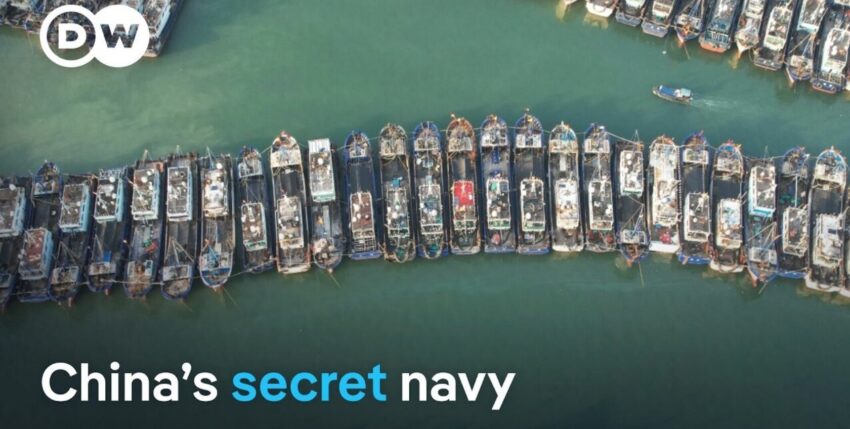




While the presidents of the USA and Israel are fanning the flames in the Middle East, far away in the East China Sea, China is temporarily changing the topography of entire sea areas with its maritime militia consisting of thousands of paramilitary fishing boats. Between Taiwan and Japan - in the middle of the East China Sea (ECS) - the Chinese navy created a 300 nautical mile long north-south line in a kind of „ocean flash mob“ with the help of around 2,000 fairly identical fishing vessels, which could be easily observed from space. On 26 December 2025, 11 January and 3 March 2026, thousands of boats concentrated like a remote-controlled swarm of insects on or near the Sino-Japanese dividing line of the economic zones and formed a precisely drawn line like an impenetrable barrier on the surface of the sea. This „Ocean Wall“ can be seen as an exercise and certainly also as a demonstration of the feasibility of a „large-scale, militarily coordinated operation“.
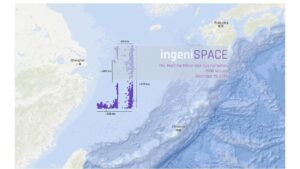
As long as fishing is involved, such behaviour is not illegal under the Japan-China Fisheries Agreement, but the „little blue men“ probably had a very different intention in this semi-military grey zone operation, which has much more to do with Chinese claims to power over Taiwan and the southern foothills of Japan, the Senkaku Islands. Assigned to Japanese administration under international law, China is very keen to claim these five scattered and uninhabited islets and three rocky reefs north-east of Taiwan for itself in order to drive a wedge between Japan and Taiwan and prospectively gain access to the mineral resources. Incidentally, all foreign companies trading in the People's Republic of China are instructed to refer to these islands with the Chinese name „Diaoyu“ in their documentation.
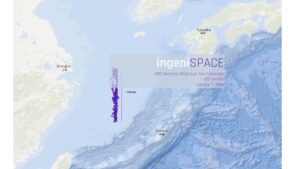
Further south of these islands, the chain of Ryukyu Islands (Okinawa regency) still blocks the Chinese navy's unrestricted access to the open Pacific. A dozen of Japan's more substantial patrol vessels are stationed in the harbour of Ishigaki, the southernmost and largest base of the military Japan Coast Guard. However, as they mostly operate on a single-ship basis in their extensive area of responsibility, confrontations with civilian-marked ships, especially if they appear in large numbers and in a coordinated manner, can lead to critical situations. Such swarms believe that the law of the jungle is on their side and can present a Japanese defence as an armed attack at any time. By reversing the narrative, they are able to deprive the Japanese forces of their legal means of action within their own territory.
However, as the Chinese navy's twin aircraft carrier operation in mid-2025 has shown,
China's expansionist movement certainly extends to the „Second Island Chain“ (Japan - Guam - Papua New Guinea) and beyond. It has shown itself capable of threatening Taiwan from the Pacific side as well. However, in order to be able to carry out such a pincer movement securely, all other maritime access routes to Taiwan must be made impassable for foreign forces in advance - preferably below an escalation threshold (grey zone), cost-effective and available at all times. This is where the Maritime Militia comes into play. What this paramilitary part of the Chinese armed forces is capable of achieving can be seen in the South China Sea over the last ten years. When the larger white ships of the armed China Coast Guard intervene, there is no longer any need for a regular navy within the First Island Chain - the grey navy is already operating outside this island chain.
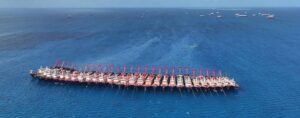
China's unmistakable threatening gesture towards Japan in the last quarter of the year with the maritime flash mobs and its „Ocean Wall“ is a challenge for the entire Western Pacific region - far beyond the „First Island Chain“. And not to be sneezed at either: The Maritime Militia's boats can be quickly upgraded with flying and underwater drones and transmitters to disrupt the electromagnetic spectrum (jamming, GPS spoofing, etc.).
The 10-minute video by Deutsche Welle (English text) deals extensively with the problem.
Houston - we have a problem.
ajs, dw

 English
  German