

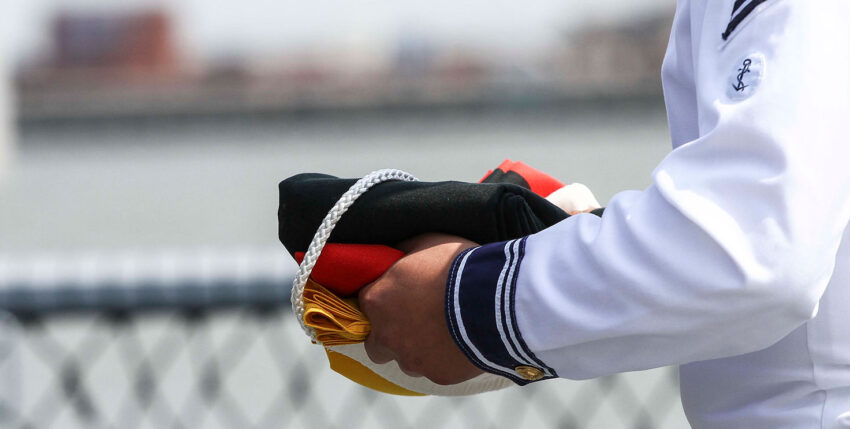






Is there a maritime identity - and if not, should there be one? The navy finds this question easier to answer than others: It flies the flag and pennant, wears linen aft and whistles alongside. Most landlubbers associate the term "maritime identity" with the blue Captain's uniform with colourful shipping company tie at the Captain's Dinner on the dream ship. In the TV report on container ships, the captain can be recognised by his casual jumper over jeans. Perhaps this is a sign of the times in which merchant shipping is focussed on short stops at container terminals. Shipping as a smooth logistics chain. Is there a better image for the contrast between applied modern seafaring and cruises where tradition is just a show?
The comments by freelance journalist Cora Stephan are remarkable in this context:
Heroes?
At least on a ship the man is still a man - we thought, until the unfortunate captain of the Costa Concordia, that milksop, a landlubber as they say in the book. Rat? Well - it's supposed to be the rats that are the first to leave the sinking ship. And the captain is the last to leave. It's all a question of honour, the law of the sea and, in the past anyway, self-interest in securing the Charge. Tempi passati. Francesco Schettino, the captain of the wrecked cruise ship, not exactly the incarnation of a sea dog, had nothing to do with either his honour or his Charge and fled instead of standing his ground. He might have been suitable as a captain of hearts - after all, the man showed feeling! - but not as an example of those proud helmsmen who keep calm on stormy seas and hold their ground to guide those entrusted to them safely into the next harbour. [...]


So the uniform is not just for show after all, at least people on board and ashore expect that there is something behind it or a whole guy is in it! The reason why people fight for the place of honour at the Captain's Dinner is precisely because they believe they can do it with a real captain in the sense of their own classical ideas.
[...] And that's why the captain is the last to disembark - not just for the sake of honour or a precious Charge because of. But because he cannot survive without the trust of his team. And he has to earn it.
The application for today? Well. That's where we falter. In the age of parking aids and navigation for everyone, the nautical-military posturing on board seems rather strange. Why do I need to have confidence in a white-robed dinner companion presiding over the captain's dinner when such a huge vessel depends solely on the finest technology instead of sails, wind, weather and the good Lord? Conversely, is there no longer a need for a disciplined and responsible man (except perhaps in the military)? [...]
And when Ms Stephan calls for myth, history and emotion with meaning behind it in a thoroughly technologised craft, she hits the nail on the head! Who is still familiar with flags and can identify home harbours such as Nassau or Liberia?
Anyone who sees this aspect solely in terms of nostalgia is falling short. If young men and women are to be enthusiastic about seafaring, there must also be an emotional aspect in a world characterised by technology. I can do the engineer somewhere else without getting wet! How could this be achieved?
Cora Stephan: Heroes? Published on 2 February 2012 in Die Welt

 English
  German
One Response
It's nice when people at least still expect seafaring to be something special and to require all human endeavour. I deliberately don't say "the whole guy", because nowadays many tough (is that how you spell it now?) young ladies also venture out to sea. I was even piloted by one the other day.
Nothing against tourist cruises, they can be very nice. But cruises are seen by many as a kind of crossover (hence the word?) between the adventure of travelling by sea and the opposite of adventure, namely the assured luxury of a privileged environment combined with the precisely measured thrill that something could theoretically happen, but you are quite sure that nothing will happen. This is bound to lead to disappointment because it doesn't go together.