

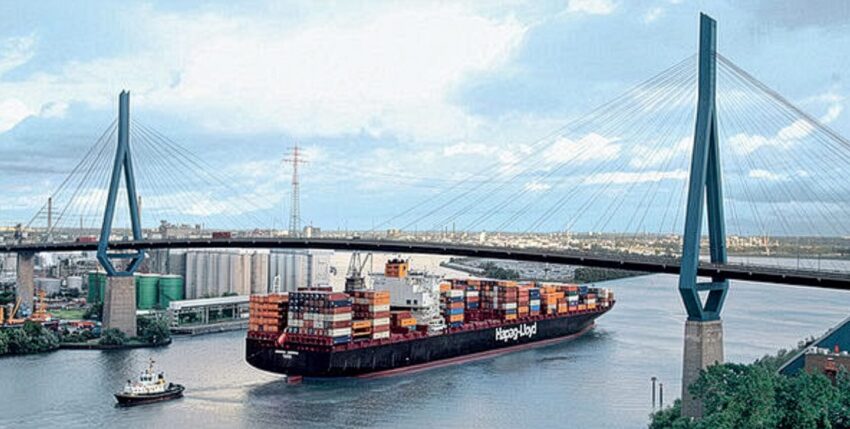










Since May, the Köhlbrand Bridge in the Port of Hamburg has been closed to heavy goods transports over 44 tonnes that require a permit. What initially appears to be a local transport measure extends far beyond the harbour industry of the Hanseatic city. The bridge is one of the most important transport axes in the Port of Hamburg and is a central infrastructure for Germany as an export location.
The impact on port operations is considerable. According to estimates by the port industry, more than 2,500 heavy goods transports will have to be diverted every month in future. Industrial export goods such as construction machinery, agricultural equipment, production facilities and highly specialised industrial components are particularly affected. For companies, this means longer journey times, additional organisational effort and rising costs due to alternative routes. Relief is hoped for from the planned A 26 East motorway as a link between the A 7 and A 1 motorways, but its completion is still delayed. This is due to legal disputes over the route and planning approval after the Federal Administrative Court declared the decision partially unlawful in December 2025. Completion is currently scheduled for 2035.
At the same time, alternative transport solutions by water are being discussed. Concepts such as intra-port ferry connections or special transport barges could relieve some of the pressure on road transport. However, doubts about the economic viability and practicability of such systems have so far prevailed in the port industry.
Around 34,000 vehicles, including around 13,000 lorries, cross the 3.6-kilometre-long cable-stayed bridge, which opened in 1974. Expert reports show that the traffic load has almost doubled since the 1970s and is expected to increase further by 2035. By then, around 38,000 vehicles are expected daily, of which around 43 per cent will be HGVs. A speed limit of 50 km/h was introduced a year ago in order to extend the service life of the structure. According to current tests, however, this is no longer sufficient. The Hamburg Port Authority speaks of a „worrying increase in damage dynamics“ to load-bearing components in the centre section spanning the current as well as increased cracks and material damage to the ramp structures.
This means that the replacement solution for the Köhlbrand crossing once again took centre stage. High costs, difficult subsoil conditions and lengthy approval procedures had repeatedly delayed the project. After a tunnel had been favoured in the meantime, the Hamburg Senate is now backing a new bridge and decided in April 2025 to replace the existing Köhlbrand Bridge. A clearance height of more than 70 metres is planned, making it around 20 metres higher than before. The costs are currently estimated at up to 5.3 billion euros. The new bridge is due to be opened to traffic in 2042, after which the existing structure will be dismantled. Until then, heavy goods vehicles are likely to remain dependent on alternative routes, as the original bridge is not designed for such loads.
The closure of the Köhlbrand Bridge to heavy goods traffic makes one thing clear above all: the condition of central transport infrastructure is increasingly becoming a disadvantage for Germany's industrial and export economy. It is not the technical challenges that are increasingly jeopardising the location, but the political and planning inertia in urgently needed infrastructure projects, including years of planning procedures that are open to legal challenge.
kdk, FAZ, NDR

 English
  German