







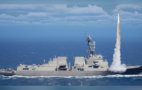
Fleet Service Boat Class 424: Rheinmetall Naval Systems launches ahead of schedule
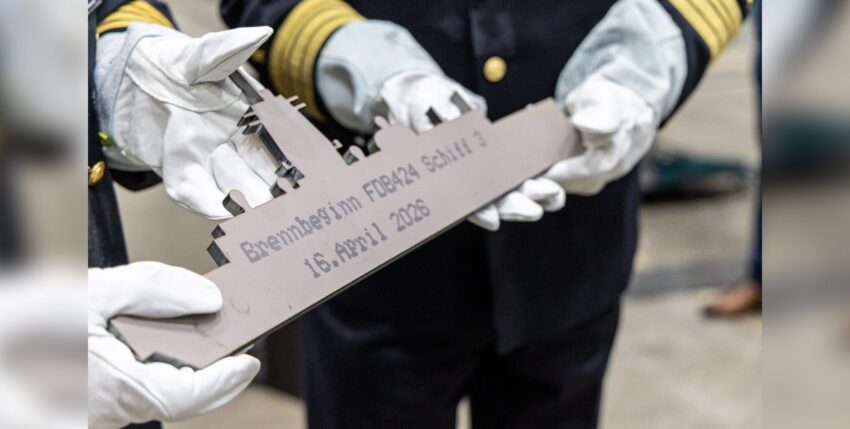
On 16 April, the first steel of the third and final Class 424 fleet service boat was cut at the Peene shipyard in Wolgast together with representatives of the BAAINBw and the German Navy. This means that firing can begin earlier than planned. „The early start of firing, which means that all ships of this class are now under construction, is much more than a technical milestone - it is a strategic signal. In the current security policy situation, which is changing faster than ever before, we are making our contribution as an industrial partner to an accelerated upgrade. Speed is a security-relevant factor today - and this is precisely where we come in,“ said Tim Wagner, CEO of Rheinmetall's Naval Systems division. This is certainly the aspiration of the former NVL, although the delays in the construction of the frigate 126 last year have somewhat favoured this project. This also has something to do with capacity utilisation. In the meantime, however, the schedule is full again and the Wolgast team can be pleased.

The fleet service boats - or FloDiBo's as the staff call them - will be used by both the German Navy and the Cyber and Information Region (CIR). The approximately 130-metre-long fleet service boats will serve the German Armed Forces as reconnaissance platforms for sea-based information gathering. The forecastle is expected to be relocated in 2027 in order to be connected to the aft section at the Lürssen shipyard. The final outfitting is then expected to take place in Hamburg. All of the ships will be launched around 2030 plus.
Back in June 2021, the contract for the procurement of three Fleet service boats of the class 424 with a training and reference system reconnaissance between the BAAINBw and the then NVL B.V. & Co. KG, formerly Fr. Lürssen Werft GmbH & Co. KG, was concluded. With parliamentary approval on 6 July 2023, the project moved from the design phase to the realisation phase. The total contract has a volume of up to 3.26 billion euros.
Fleet service boats the navy has had almost since its foundation. The first units mainly reconnoitred the Warsaw Pact fleets in the Baltic Sea. The current one is the third generation of Fleet service boats of the navy. Their missions are not communicated publicly, they tend to operate covertly, and what exactly they do is only known to security-cleared circles of people. Strict security requirements apply not only to the operation but also to the construction of these ships. Against the backdrop of the current security situation and speculation about sabotage of naval units, this has once again attracted particular attention.
Fleet service boats of the German Navy are specialised units for monitoring sea and coastal areas with electronic, hydro-acoustic and electro-optical sensors (reconnaissance). The new boats, with a length of around 132 metres and a displacement of between 3,500 and 4,000 tonnes, are intended to replace the existing Fleet service boats of the 423 class. The crew of the boats is expected to be 50 people, and the reconnaissance team to be embarked will also be around 50 people. Class 424 is scheduled for delivery between 2029 and 2031 - the training facility will be available to the navy as early as 2027. The boats with their specialised sensors are of central importance for strategic information gathering. This includes intercepting radio traffic, detecting electromagnetic signatures and identifying ships and equipment. This is why these boats were sometimes referred to as "measuring boats" in the past. Their area of operation has shifted from the Baltic Sea to the Mediterranean in recent years.
They are under the operational command of the cyber and information space sub-force and are always managed nationally; these valuable capabilities are never relinquished, not even to NATO partners. However, the results are of great importance to all allies. During the Cold War, for example, the photos taken by the „measuring boats“ of Warsaw Pact units, even in 3D, were a popular „commodity“ among the allies. These ships offer more than just a military picture of the situation in the Baltic Sea, for example; they may also provide an essential basis for decision-making by committees of the German government.
Text: RM/hsc

 English
  German