









The situation in the Persian Gulf remains highly dynamic.
The two-week ceasefire of 8 April 2026 is still in force. This agreement has led to a temporary cessation of direct air strikes between US forces and Iranian units. Nevertheless, the region remains highly volatile. Iran wants to include Lebanon in a further ceasefire. However, Israel and Hezbollah are currently continuing to attack each other. The negotiations between Iran and the USA on 10 April 2026 were unsuccessful. The IRN oil embargo released by the USA ends on 19 April 2026.
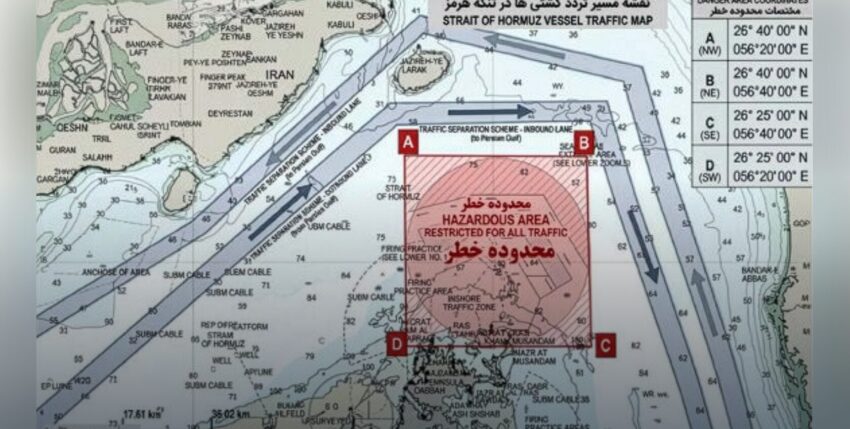
On 13 April 2026, US CCENTCOM issued a Blockade of all Iranian harbours and coastal waters announced from 1400 UTC on the same day. This blockade was established east of the Strait of Hormuz (SoH) in the Gulf of Oman, the Arabian Sea and along Iranian coastal waters. According to the US NAVY, this blockade affects all shipping transiting through the SoH into Iranian coastal waters or to and from Iranian ports. Neutral vessels not calling at Iranian ports will not be affected, but could be searched by US forces. According to various media reports (Deutsche Welle, CNN), US President Trump announced on Sunday 12 April 2026 that the blockade would also affect all ships that have paid a passage fee to Iran.
According to AIS data, this blockade has already been successful in several cases and ships have turned back towards the Persian Gulf after passing the SoH to the east. According to official information from the USA, the blockade of the SoH is also to be used to clear mines. There are reports in the public media that two US NAVY Avenger class mine countermeasure ships have set off for the Strait of Hormuz.
Iran is threatening to blockade the Red Sea (according to the AFP news agency) if the USA continues to deny Iranian ships passage through the Strait of Hormuz, thereby jeopardising them. Iran sees the blockade of the strait as a violation of the ceasefire. AIS and GPS are still available, but have been greatly reduced. The interference is localised to certain key points. Nevertheless, further disruptions must be expected. Since the start of the war, a total of 23 merchant ships have been hit in the Persian Gulf, some of which have suffered severe damage. No ship has been attacked since the last situation on 09.04.2026 However, there was an attack on a bulk carrier on 07.04.2026 that was not previously recorded.
The transit corridor north of the island of Larak remains open from the Iranian side. Transit there takes place exclusively under Iranian control and is currently reserved for ships that either have a direct link to Iran or pay the required „passage fee“ of around 2 million US dollars.
According to AIS data and after consultation with shipping companies, there are around 139 ships with a German connection in the area of interest (see annex), 56 of which are in the Persian Gulf.
The current situation for shipping in the Persian Gulf and the adjacent waters is characterised by a massive threat despite the official ceasefire of 8 April 2026. The additional blockade of the SoH from the east by the US NAVY, which has been active since 13 April 2026, is leading to tensions between the USA and Iran. According to statements by the US President, a payment to Iran is seen as a reason for blocking the onward journey of a ship. Iran and the USA are threatening to use force if their different rules are not adhered to. In addition, the operational risk of technical faults remains high. Even if the massive GPS manipulations in the entire sector have decreased, there is still a risk of renewed interference. It is also assumed that Iran still has sufficient missiles and drones, especially for attacks in the Persian Gulf. The danger to ships remains.
The Houthis in Yemen have announced the resumption of attacks against shipping, but have not yet implemented them. However, they have confirmed that attacks in the Red Sea can be resumed as soon as the Houthis deem them necessary. Iran has also threatened to block the Bab El-Mandeb strait if it is deemed necessary and the blockade of the US SoH remains in place.
Conclusion
The risk situation for ships and crews has reached a complex level. Although the nominal ceasefire offers a deceptive diplomatic respite, the situation remains critical in operational terms due to the entrenched blockade in the Strait of Hormuz. Passage through the strait is now impossible due to the blockades by Iran and the USA. has become de facto impossible.
The risk potential for the Persian Gulf and the neighbouring regions must still be classified as critical overall.
With thanks to Naval Command Department Naval Shipping Management / Situation assessment of 10.04.2026

 English
  German