





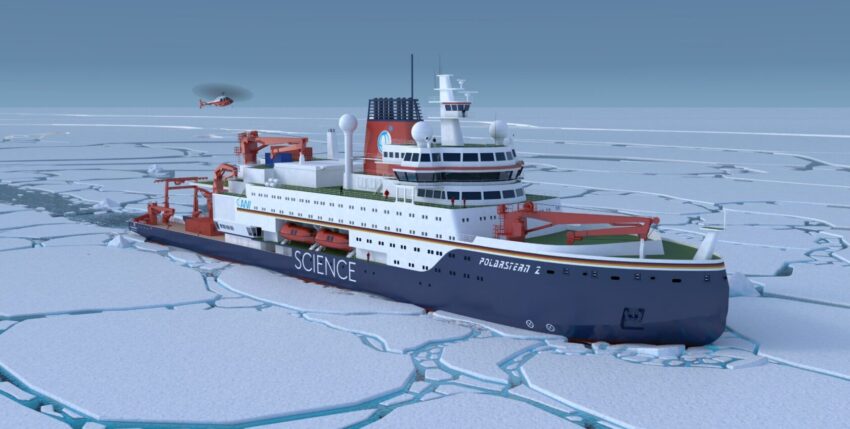






The German research icebreaker, which is being built by TKMS in Wismar for the Alfred Wegener Institute, Helmholtz Centre for Polar and Marine Research (AWI), will be the future flagship of German polar research. Designed for operations in the Arctic and Antarctic, the new „Polarstern“ will enable scientific missions in some of the most remote and challenging environments on Earth. Completion and delivery of the ship is planned for 2030.
Many German companies will be involved in the new high-tech ship. For Thyssenkrupp Marine Systems (TKMS) as the shipyard, the challenge is to select industrial partners for cutting-edge technology. The competition for suppliers of the „Polarstern II“ is underway. The Hamburg-based company OPTONAVAL has now been awarded the contract for a helicopter visual landing aid system (HVLAS). The company will not only manufacture the system, but also provide all lighting systems to ensure safe helicopter operation. Under the environmental conditions in polar regions, the system must function in ice-covered waters, poor visibility and harsh weather conditions. OPTONAVAL is a provider of high-end lighting systems for helicopter operations, navigation lighting and stabilised platforms.
The new „Polarstern II“ will replace the current research vessel „Polarstern“, which has been a legendary cornerstone of international polar science since 1982. Expectations of the successor ship are correspondingly high, not only because of its scientific capabilities, but also in terms of sustainability and efficiency for future climate and polar research. At around 160 metres in length, the ship will be almost 40 metres longer than its predecessor, making it the largest German research vessel. The construction costs for the federal government are estimated at around 1.2 billion euros.
Text: Hansa/Editorial department
Photo: Alfred Wegener Institute/TKMS

 English
  German