








The destroyer „Severomorsk“ causes unrest
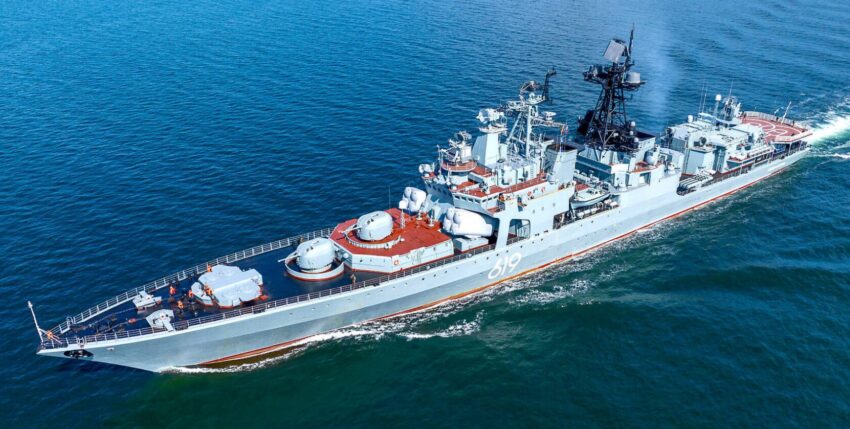
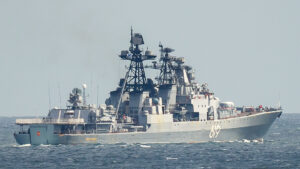
The Russian destroyer „Severomorsk“ (Udaloy I, 1987, 164 metres, 7,500 tonnes) has been moored in the Baltic Sea south-east of the island of Fehmarn since the weekend. Previously, the Buyan M-class missile corvette „Stavropol“ (new build, 74 metres, 950 tonnes) was already there. The corvette had apparently been supplied by the workshop ship "PM-82", which is assigned to the Baltic Fleet, in the first week of May.
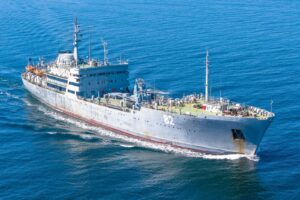
The 122-metre-long Amur-class ship lay in international waters between Fehmarn and the Danish island of Langeland for around four hours together with the corvette. On 2 May, the workshop ship moved through the Great Belt towards the North Sea. According to British media, the "PM-82" is said to have been just outside the Strait of Dover on 5 May 2026, then turned around and re-entered the Baltic Sea via Skagen on 7 May 2026. Open sources report that during the presence of the "PM-82" in the North Sea there was an encounter with the frigate „Admiral Grigorovich“ (type ship, 2026, 125 metres, 4,000 tonnes). Exactly the same sequence of events was observed in the same sea area in mid-April. It appears that the workshop ship serves as a supply platform for units that are at sea for several weeks without being in harbour.
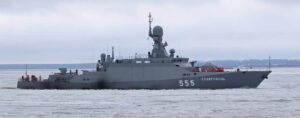
The corvette „Stavropol“, which had only been in service with the Russian navy for nine months, had occupied various positions in the Fehmarn Belt and Mecklenburg Bay for several weeks. She was constantly monitored by an operational vessel of the Federal Maritime Police - most recently the operational vessel „Eschwege“ carried out the escort. At times, a Danish Navy frigate and a German Navy mine countermeasure unit were also involved in the surveillance tasks.
In the meantime, NATO has also reacted and is apparently moving the alliance's standing maritime task force SNMG1 towards the Bay of Lübeck. The group is currently under the command of the German frigate „Sachsen“ (F124 class, 2004, 143 metres, 5,800 tonnes).
Russian activities are symbolism
The increase in Russian activities can be explained in two ways:
On the one hand, it could be a reaction to parry NATO's constant presence in the Baltic Sea. It has been rumoured in naval circles that the Russian forces in the Baltic Sea are being actively „kept busy“ and are not being left in peace. The constantly changing presence of NATO units - whether at or above sea - is forcing the Russian navy to also launch aircraft and keep ships at sea. This is draining and uses up resources that Russia then no longer has left for Ukraine. They do not want to leave the Baltic Sea to Moscow's initiative. It is also not a „NATO sea“, but a freely navigable body of water - for all nations. And this is precisely what NATO is defending with its presence in the sea area.
Secondly, an increased Russian deployment - and this is the more obvious assumption - could be a reaction to measures taken by Western states against the so-called Russian shadow fleet. As tankers and freighters with links to Russia have been repeatedly inspected or detained in the Baltic Sea due to suspected sanctioned cargo, most recently in Sweden in April, this is becoming increasingly critical for Russia. The federal police are taking ever tougher action - in theory, almost any ship with a dubious flag could be stopped and inspected. That would be almost every third tanker. But is the positioning of a destroyer a deterrent? Probably not! The operational deployment options of a Russian warship under international observation against an official measure by Western states are very limited on the one hand and politically associated with a high risk for Russia on the other. Furthermore, if Russia were to officially admit to wanting to protect this trade militarily, this would also officially confirm that the ailing oil fleet is operating under Russian sovereignty.
It is more likely that the intention here is to create symbolic unrest. A cargo ship with a good flag, not subject to sanctions, properly insured and technically sound has nothing to fear and does not need a destroyer as protection. Certainly such a ship does not lose the international maritime right to pass through straits such as the Danish and German belts unmolested.
Is the old Fehmarn outpost back?
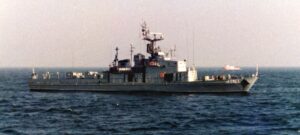
Until the end of 1989, the naval forces of the Warsaw Pact positioned outposts directly off the German and Danish coasts. Nickname of the then German Navy: “See-UvD“. Off Fehmarn, within sight of the Staberhuk lighthouse, there was always a Russian reconnaissance ship or a National People's Army outpost boat, in recent years the modified Kondor-class minesweepers "Komet" and "Meteor". These guard ships reported all incoming and outgoing shipping traffic through the Fehmarn Belt. Other outpost boats were also deployed by the Polish navy off Bornholm and in the Kriegersflak sea area (south of the Öresund/Copenhagen exit). That was normality, have we forgotten? And now, unfortunately, the outpost is back: first with corvettes, now with a forty-year-old Udaloy-class destroyer. The heavy destroyer, which dates back to Soviet times, specialises in anti-submarine warfare and is still in service with four units each in the North and Pacific fleets. The crew consists of 220 to 300 soldiers. At the beginning of January, the ship was already escorting two sanctioned freighters off the Portuguese coast. The special representative of the Russian Foreign Ministry, Artem Bulatov, hinted at the deployment of warships to escort the "shadow fleet" weeks ago.
Text: Schlüter/Nitz

 English
  German
One Response
The reconnaissance ships that were moored off Fehmarn until 1989 were not Russian, but Soviet. Likewise, although they were all „citizens of the Soviet Union“ (nationality) on board, they had many different nationalities. As shown in the blockbuster film „The Hunt for Red October“, the commander of the Soviet boat is admittedly a Soviet citizen, but his nationality is Lithuanian, who ends up killing the political officer „Putin“.