










Warning from the naval command
The situation in the Persian Gulf remains highly dynamic. In the last reporting period, the US armed forces have carried out several attacks on targets on land and on boats suspected of laying mines over the past week. According to the US, this was done in self-defence. Iran then announced retaliatory measures. According to media reports, a US airbase has already been attacked and the air defence system in Kuwait has been activated. The status of the negotiations is currently unclear due to the differing statements from both camps.
The US naval blockade of Iranian harbours and coastal waters is still active. This is said to have already prevented 100 ships from entering or leaving Iranian harbours. A danger from mines, fictitious or actual, in the area of the Strait of Hormuz can still not be ruled out. Interference from AIS and GPS is still present, but significantly reduced compared to March. The disturbances occur irregularly and locally. In recent days, there has been an increase in interference off the Saudi Arabian harbour of Yanbu in the Red Sea and in the Strait of Hormuz.
Situation display
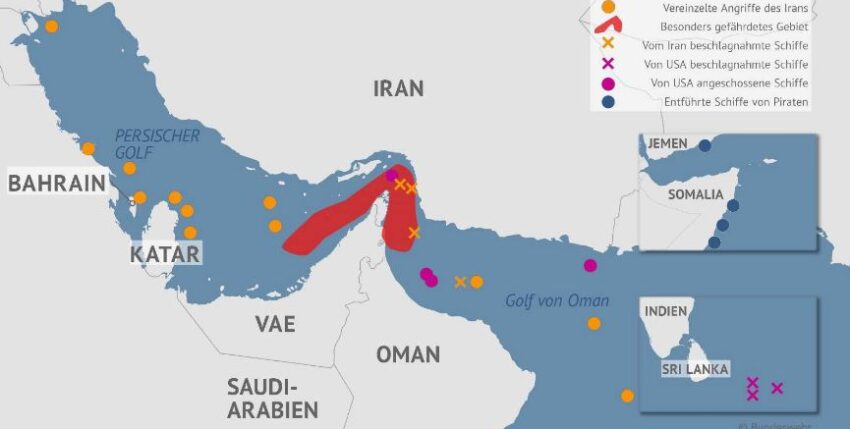
Since the start of the war, a total of 34 merchant ships have been attacked in the Persian Gulf, some of which have suffered severe damage. There have been no confirmed attacks against merchant ships since the last situation on 21 May 2026. The Somali Basin and Indian Ocean are currently experiencing a south-westerly monsoon with a wave height of around 2 metres. It is therefore assumed that small boats cannot currently be used to attack merchant ships in this area. There have been several suspicious approaches in the Gulf of Aden in the last reporting period and two active pirate groups are currently believed to exist. However, no actual attacks have been reported and the warning level for Bab al-Mandab, the Gulf of Aden and the southern Red Sea can still be categorised as moderate. Nevertheless, serious warnings are still in place for the Somali coast and the Somali Basin.
There have been no attacks on harbours or maritime infrastructure for a week. According to AIS data and after consultation with shipping companies, there are around 153 ships with a German connection in the area of interest (see annex), 45 of which are in the Persian Gulf. So far, three ships with a German connection have been attacked. The current situation for shipping in the Persian Gulf and neighbouring waters continues to be characterised by a massive threat. The renewed attacks by the USA could lead to further retaliatory strikes by Iran. It is also unclear how the negotiations between the two parties are progressing and what impact the attacks will have on them. The US naval blockade also remains in place and is not contributing to harmonisation.
The operational risk from technical disruptions remains high. The massive GPS manipulations in the entire sector have decreased compared to March, but current information shows a renewed uptake of localised interference. It is still assumed that Iran still has sufficient missiles and drones, especially for attacks in the Persian Gulf.
The risk situation for ships and crews remains complex. Operationally, the situation remains critical due to the entrenched blockades and the possibility of further attacks in the Strait of Hormuz. The potential threat to the Persian Gulf and neighbouring regions must continue to be classified as very critical.
Text: Naval Shipping Management Hamburg Naval Command

 English
  German