




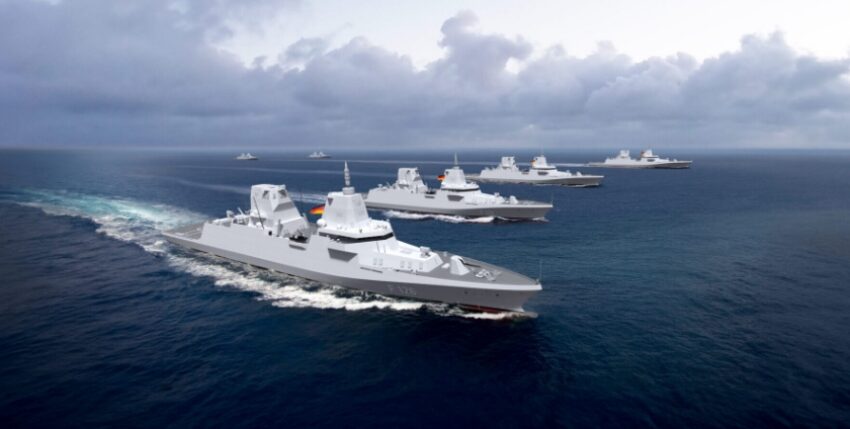




Federal Chancellor Friedrich Merz used the podium at the National Maritime Conference in Emden to send an unmistakable message: the F126 frigate is to be led to success under national leadership. But while the political commitment earned applause in the North Sea Hall, a look at the balance sheets reveals a project at the limit. marineforum.online analyses the 15-billion-euro poker game between Berlin, Kiel and Düsseldorf.
The F126 project has long been more than just a naval procurement process; it has become a test case for Germany's maritime industrial strategy. Originally with a budget of around 9.5 billion euros The financial waters have changed dramatically since the tender for six units was launched. Current analyses put the new offer from Rheinmetall Naval Systems for the general contractorship at approx. 12.8 billion euros (Spiegel 7 May 2026). If you add up the approx. 2 billion euros, which already flowed out in the phase under Damen's management, the total bill breaks through the sound barrier of 14.8 billion euros. An increase of over 50 per cent, which is causing a lot of discussion in parliamentary Berlin - or rather a telling silence.
The time factor: when technology overtakes the schedule
Behind the price jump is the inexorable logic of time delays. The fact that the first ship cannot be put into service until 2032 according to current planning - instead of 2028 as originally announced - is more than just a logistical nuisance. It is a technological risk. There is more than a decade between the original design freeze of 2020 and the planned delivery. During this time, the battlefield at sea has changed fundamentally, particularly due to the massive use of AI and swarms of drones.
The result is costly obsolescence management: the „brains“ of the ships (such as Tacticos or AWWS) and the sensor technology (TRS-4D) have to be upgraded during the construction process to a level that was barely foreseeable in 2020. Experts estimate that this adaptation effort will cost at least another billion euros. The F126 will therefore become a race against its own obsolescence.
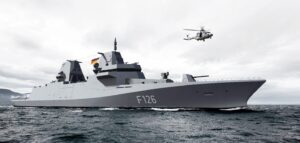
A „tank builder“ goes to sea: the moulding of a champion
In terms of industrial policy, the sector is currently undergoing a tectonic reorganisation. The fact that the Düsseldorf tank builder Rheinmetall now has a firm grip on the reins and has also completed the takeover of German Naval Yards Kiel (GNYK) is a strategic bang for the buck. This vertical integration puts an end to the risky „piecemeal approach“ of the past. If the forecastle, aft ship and final assembly are coordinated under a standardised management structure, the loss-making interfaces of the Damen NVL era will disappear.
This step also serves as a foundation for future major projects such as the F127. Consolidation at the Kiel site not only secures the expertise for current construction, but also creates the necessary industrial mass to compete in Europe against giants such as the French Naval Group or the Italian Fincantieri to operate on an equal footing. It is about a „national champion“ that acts as a technological pacemaker and not just as an extended workbench.
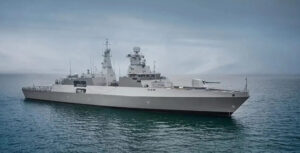
The parliamentary safety net: the MEKO lever
However, Parliament is not relying on industrial solidarity alone. With the 2025 programme sharpened in November „MEKO lever“ the Budget Committee has secured a fall-back option. Around 7.8 billion euros are reserved for an alternative platform - the MEKO A-200 from TKMS. The MPs retain control through qualified blocks: the funds will only flow if the F126 demonstrates progress and cost stability. This dual strategy keeps the pressure on Rheinmetall high, while the ministry has already signed preliminary contracts for the MEKO variant to ensure delivery capability from December 2029.
Conclusion: Industrial guarantee of existence
The fact that there has so far been no public outcry in the face of the 15 billion mark shows the predicament: the F126 is „too big to fail“. Failure would immediately plunge the shipyard landscape in Wolgast, Hamburg and Kiel into an industrial vacuum until follow-up orders such as the F127 are within reach.
For Chancellor Merz, the project is inextricably linked to his vision of a defencible, technologically sovereign nation. But the timeline is tight: if no decision is made before the summer break, the project threatens to become a memorial to the failures of past armaments decades. The coming weeks will show whether there is sufficient political will to manoeuvre this maritime heavyweight safely into the harbour of realisation.

 English
  German
2 responses
Sehr geehrter Herr Mergener, vielen Dank für den aufschlussreichen Artikel. Ich hatte das Projekt am Rande verfolgt und mich damals über die Auswahl des Generalunternehmers gewundert. Wenn ich mich recht erinnere war es eine recht dramatische Phase. Am meisten erstaunte mich der Verkauf der Lürssen Naval Yards an Rheinmetall. War das Projekt der Lürssen Gruppe über den Kopf gewachsen oder drohten Kosten die Lürssen Gruppe zu überlasten?
Da Sie ein überzeugter Schnellbootfahrer sind, würde ich Ihnen gerne einen kleinen Erlebnisbericht über meinen Einsatz auf einem Lürssen S-143 B Schnellboot ‘Hamilkon’ der tunesischen Marine, das unter dem Namen ‘Geier’ bei der Bundesmarine Dienst tat. Der Zustand war ganz vorzüglich, gepflegt und noch zu 45 kn fähig, die wir dann auch fuhren.
Sehr geehrter Herr Rabba.
Auf Ihren Erlebnisbericht bin ich gespannt.
Vielen Dank für Ihre Kommentierung. – Zu Ihrer Frage wird es schwer, eine sachgerechte Antwort zu finden. Die Kosten können es nicht gewesen sein.
Mast and sheet breakage
hum