









Between threat and bluff
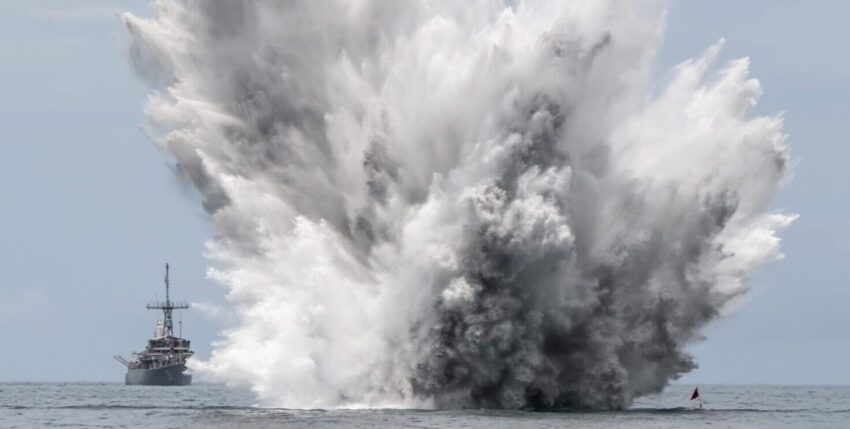
In the context of the Iran conflict, we are currently hearing a lot about mine warfare and mines in the Strait of Hormuz. We see the symbolic bullets with nasty thorns in the background on TV, reminding us of figurative viruses. These weapons cause fear and terror, you can't see them, they don't announce themselves, they are sneaky and cause enormous damage. They sink ships, hinder free navigation, are extremely difficult to localise and even more problematic to remove. Reports on the possible clearance of mines in the Hormus and European involvement in this are also currently full of drama. But what do mines really look like, how do they work and what danger do they pose? How do you lay mines, how do you find them, and when does it make sense to mine at all? Before the myths are ranked any further, here is an explanatory piece for all those who would like to have a quick overview of mine, i.e. just the essential facts for categorisation or discussion.
What types of sea mines are there and what is the operating principle behind them?
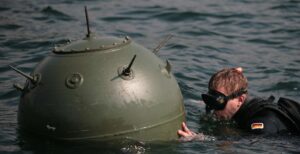
What we all have in mind are Anchor buoys. They are basically 200 years old and are held by an anchor rope just below the surface of the water and triggered by touch. One of the thorn-like ignition horns is bent and breaks an acid capsule inside, which makes electrical contact and ignites the explosive charge. The correct depth setting is crucial, as too deep or too shallow a position impairs the probability of being hit or camouflaged. According to the Hague Convention, they should be disarmed by a technical safety device when they float to the surface, i.e. when they are torn loose from their anchoring or mechanically separated by a mine-clearing harness; however, this may well fail in the case of old mines. They then float on the surface and in this state are referred to as drifting mines. The intended production and transport of Propellant mines is classed as unlikely, they practically do not exist - they are almost always just detached anchor mines.
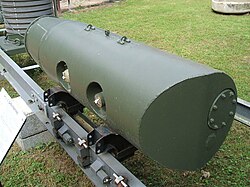
Base mines lie on the seabed and act as remote detonation mines on passing ships. They do not detonate through direct contact, but react to changes in the environment, such as the magnetic field, noise or water pressure. The explosion creates a gas bubble that first lifts the ship's hull and then causes it to fall, which can lead to the ship breaking apart. It is questionable whether a single mine can sink a tanker. Nor is a large warship more or less endangered depending on the depth of the water and the proximity of the detonation. In any case, a shock wave runs through the ship, which can tear equipment from its moorings, bring machinery to a standstill and put people at considerable risk.
Modern bottom mines combine several sensor systems, can have delays and counters and thus target specific types of ships. The target of a mine is not the minesweeper, but the valuable, large transport or warship.
In addition to these two types, there are special modifications and special mines that have been developed for use in deep water or against landings. These Anti-invasion mines (for rivers and shore zones) are used in shallow water and are not dissimilar to landmines. They also have magnetic or acoustic sensors and are aimed at landing craft and hovercrafts. Their charge is small but effective. Types include the German "Seemine Antiinvasion" (SAI) DM 51 or the U.S. NAVY's "Quickstrike", which is dropped from aircraft. Anti-invasion mines can also be switched on and off or remotely detonated from land.
Torpedo mines, such as the American MK-60 "Captor", consist of a platform and a torpedo that automatically launches itself at the target when approached. There are also torpedoes that remain in place as bottom mines after use, such as the MK-67, which is a modified MK-37 torpedo with additional firing devices and is fired from submarines - useful for waters that are controlled by the enemy or are too shallow. Iran has mines with their own propulsion, including the EM-52, which fires to the surface as a „climbing mine“. Other newer mines such as the EM-56 can change position independently, which makes mine defence much more difficult.
How do you lay them - and with what?
In principle, any seagoing vessel can lay mines, depending on the size. Anchor mines and sea bottom mines of German design, for example, are guided to the discharge platform on rolling racks via special rails on the upper deck and „laid“ in the water, as they say. Depending on the type and explosive charge, the weight varies from 500kg to around 1000kg. Mines on the often-mentioned Iranian small combat boats (not speedboats) can therefore only be laid in small numbers and as light mines with a small explosive charge. Military minelayers - these can be minesweepers and speedboats in their alternative role - usually have around 30-40 mines on board. Mines are laid after a tactical assessment of the sea area and the definition of the military condition to be achieved. Each minefield is subject to precise prior planning with documentation that enables subsequent clearing with pinpoint accuracy. Throwing mines without a plan is more likely to be seen as an act of desperation, especially off one's own coast. Attention: Mines change the geography, for both the attacker and the defender. Once mines are live in the water, there is no turning back under wartime conditions. So you have to be clear beforehand whether or not you can accept an environmental catastrophe off your own coast by damaging oil tankers. This is something to bear in mind if you want to believe the rumours about mines being laid. Psychologically, the simple claim that mines have been laid is enough to frighten everyone and paralyse shipping. Mines also hinder friendly shipping.
How do you actually clear mines?
The methods of mine clearance are as varied as the mine threat itself. Mine warfare) is perfidious - and anyone who knows how to clear mines is also aware of the weak points, which in turn feed into the development of new types of mines. Mines can be laid from almost any platform, including aircraft and submarines, but clearing them is considerably more complex. Mine clearance therefore requires specialist knowledge about mines, it requires specially trained personnel, it requires specially equipped units - and it requires Time! The mine in the water can wait, even years. However, the mine defence vessels can only start their tedious job when the surrounding area is sufficiently safe. And since shipping can't wait either, it is more important to initially concentrate on so-called „clearance channels“ and clear safe passages than to search entire sea areas. Mine defence requires patience, as it would take months to make a sea area like the Strait of Hormuz 100% safe. This is why mine detection also requires mathematical skills: you calculate probabilities depending on the area, time, effort and method.
The Methods of clearing are based on the findings as to which mines or which mix has been transported and is to be expected in the clearance area. Anchor mines are cleared with a towed crockery They are separated from their anchor chain mechanically or with small explosive devices, then float up and can be destroyed by explosive charges. These floating mines (floating mines, see above) are always dangerous. Detonating them by shelling is difficult and requires a lot of ammunition (the author knows what he is writing about). This makes little sense, especially as the hollow body can be broken without detonating the charge. If the mine then sinks, it is invisible but still highly dangerous.
Mechanical minesweeping was even carried out by small destroyers during the last world war. This old method has long since been replaced by the use of remote-controlled drones. This is why we still talk about mine hunting today. Speaking of destroyers: A news report claimed that American destroyers had travelled through the Strait of Hormuz to clear mines. Let the reader judge for himself at the end of the text how likely this is.
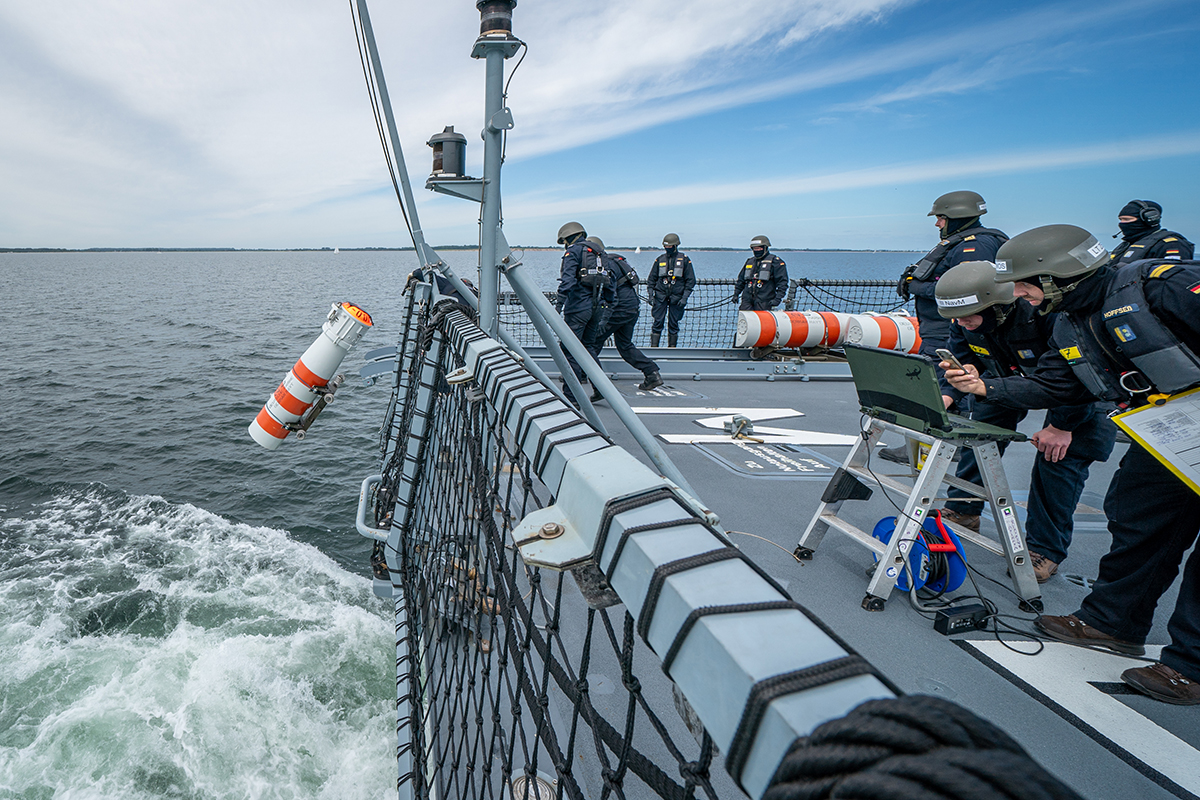
In simple terms, there are two methods for clearing bottom mines and special mines: using the Simulation rooms and the Mine hunting. At the Simulation rooms the magnetic field and the acoustic signature of a ship are generated by a towed harness. This harness essentially consists of a gigantic power cable and towed sound generators. Using high currents and various adjustable frequencies, the mines can be tricked into believing they are any kind of ship in order to trigger their switch - to make them "move". Since this method requires the mines to be overrun by the minesweeping unit, minesweepers are designed to be non-magnetic and quiet (formerly wooden, now GRP hulls, or non-magnetic steel). Since the 1980s - long before such things were called "drones" - the German Navy has been using unmanned small vehicles as an alternative, known as "remote sweepers" or "sea dogs", which can simulate a large target ship with the appropriate equipment. This is technically complex and time-consuming, but today it is safer and faster: with the Mine hunting. While the aforementioned methods could still be used provisionally on other warships, technically complex mine hunting is a case for absolute specialists. Minehunters have a sonar in the bow (hull mounted), which is designed to search the seabed. In a sophisticated detection and identification process - coupled with seamanship - cable-bound or self-guiding drones are steered towards the mine and lay explosive charges to destroy the object. These drones can be equipped with cameras as well as their own sonar. If it is not advisable to blow up the mine, be it in harbours or near critical infrastructure, mine divers are deployed. These highly specialised explosive ordnance disposal experts defuse the mine under water. Diver intervention boats - basically specialised minesweepers - have been specially designed for their use and are equipped with pressure chambers and extensive diving equipment, among other things.
What can the German Navy do?
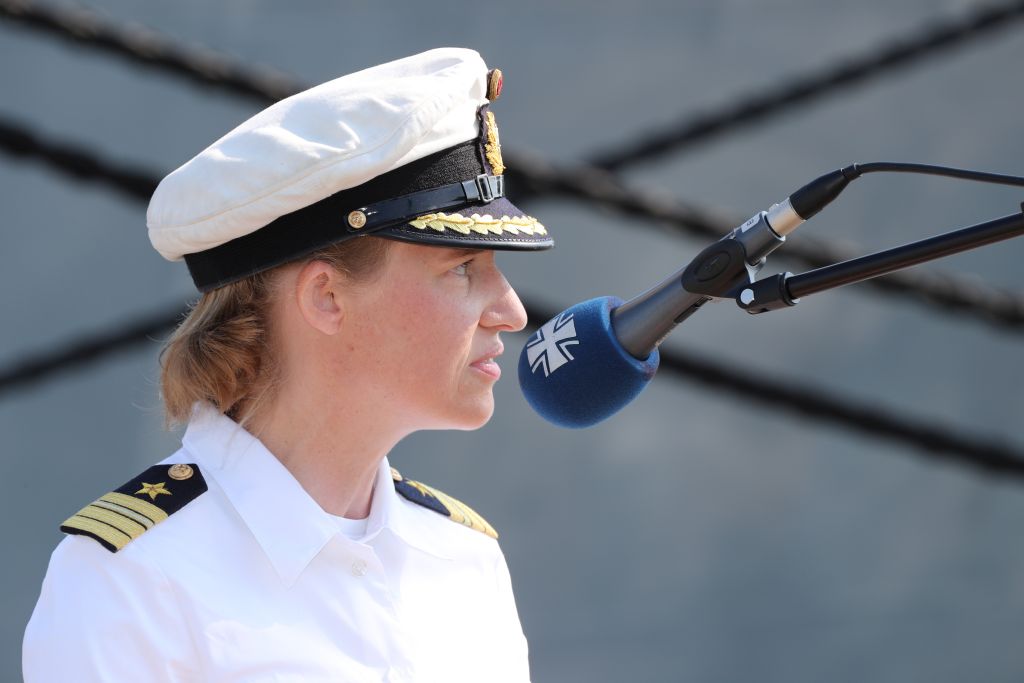
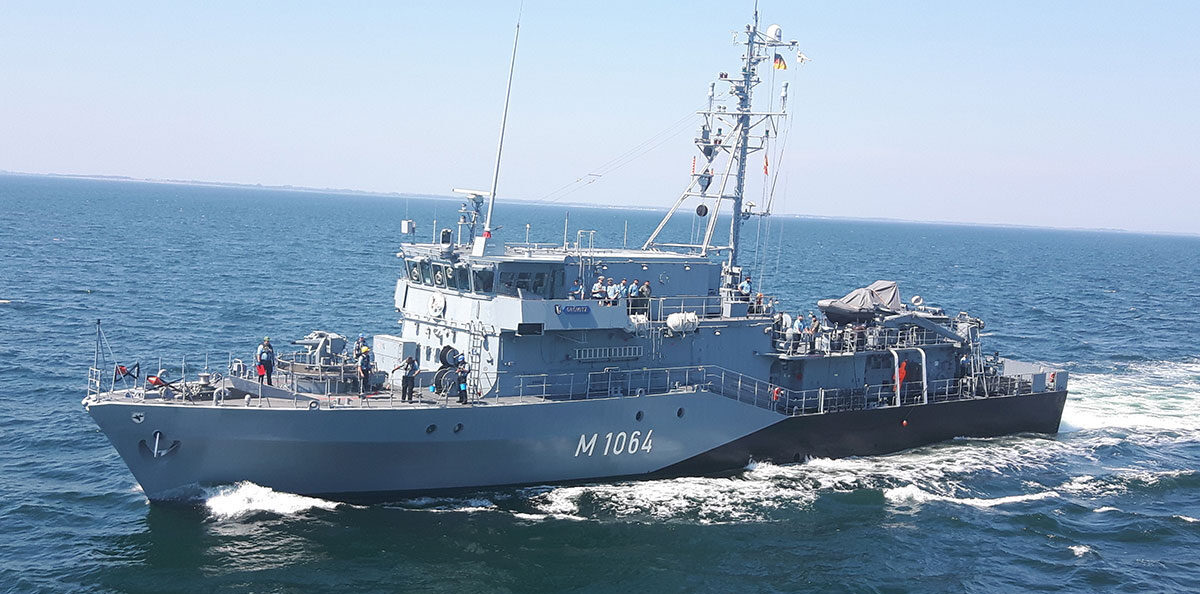
The German Navy has a well-equipped minesweeper squadron (3. MGschw) in Kiel, which has something to counter almost all common mine threats. It is the only remaining minesweeper squadron that still has ten Frankenthal-class boats in various stages of equipment and development. It is proficient in all of the above-mentioned clearance methods, including the use of mine divers, although mechanical clearance has now been dispensed with. The navy calls it „linked sea mine defence“. As the mine divers were bundled into the naval battalion years ago, they have to be embarked on the mine diving boats for operations. The Frankenthal-class boats made of non-magnetic steel are the latest evolutionary stage of several generations of minesweepers, whose task during the Cold War was to keep the Baltic Sea approaches clear as part of the defence of NATO territory. Although they have been in service for around three decades, they are a continuously modernised and very robust ship design. After the Second World War, the post-war Baltic Sea was contaminated with mines and is still contaminated with munitions to this day. After the war, the routes were initially cleared under British command and later by the German Navy until the 1960s. With the task of denying the Warsaw Pact forces access to the Baltic Sea and landings, an enormous amount of expertise developed, from mine laying to mine clearing, tactical procedures and technical developments. The resulting capabilities of the German shipbuilding industry and its suppliers were unrivalled. With over 60 units in the 1980s, the former mine countermeasures flotilla was the most extensive flotilla in the navy - equipped with state-of-the-art sonars and remote guidance systems, with sophisticated conceptual procedures. In numerous NATO manoeuvres, Germany has consistently demonstrated its capabilities on a par with other „minehunting nations“ such as Denmark, the Netherlands, Belgium and France - often in a leadership role. Many navies have adopted German concepts and adapted them for themselves. Other countries such as Indonesia have recently acquired the latest units from a German shipyard or, like Turkey, are having them built under licence.
It has proven itself today that these skills have been tenaciously held on to over the last few decades of disarmament and an enormous effort has been made to prevent an even greater loss of knowledge. Tasks such as patrols in the Mediterranean (UNIFIL) were not conducive to the level of specialised training. It was only with the recent development in the Baltic Sea, the focus on national and alliance defence, that the guardians of the hidden treasures - or rather, female guardians, as the first female commanders were to be found in this squadron. Incidentally, this combat unit is currently led by the first female commander.
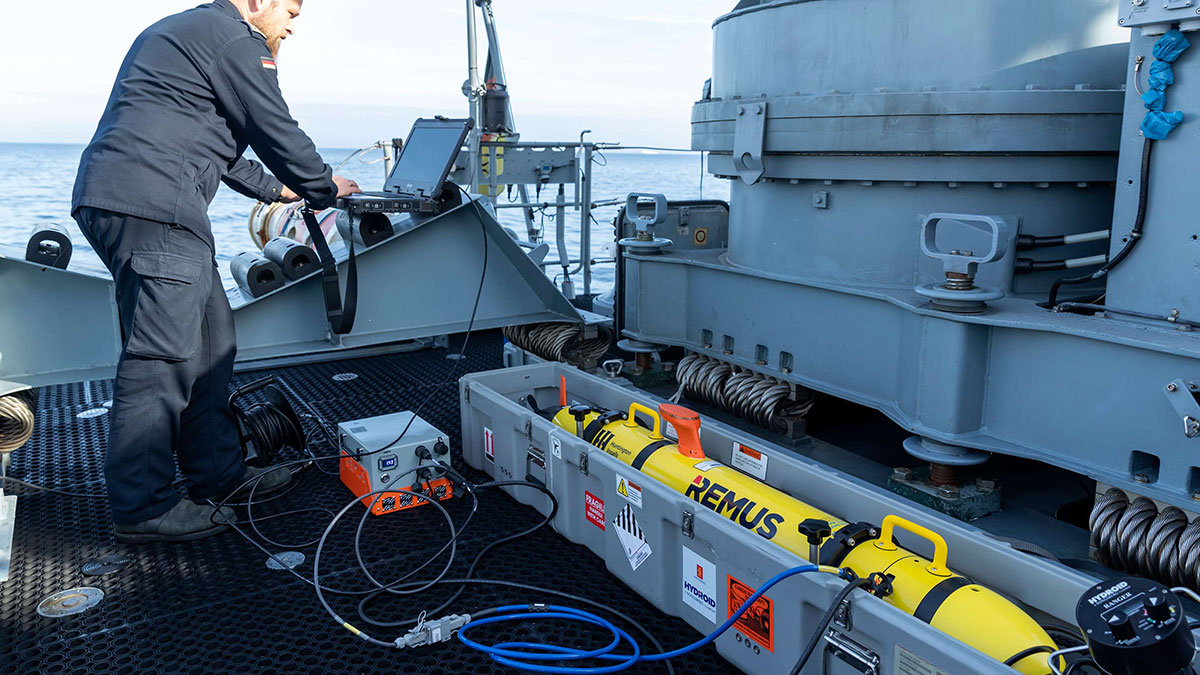
Unfortunately, the German priorities in recent years have not been minehunting boats. Mine defence is more of a nautically demanding craft than an operational-tactical art, and anti-aircraft armament does little to change this. The focus was more on prestigious combat units such as frigates for worldwide deployment. After several conceptually complicated and rejected successor approaches and several postponements of new procurement, the result is shocking, but not hopeless: the old units are being painstakingly modernised and maintained on life support until a successor system has been fully developed. Based on the navy's plans, a German shipyard already has a system „in the drawer“ that takes the further development of unmanned systems very much into account. However, this is not yet of any use for deployment in the Persian Gulf.
What can the navy do in the Iran conflict?
The slogan of the Kiel „miners“ is: „We make the sea routes safe!“ Especially in the current situation, the association is demonstrating its fundamental value in the Baltic Sea. And what you can do in the Baltic Sea also applies to the Persian Gulf: you could - if you fulfil a few conditions. But it will not be a „walk in the park“ It will cost an enormous amount of time and effort. First of all, intelligence and information from the secret services must be used to determine what mine threats exist in order to assess the feasibility of the already risky procedure. And there should be a ceasefire in the sea area, because mines cannot be cleared responsibly for life and limb under threat from missiles and armed speedboats. The biggest challenge, however, is getting there: an enormous feat in every respect - logistically, operationally and in terms of time. In 1990/91, in the aftermath of the Gulf War, the navy had already proven with „Operation South Flank“ that it was recognised as being up to the task. But at that time there were still half a dozen fully operational minesweeping squadrons. In addition, compulsory military service had not yet been suspended, which made the personnel situation more relaxed than it is today. The experiences from this deployment are hopefully well documented! One thing is clear: it will take several years to deal with the lasting logistical „damage“ of such a mission. Recognition of what was achieved also remained low - due to the circumstances of those years. This can and must be organised more professionally today.
Political will?
Ultimately, it must primarily be a fundamental political decision to withdraw important units from the Baltic Sea and use them to represent German interests in the Gulf. This is not about helping the mighty US Navy, whose limited mine defence capability has rarely been able to match the performance of its European allies - despite the new mine countermeasures mission package of the American Independence-class LCS trimarans. It is more about helping the friendly states in the Gulf, which are bearing the brunt of the war. Germany would benefit from this in the long term. That is for Berlin to decide - not Rostock.
hsc, ajs

 English
  German
9 responses
1. they are push horns! Just have a look at the TDV, it's clearly stated there. Ignition horns no longer exist.
2. just talk to your comrade in the US Navy, they have these capabilities. Even the SF-C can be used from a CH-53.
3) I don't know why you're doing whataboutism now. I was talking about civilian vehicles, not warriors...
4. just google it, there are already a lot of new and therefore modern MCM units. Shall I list them?
5 Uiiii, 1991, that was only yesterday. Shall we include 1945/1946 as well? That was also 25 years ago. Since then we've had different boats, systems and procedures. As I've personally been to the region several times, I know what our boats can and can't do, but Axel knows better.
5.1 „They can do it!“ What exactly? Should we slide into the mission like we did in Afghanistan or like the frigate HESSEN ASPIDES? With the threat situation? A USA that doesn't share its information with its NATO partners? Just talk to the former KDT of the Hessen.
Or go to Kiel with „they can do it“ and tell the crews, I can already imagine the reactions.
Overcome by events - see yesterday's Mine Media Day with the Inspector of the Navy at the 3rd Minesweeping Squadron in Kiel and the coverage on this portal.
But thanks for the flowers anyway.
A. Stephenson
Editorial team marineforum
Congratulations on this very informative article and exchange of opinions in the comments section (especially the additional facts (!!) ) by Axel Stephenson. As a speedboat driver you have already laid (practice) mines. But minesweeping is a very special and difficult „craft“.
Will other media take note of this treasure trove of information and disseminate the facts? Unfortunately, probably not. Because half-knowledge sells better.
Many thanks for this clear summary, which also (or especially) allows „non-miners“ to better categorise the current discussion. Hopefully the article will be widely read so that the numerous publications and opinions on the subject can be better categorised.
BZ! Now it would be interesting to know what the depth conditions are in the Strait of Hormuz, i.e. where to expect mines of various types and where not. The whole road can probably not be completely closed.
Mfg Matthias Roesner
Two sources provide generally readable information on the depth conditions in the Strait of Hormuz.
1 Wikipedia under „Strait of Hormuz“ with a map (including maritime borders and areas of separation) and a depth profile as a cross-section from south (Oman) to north (Iran):
https://de.wikipedia.org/wiki/Straße_von_Hormus#/media/Datei:Ct002935.jpg
https://de.wikipedia.org/wiki/Straße_von_Hormus#/media/Datei:Querschnitt_durch_die_Straße_von_Hormus.svg
2. i-Boating at fishing-app.gpsnauticalcharts.com with high-resolution map material „Gulf of Oman to Shatt al Arab“:
https://fishing-app.gpsnauticalcharts.com/i-boating-fishing-web-app/fishing-marine-charts-navigation.html?title=Strait+of+Hormuz+boating+app#9.22/26.5055/56.7751
Have fun reading the cards!
The deeper side of the Strait of Hormuz is clearly the southern half, where the agreed shipping lanes also run. It is really deep between the Omani mainland rocks and the „Little Quoin“ island offshore to the north. So if Iran claims that the Strait of Hormuz is mined, then Iranian underwater weapons must have been placed on Omani territory. No word on this from Oman - can this be true?
The corridor to the north around the island of Larak, which Iran has cleared for „friendly shipping“, runs exclusively through Iranian territorial waters - virtually within sight and reach of the coastal defences along the island of Qeshm. The USA cannot block this traffic directly on site, but only outside the strait - another challenge.
The situation remains dynamic.
Axel Stephenson
Editorial team marineforum
Supplement:
The Arleigh Burke class can install and carry modules, so it can also carry an MCM component and hunt mines.
Control can also be carried out from a CH 53 with Seefuchs C.
So the above lines are very arrogant „Speaking of destroyers: A news report claimed that American destroyers had travelled through the Strait of Hormuz to clear mines. Let the reader judge for himself at the end of the text how likely this may be...“
Edit: it doesn't say „thorns“ but "horns".
The technology used in the German Navy today is totally outdated. You stare at monitors for hours hoping to find something (the water plays the biggest role). If the sonar conditions are not right, then you can't do any mine hunting.
The boats themselves are all over 30 years old and are to be kept alive until 2040. New procurement has been neglected for far too long. Instead, the crews are constantly labouring to keep the boats running, which costs time, nerves and huge amounts of money.
On the bottom mine point: „Whether a single mine can sink a tanker is questionable.“
Is that the point or what were mines developed for? A bottom mine could cause huge damage to any tanker, whereupon the ship would be out of action for several months or even have to be scrapped or dismantled; anyone can imagine the costs and the deterrent effect would be immense. Civilian ships do not have the manpower to plug such large holes in the hull, let alone the material.
On the point What can the navy do in the Iran conflict: „And what you can do in the Baltic Sea also applies to the Persian Gulf: So you could...“ To equate the Baltic Sea with the Persian Gulf is something I definitely don't agree with. It has something to do with the technology of the boats, but what do I know...
Thank you for the somewhat angular comment, which should not be denied a corrective response from the editorial team.
1 „Thorns“ or “horns“ - let's stick with the official ZÜNDHORN.
2. could - would - anchor chain! Arrogant or provocative - this is about the plausibility of the message content: An Arleigh Burke destroyer can do a lot in terms of surface and air space (sea/air targets) - it can do some things that cover the underwater area (sub-hunting) - but what it is only very conditionally suitable for is searching the seabed for laid/anchored mines and the targeted clearing of these weapons. Unless it triggers them itself - then the mine is at least „cleared“ - but the destroyer is also seriously damaged. And then it is no longer capable of what it was actually designed for, namely securing an aircraft carrier convoy in open sea space.
The wording chosen by the marineforum editorial team is merely a reminder to readers that not all reports, even those from well-known media portals and editorial offices, should necessarily be believed. They are looking for spectacularly formulated headlines without in-depth detailed knowledge, because only in the rarest of cases do these editorial offices actually have marine expertise.
3. units of the US Navy have already suffered several mine hits without being sunk.
In 1988, the frigate USS Samuel B. Roberts (FFG 58, Oliver Hazard Perry class) struck an Iranian mine (M-08) in the middle of the Persian Gulf while escorting Iraqi oil tankers during the Iran-Iraq war and ran into a freshly laid minefield. The frigate's keel was broken and its two gas turbines torn from their moorings. After five hours of fire and leak defence - during which the frigate remained combat-capable for all but a few minutes - she was able to resume her slowest speed. After an emergency docking in Dubai and one year of repairs in the USA, the USS Samuel B. Roberts continued to sail for another 30 years - including several missions in the Persian Gulf.
The amphibious assault carrier USS Tripoli (LPH-10, Iwo Jima class) ran into an Iraqi anchor mine in the northern Persian Gulf in 1991, which tore a 5×7 metre hole in the starboard bow, but did not prevent the ship from carrying out its duties as the lead unit for helicopter-borne American mine defence in the Persian Gulf after 20 hours of damage defence.
Only a few hours after the mine hit on the USS Tripoli, the USS Princeton, a Ticonderoga-class AEGIS cruiser patrolling south of the Shatt al Arab river delta during Operation Desert Storm, was hit: a bottom mine detonated under the port rudder, another detonated (possibly due to the pressure wave) in front of the starboard bow. Despite considerable damage, the weapon deployment system only failed for a quarter of an hour. A Canadian destroyer supported the cruiser for over 30 hours, and a minesweeper then escorted it out of the minefield. After eight weeks of repairs in harbours in Bahrain and Dubai, the USS Princeton was able to return to the USA on her own keel - she is still in active service today.
So much for the effects of a few mine hits on warships in recent decades.
4. you are honoured that you feel sorry for the crews of our Frankenthal-class minesweepers because of the age of their platforms. However, talking things down does not contribute to the solution in view of a limited defence budget. Although new mine defence systems are constantly being tested and deployed in order to keep pace with developments in technology and threats, this does not make the boats themselves any younger. It doesn't help when you realise that other navies are not doing much better. However, the tide has turned in recent years: A number of new construction projects and conversions of civilian support platforms into mine countermeasure mother ships are currently underway among our European neighbours - and even in Germany, the latest minehunting boats have been built, unfortunately at Indonesia's expense, where they were also delivered. With the closure of the Strait of Hormuz, the German population is once again becoming aware of the importance of mine defence - and this leads us to expect that some priorities will be reassessed by the defence planning and financial policy side (in ministerial terms)!
5 The Persian Gulf is not the Baltic Sea, that is correct. However, German minesweepers were already deployed in the northern Persian Gulf as part of Operation South Flank after the Second Gulf War from August 1990 to September 1991 in order to clear the mines laid by Iraq together with other mine action forces. Why were these boats called out there in the first place? Because they could. And even if German minehunting boats were to be deployed to the Persian Gulf again - what is the German saying when faced with a real but feasible challenge? „They can do it!“
Axel Stephenson
Editorial team marineforum